


I was recently contacted by my friend Fr. Andrew Marlborough, a priest based in England. Before becoming a priest, his career was in the commercial art world, and he still spends time searching for items of interest, especially to Catholics, in the auction houses of Britain and Europe.
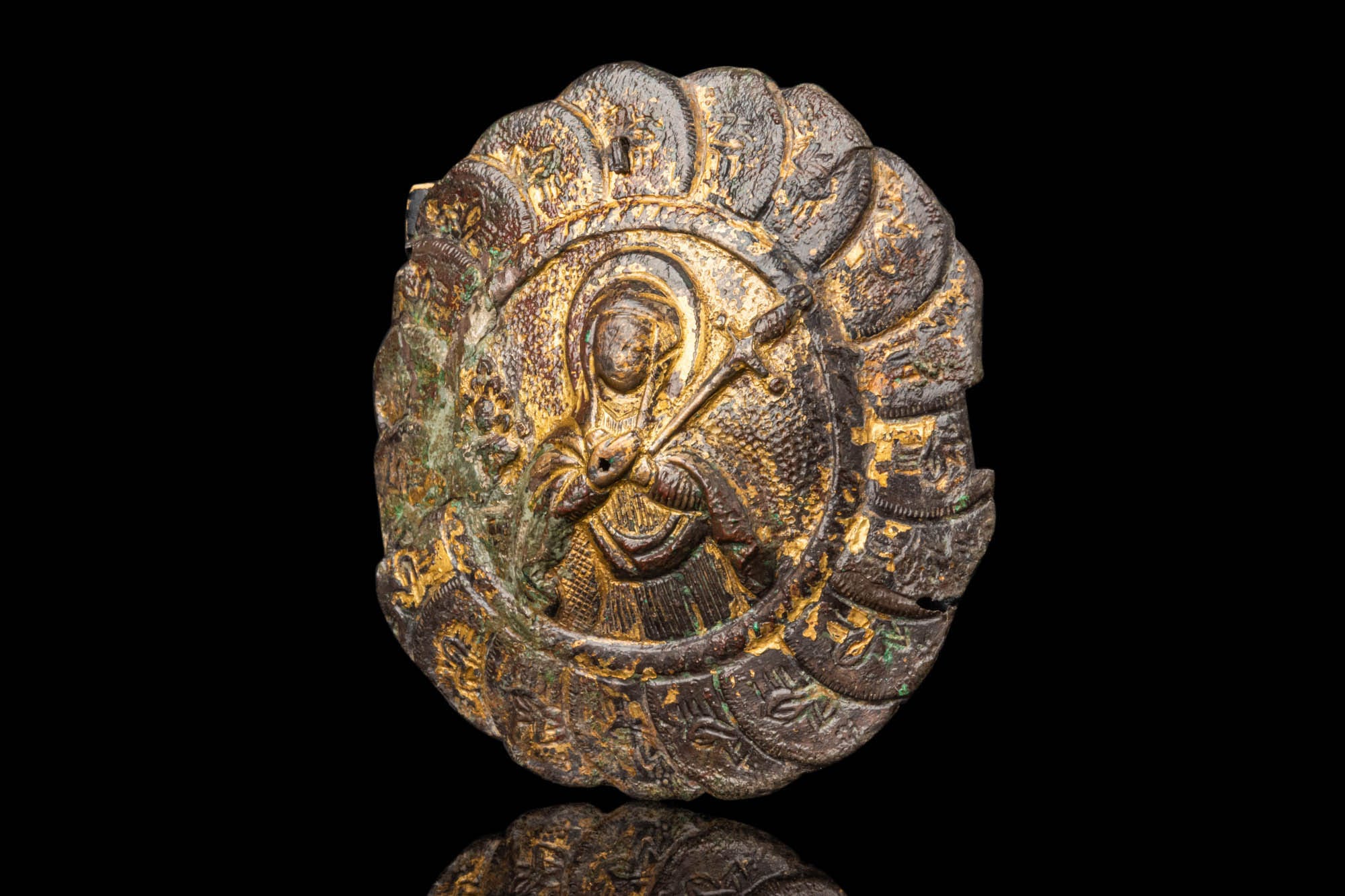
This time, he wanted to know if I could shed any light on a recent purchase he had made, which, he was speculating, might be the earliest known example of an image of Our Lady of Sorrows, dating back over 1,000 years and possibly as much as 1,400 years. I could not offer any new information, so I open this up to you, the readers. It was described in the auction house as early Byzantine, but Fr. Andrew thinks it might be of Ottonian or Carolingian origin. Here is the roundel, followed by the letter he sent to me, with his description and thoughts.
Fr Andrew wrote:
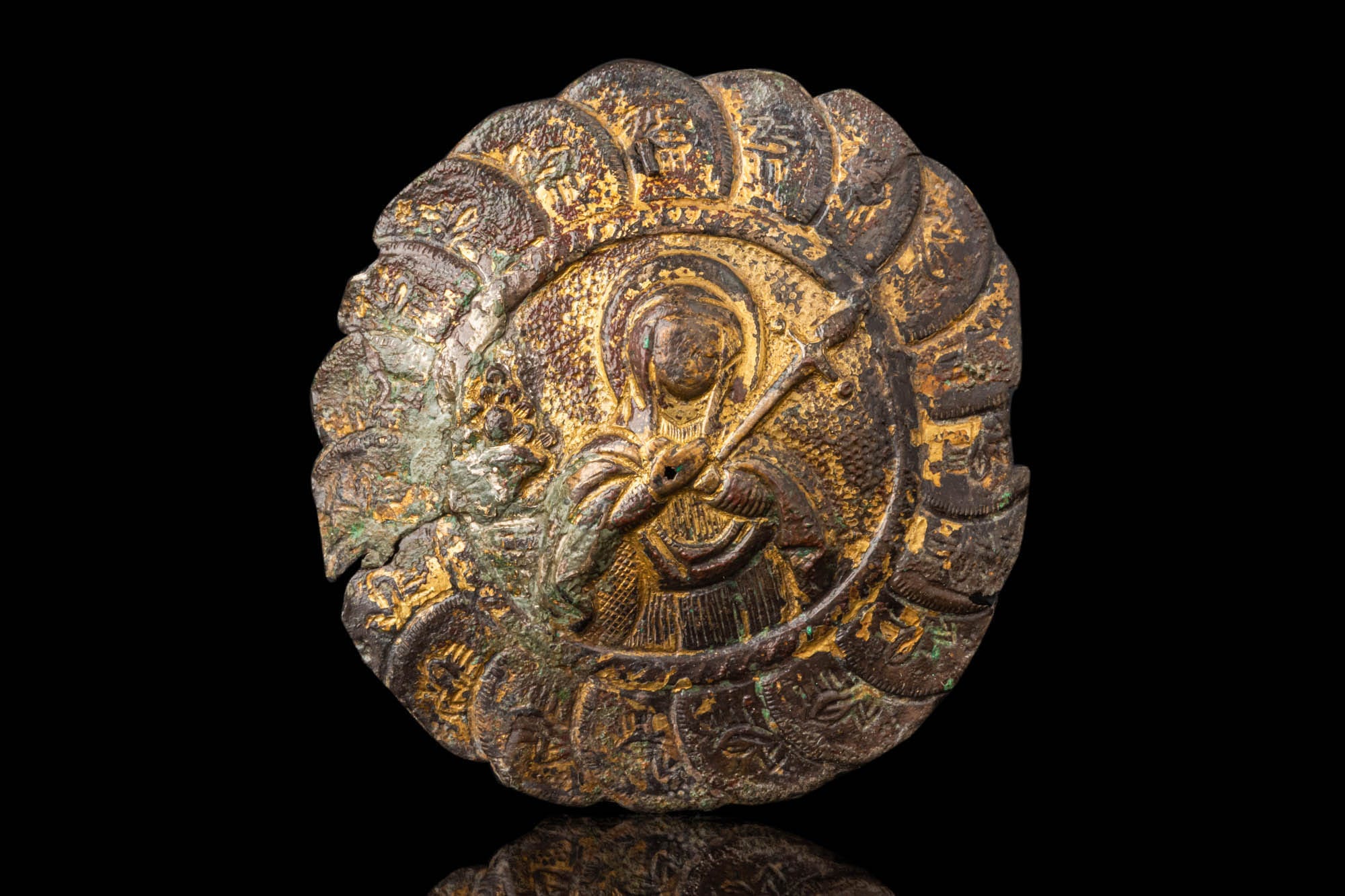
“I recently purchased this small gilt-bronze roundel (7.5 cm diameter) at an auction in London. It was catalogued as 6th-8th century Byzantine and described as the Virgin Mary ‘grasping a long staff’. But I could see that it is clearly an early image of Our Lady of Sorrows. It is generally thought that this devotion developed between the 12th and 15th centuries. Therefore, it seemed a rather important object that could rewrite a chapter in the history of Marian iconography. I suspect the Byzantine attribution is wrong and that it is a little later, possibly Carolingian or Ottonian. If so, it could be one of the earliest depictions in art of Our Lady of Sorrows, if not the earliest.
“As well as the question of dating, there is also the question of function. The auctioneers described it as a Byzantine phalera. These were decorative metal roundels which adorned the chest armour of soldiers or the harnesses of their horses in antiquity. This is possible, but I wonder if it may have been some kind of ornament for religious processions, pilgrimages, or for membership of a confraternity. Markings visible only on one side of the reverse suggest it has been used as a brooch. The amount of hand-finished detail on the roundel is impressive and finely executed. The use of gilding also indicates that it was a costly and highly prized object.
“Stylistically, it seems more Western. This is supported by the fact that Eastern depictions of the Virgin Mary without Jesus are very unusual. The style of the sword/dagger may also help identify its date and origin.
“I’d be grateful if anyone could shed further light on this.”
Any thoughts, please message me, David, and I will pass them on to Father.
What amazing news! Our Lady of Sorrows, standing pierced with Simeon's predicted sword in her heart, is at the very Heart of Faith and Salvation, and coherently ties so many things together for a Christian.
You might reach out to Dr. Vaselios Marinis at Yale. He's very good with this sort of thing. Or, he could at least get you in touch with the right people.
https://divinity.yale.edu/faculty-and-research/yds-faculty/vasileios-marinis