


I was reading of the hymns from the Mesonyktikon of the Byzantine Rite recently. The Mesonyktikon is the midnight Office, called Matins in the Roman Liturgy. The following caught my attention, and comes from the Octoechos, Tone 3 on Sunday:
In days of old, Elijah ordered that water be poured three times over the wood and the sacrifice; thus, he manifested a symbol of the Three Hypostases of the one and divine Lordship.
It is a commentary on a passage from 1 Kings 18, in which the prophet Elijah challenges 450 prophets of Baal to a contest on Mount Carmel. Each side prepares a bull on an altar without lighting a fire:
Then Elias bade the people come near; and when they were standing close to him, he began repairing the altar of the Lord, which was broken down. Twelve stones he took, one for each tribe that sprang from the sons of Jacob, to whom the divine voice gave the surname of Israel; and with these stones he built up the altar again, calling on the Lord’s name as he did it. Then he made a trench around the altar of some two furrows breadth; piled the wood high, cut the bull into joints, and laid these on the wood. Now, he said, fill four buckets with water, and pour it over victim and wood alike. And again he bade them do it, and when they had finished a third time. The water was running all around the altar, and the trench he had dug for it was full. (1 Kings 18:30-35)
He then calls on their god to send flames from heaven to consume the sacrifice. Elijah, needless to say, prevails, calling upon God who consumes altar, bull and water with fire.
Here are some examples of the art of this scene that I found. There weren’t many to choose from. This is pretty much all of them.
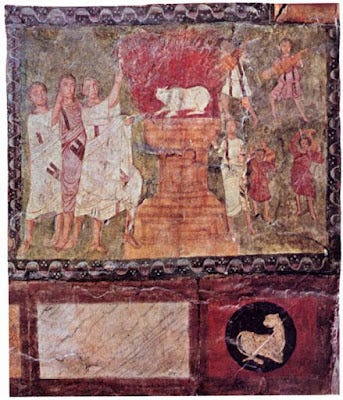
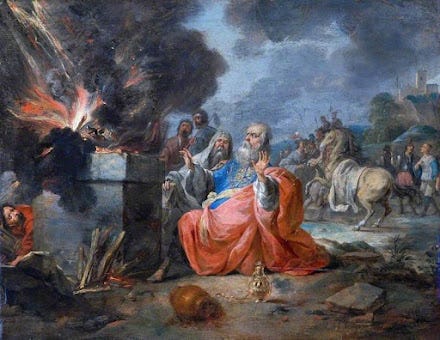
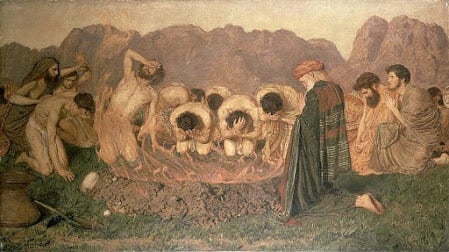
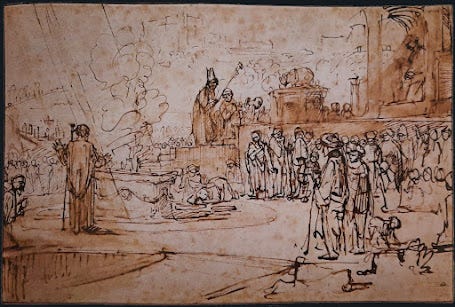
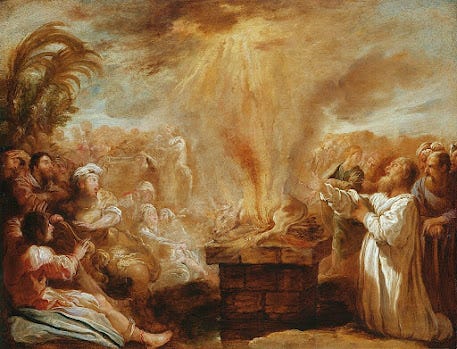
As I looked at these, I realised that, as far as I could see, none of the artists attempted to draw out the simple Trinitarian symbolism referred to in the liturgy. This, therefore, provides an opportunity for contemporary artists to enrich the tradition, it occurs to me. It is important to draw out these parallels, just as Rublev reflected the Trinitarian imagery in his depiction of the Hospitality of Abraham. By connecting the texts of the Old and New Testaments through prototypes, artists and hymnographers help to reinforce the unity of Scripture and establish the sense of a single arc of time in Salvation History.
I was reflecting on this and thinking about how I would do it if I were to paint it. What follows is purely speculative.
I suggest incorporating a clear triangular geometry and a representation of the triple action of pouring water, showing each of the three instances as a triple image.
We might also draw out other prototypes too, it occurs to me. First is Eucharistic (just as Rublev’s Trinity is both Eucharistic and Trinitarian...and even Marian); second is Baptismal; and third is Pentecostal.
The Eucharistic parallels are there in the sacrifice, while the baptismal arises from the purifying action of the water.
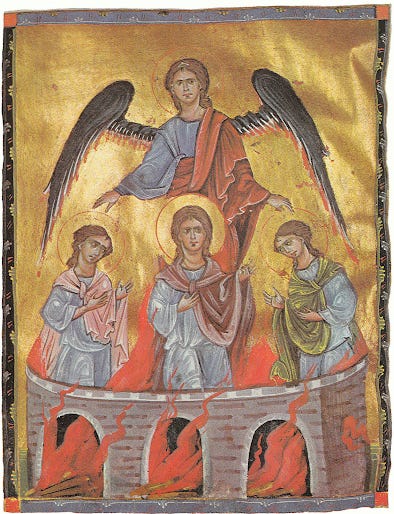
It is the Pentecostal that is most interesting to me. First, the action of fire that consumes evil but leaves the pure untouched echoes that of the three figures in the fiery furnace in the book of Daniel. The hymns of the liturgy describe this scene from Daniel, too, and refer to the action of God in the fire of the furnace, and how the presence of a cooling dew protected the young men. Both dew and fire are connected symbolically to the Holy Spirit. The other place where this parallel with dew and the Spirit is made in the commentaries of Church Fathers is in the description of the fleece of Gideon. So how might I bring all of this together?
I suggest creating a painting of Pentecost in which the New Testament scene is the primary image, with subsidiary images of Gideon, Elijah, and the prophets of Baal, as well as the three young men in the fiery furnace. Just a thought!
This is a great meditation, thank you for sharing! It caused me to go look at the book of Kings and I found it interesting my Bible commentary ( the great adventure bible ) noted the connection between Elijah and John the Baptist. How Elijah passed his ministry to Elisha at the Jordan river. I suppose I was meditating on how you said one pour of the water on the fire represented baptism. Anyways, great meditation. Recently I have been wishing there were more meditations on the relationship between Elijah and Jezebel, who I think imported all those priests of Baal.