


In this and another post next week, I want to look at the Gothic style of Christian art: where it came from, what makes it theologically and artistically distinctive, and how to recognize it in practice through a series of examples. Part 2, next week, turns to the later Gothic masters, the point at which the style begins its transition toward the Renaissance, and the development of secular art that the Gothic spirit made possible.
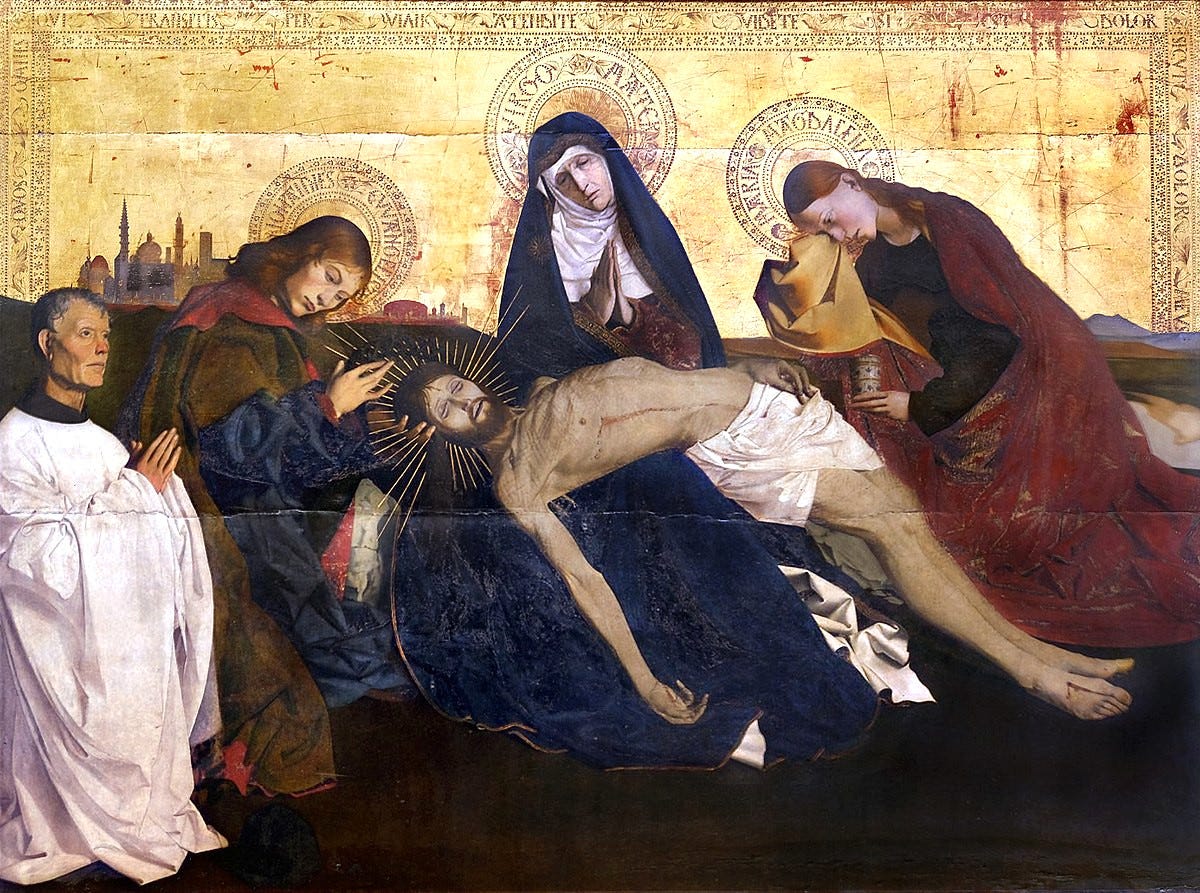
Pope Benedict XVI, in The Spirit of the Liturgy, identified three authentic traditions of Christian liturgical art: the iconographic, the Gothic, and the Baroque. Each is a legitimate expression of the Christian understanding of the human person and our relationship to God, and each communicates that understanding through a distinct visual language, thereby promoting prayer and worship among the faithful. The iconographic tradition, which dominated Christian art in both East and West until the 12th century, portrays man as he will be in heaven: transfigured, luminous, outside ordinary space and time. The Baroque, which developed in the 17th century, portrays fallen historical man in this life, in the full drama of suffering and grace. The Gothic stands between them, and it is the art most characteristic of the high medieval period in the West.
What Is the Gothic?
The Gothic is an authentic and distinct style of liturgical art that developed organically in the West from the iconographic prototype. As the change was gradual, any attempt to date its beginning involves some arbitrary choice. Most commentators settle on the mid-12th century, coinciding broadly with the completion of what is generally considered the first Gothic church, the Abbey of St Denis in Paris, in 1144. The name ‘Gothic’ was coined by High Renaissance commentators as a term of contempt. They held it to be a barbaric style belonging to the period of cultural decline that they believed had begun when the Goths overran the Roman Empire in the West a thousand years earlier. Historians today do not generally share that view of cultural decline, but the name stuck. Even those of us who admire Gothic culture and art continue to use it!
The impetus for the departure from the iconographic prototype stemmed from an increased emphasis on the reliability of human experience and the value of information received through the senses. This led to a greater curiosity about and appreciation of the natural world. Such appreciation was not new: Christians had always relied on sensory information and valued the beauty of the cosmos. What was different was the degree of weight now placed upon them.
Tied to this was the conviction that our world, though fallen and imperfect, is nevertheless good, ordered, and beautiful. There may be evil and suffering in the world, and it may not be as good and beautiful as it ought to be, but it remains God’s creation. This appreciation of the natural world and confidence in our ability to know it through the senses sparked curiosity and a desire to observe it more closely. One effect was the rise of scientific inquiry; another, the one that concerns us here, was an increased naturalism in art, a greater correspondence to natural appearances. The devotion to rational inquiry bound up with this cultural movement also led to a new approach to learning and to the establishment of the great universities, among them those of Paris and Oxford.
Several factors combined to produce this cultural shift. Around 1000 AD, the Latin West increased its contact with the Greek East and the Islamic world through trade and warfare, including the Crusades and the Reconquista, the reconquest of Spain from the Moors (Toledo fell, for example, in 1085). This gave Western Europe, for the first time since the decline of the Roman Empire in the West, access to many lost works of classical writers, particularly in the form of Arabic transcriptions of Aristotle. Over the following century, Christian, Jewish, and Muslim scholars collaborated to translate and interpret these texts. It was the friars, the new mendicant orders, the Franciscans and Dominicans, who achieved much of the synthesis of the new learning with the tradition inherited from St Augustine and the Church Fathers. The most significant of these figures is St Thomas Aquinas, the Dominican.
This age was characterized by the creation of new ideas and a drive to popularize them. The preaching of the Dominicans and the broad appeal of St Francis of Assisi’s spirituality, which included a love of the beauty of the natural world, led in particular to a wider appreciation of the natural world as part of God’s creation. This shifting worldview, while still firmly Christian, gave rise to cultural movements driven as much by holiness and great artists as by great thinkers.
The New Naturalism
The greater emphasis on direct observation led to an enhanced naturalism fused to an iconographic substrate. What began in the Romanesque period, up to the mid-12th century, as a more naturalistic variant of the iconographic style eventually became so naturalistic that it broke the limits of what had constituted an icon, for example through the introduction of cast shadows and the depiction of figures in profile. Nevertheless, Gothic art always owes something stylistically to the iconographic. It retains, for example, the emotional distance maintained in the portrayal of figures, so that the observer always feels slightly detached from the scene depicted. Even in late Gothic styles, such as those of the Flemish artists Van Eyck and Hieronymus Bosch, we can see how much they owe to the iconographic tradition.
If one were to characterize this style theologically, it is too naturalistic to be considered a portrayal of man as he will be in heaven, which is what the iconographic style portrays, and not naturalistic enough to be a portrayal of fallen humanity as we experience it in this life, which is the subject of the Baroque. It straddles the divide between the two, much like the Christian life within the Church.
When a man is baptized, confirmed, and living the sacramental life, he is transfigured partially by grace even in this life. We may not see it ourselves, but that transformation is real. We are, to use St Peter’s phrase, ‘partakers of the divine nature.’ But we are only setting out on the journey, and we can suffer setbacks and reversals as well as progress. This transformation is only complete and permanent when we are in full union with God in heaven, but while we are on this pilgrimage to heaven, as part of the mystical body of Christ, practicing Catholics are in this respect Gothic men and women.
It is worth noting that the Gothic age is characterized historically as an age of pilgrimages. Many of the great cathedrals were pilgrimage destinations, and it is, I suggest, fitting to describe Gothic art as the art of pilgrimage for that reason also.
If we wanted a single symbol of this age, it might be the spire of the great Gothic cathedral. The Gothic cathedrals of France and England, perhaps more than any other aspect of the culture, characterize this period. The new learning led not only to a new approach to design, developing gradually from the Romanesque styles that preceded it, but also to advances in structural engineering that enabled the creation of higher, more complex structures with larger windows. These stained-glass windows became works of art manifesting the same stylistic elements as the paintings, but now in the medium of colored glass. The Gothic spire that so often sat atop the magnificent new churches and cathedrals born of an outpouring of faith symbolizes this age of pilgrimage in that, more than any other architectural feature, it seems to span the divide between heaven and earth.
Early Gothic: Duccio’s Transfiguration
We can now look at some examples to illustrate the style’s general characteristics. Consider this painting of the Transfiguration by Duccio.
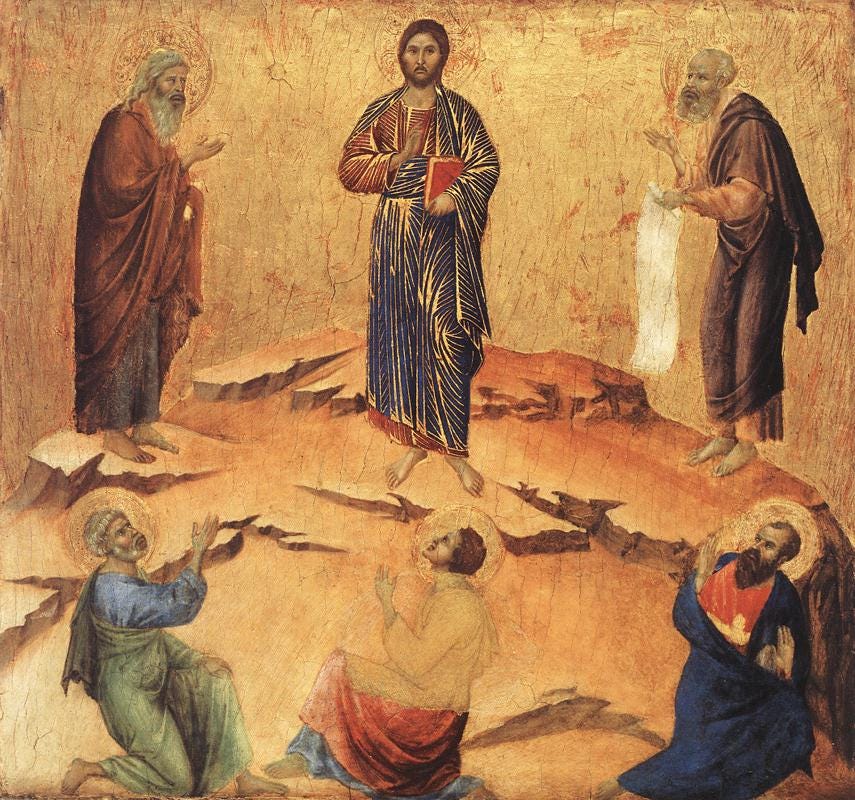
This painting has many characteristics of iconographic art. Christ, the most important figure, is the largest; the mountain, which in nature would dwarf any of those present, is significantly smaller. Through these differing relative sizes, the hierarchy of being is communicated: Christ is the highest, and inanimate mountains the lowest. There is no scenery beyond what is necessary to the narrative; anything superfluous to the spiritual message is omitted. All the figures have halos, and Christ has gold-leaf lines on his garment, indicating that even his clothes shine with the heavenly, uncreated light. All of this is strongly iconographic.
However, here is the departure: the figure of John in the center is shown in profile. Duccio has done this to visually connect John with Christ. He wants to show John looking at Christ; given that John is closer to us than Jesus, to look at him John would have to turn away, and we would see only the back of his head. Duccio does not want that, so he uses the pictorial device of portraying John looking directly upward, as though Christ were physically above him and both were in the plane of the painting, which forces him into profile. A conventional iconographic portrayal of the Transfiguration would show the central figure, John, looking towards us, and away from Christ in shock, to avoid depicting him in profile.
Lorenzetti’s Deposition
The Deposition from the Cross by Pietro Lorenzetti, painted in 1320 for the Basilica of St Francis of Assisi, is a good illustration.
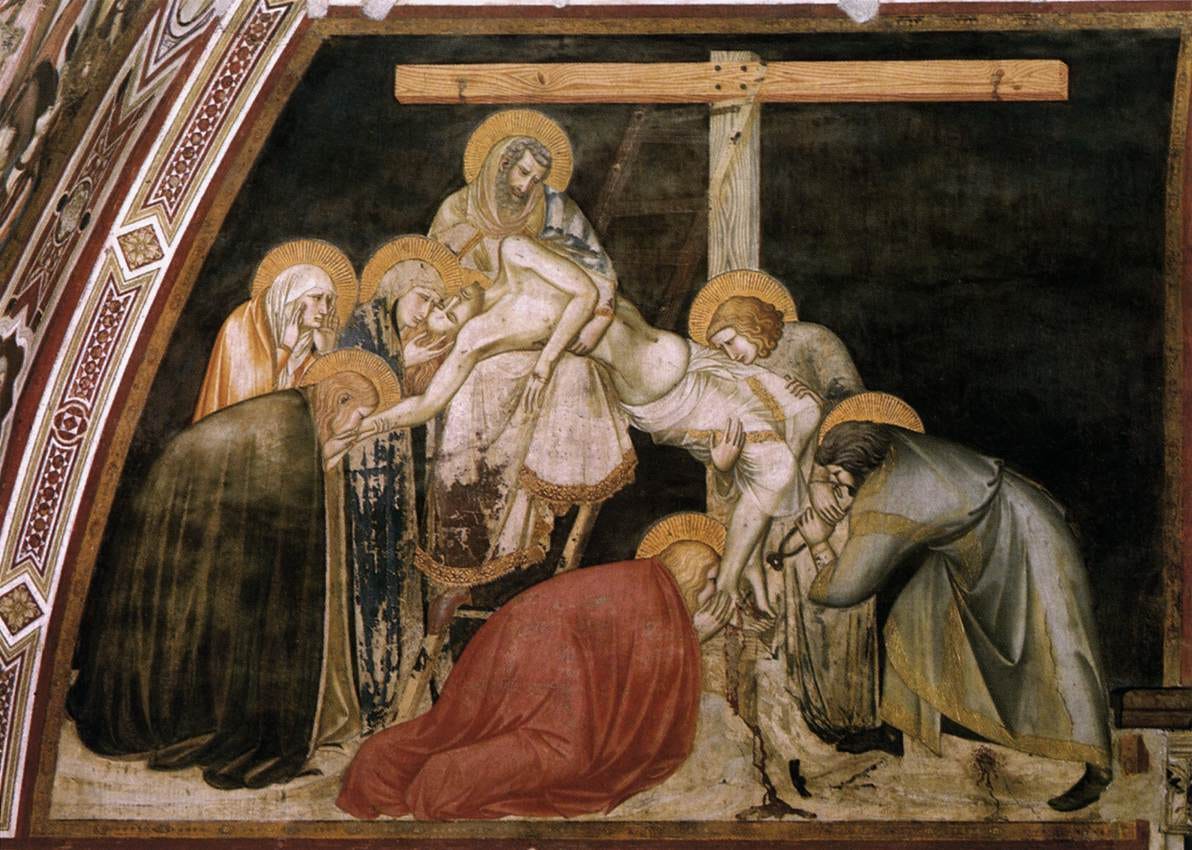
As with Duccio’s Transfiguration, this painting has many figures in profile. This allows Lorenzetti to place them in close proximity to one another, so that each can participate in a beautiful, rhythmical, and flowing design as a harmonious expression of love. While intimacy between two figures can be conveyed in the iconographic style (the Mother of God and Christ are often portrayed cheek to cheek), it is very difficult to show so many figures connected in such an intimate way, each acknowledging the others’ presence, without showing them in profile. This enhanced emotional register is characteristic of Gothic painting generally. The emotion of the figures should be distinguished from the modern concept of ‘self-expression’ or from the artist’s passion. Lorenzetti’s goal is not to tell us what he feels; it is to portray what the figures depicted felt.
Matthew Paris and the English School
Matthew Paris was an English monk who lived at St Albans, in southern England, in the 13th century. We have many examples of his pen-and-ink sketches, which include direct observations of the natural world around him. He also illuminated psalters, including the Westminster Psalter. The image below is taken from a manuscript, the Life of St Alban, depicting Heraclitus taking down St Alban’s head.
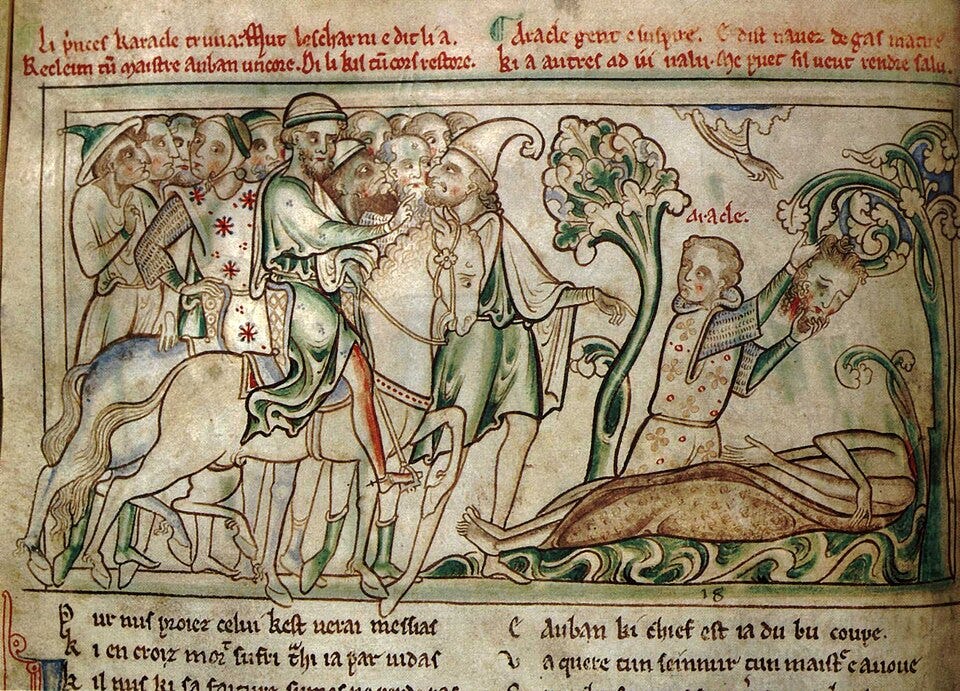
His style is characteristic of English art of the period, in which form is described by line almost to the exclusion of tonal description. He controls the quill pen with great assurance, creating smooth, rhythmically flowing lines and varying its darkness and width to draw the viewer’s eye to the most important parts of the composition. The coloration and shading are restrained, which gives his images a symbolic quality appropriate to sacred art. Many wall paintings of this period can still be found in English churches, including St Albans Cathedral itself, that follow this basic structure. Because it is reminiscent of modern illustration and animation art, familiar to and popular with so many people today, this is a form that 21st-century artists could take to easily. It is powerful yet accessible. I teach classes in this style, which I call the School of St Albans, myself.
Next week, in Part 2, I turn to the later Gothic masters: Van der Weyden and Fra Angelico, and the point at which the style begins its transition to the High Renaissance as seen in Ghirlandaio. I also look at how the Gothic’s new appreciation of the natural world gave rise, for the first time, to sculpture as a fully three-dimensional art form, and to portraiture and landscape as distinct genres in their own right.