


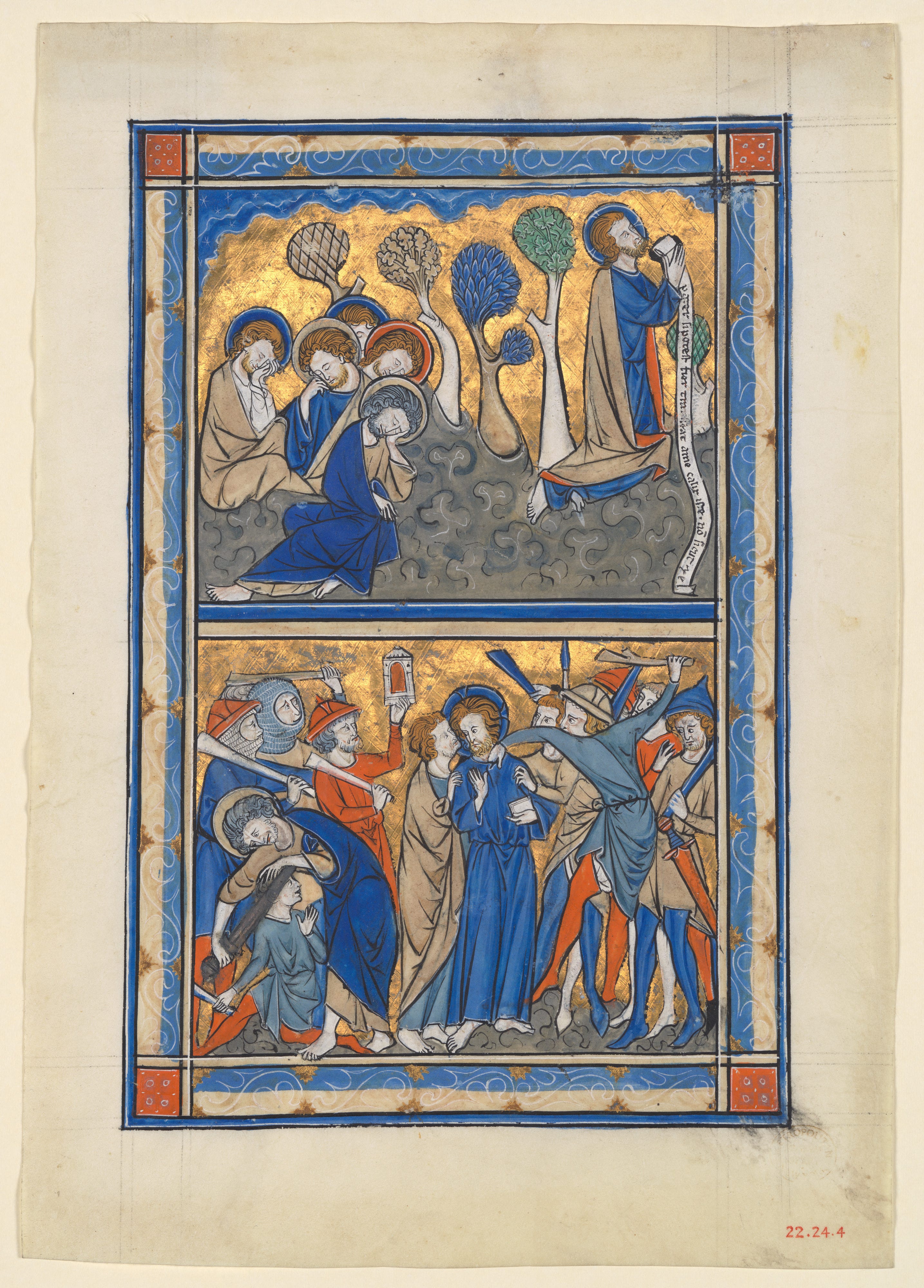
Here I compare two images of the Betrayal of Christ, made around the same time, around 1270: one painted on parchment for an English royal psalter, the other carved in limestone for a choir screen at Amiens. They are different media, and they come from different countries. What they share is more striking. Both compress several hours of the Passion into a single scene, and both do so in a closely related Gothic style. The comparison shows how sacred art can hold a whole narrative before the eye at once, and how England and France belonged, in this period, to one visual culture.
The first image is a manuscript leaf showing the Agony in the Garden and the Betrayal of Christ, from a royal psalter. It was painted in England around 1270, in tempera and gold on parchment. This Psalter was made for an English monarch, probably Queen Eleanor of Provence (ca. 1223–1291), the wife of King Henry III.
The second is a limestone relief of the Betrayal and Arrest of Jesus, carved in Amiens, in Picardy, between 1264 and 1288. Traces of the original polychromy and gilding survive.
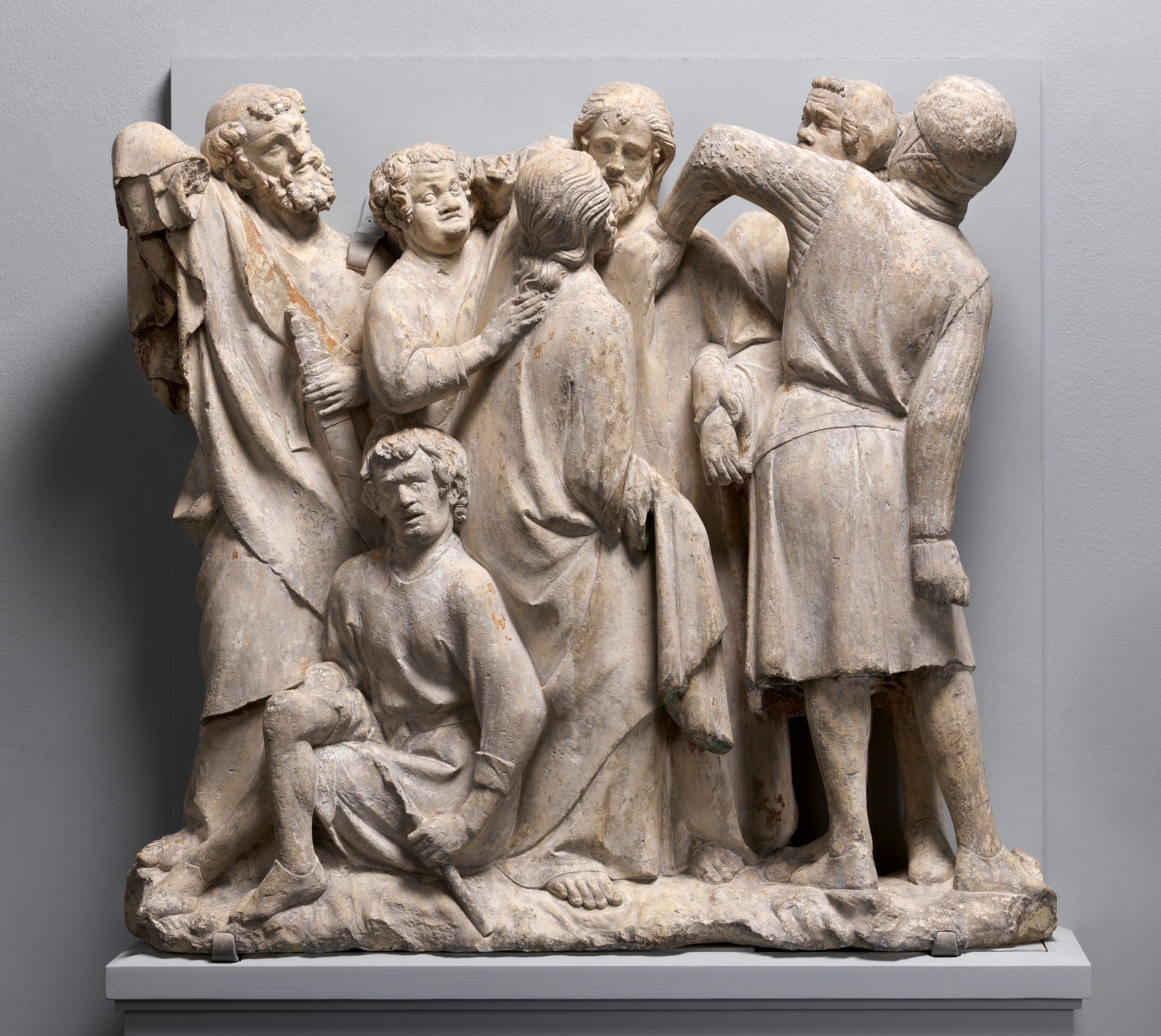
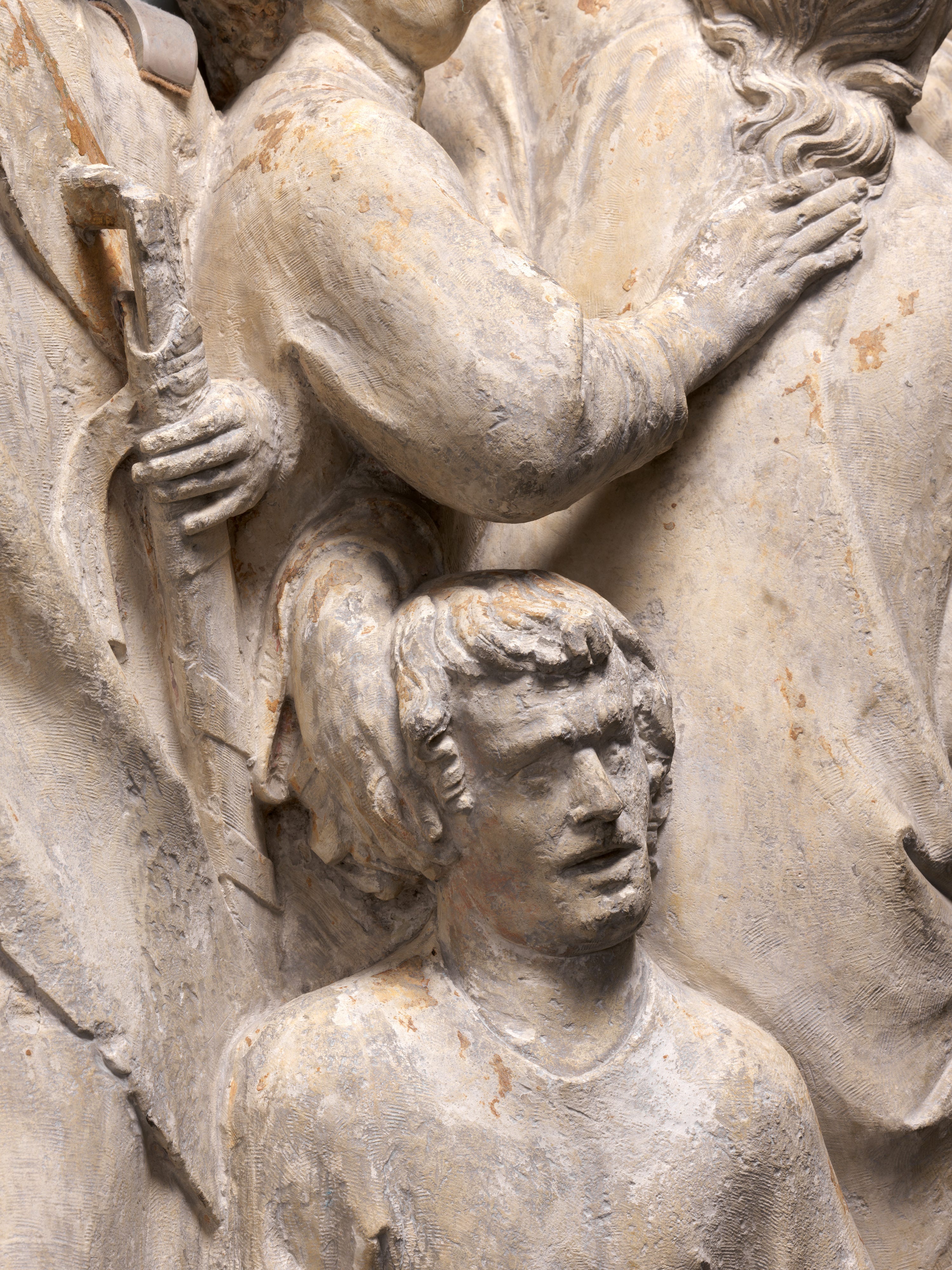
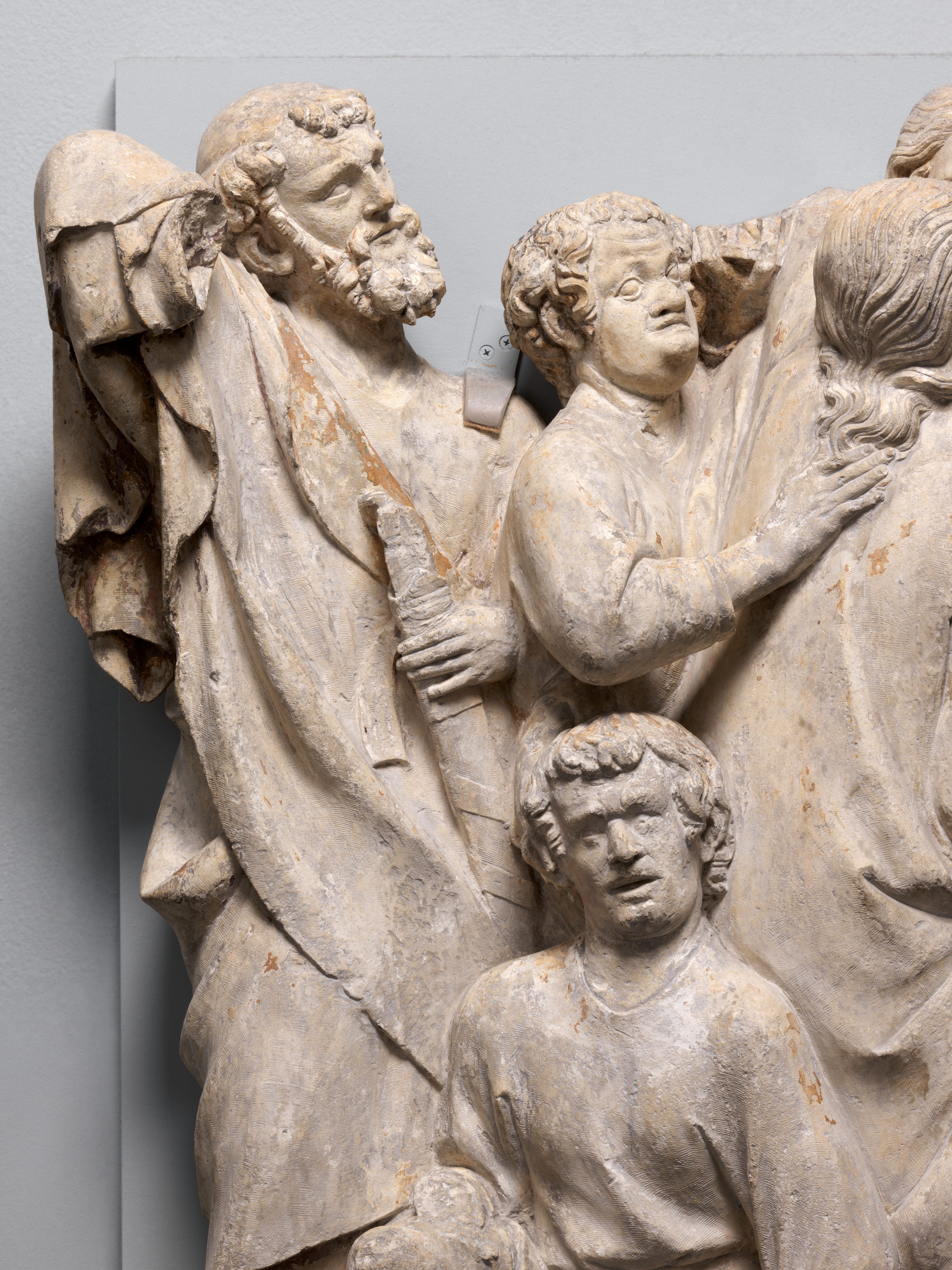
Four key events from the final hours of Jesus’s life are shown in the relief, reading from left to right: Peter sheathing his sword after severing the ear of Malchus, the high priest’s servant, who is seated; Jesus miraculously restoring the ear; Judas betraying Jesus with a kiss; and the Roman soldiers making the arrest. Compressing these four events into a single scene communicates the whole narrative in one instant.
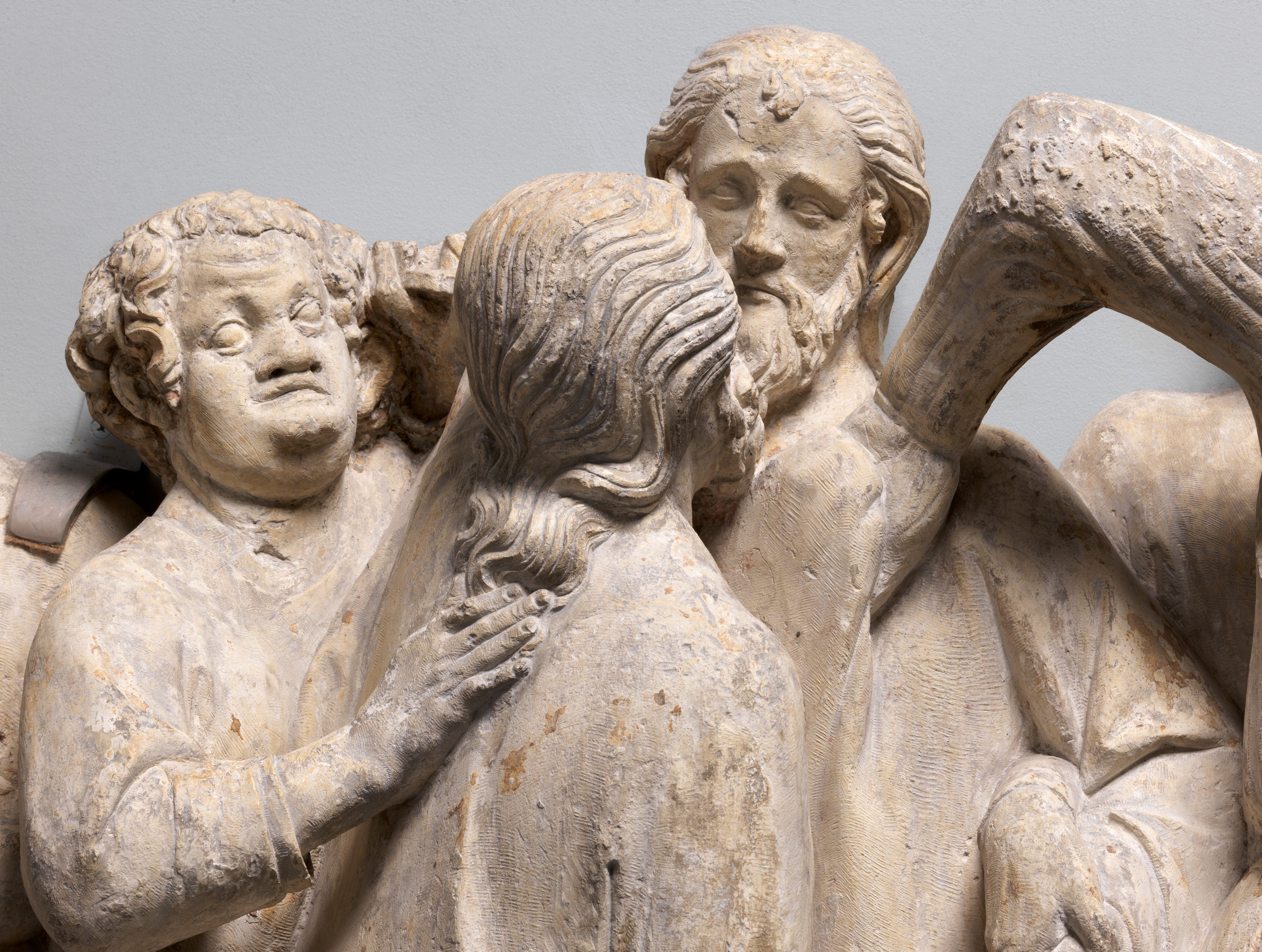
The relief comes from a choir screen. In the medieval church, the choir screen separated the nave from the choir, and by the thirteenth century these barriers were often decorated with extensive narrative programs, the Passion being among the most common. Such screens were steadily removed after the Council of Trent because they were felt to hinder the laity's participation in the liturgy, although the Council never mandated their removal. Most European churches eventually eliminated them. The choir screen at Amiens was taken down in 1755, and this relief is a surviving fragment.
What interests me is the comparison between the two works. They were made at almost exactly the same time, and stylistically they are very similar, despite one being a painting and the other a stone carving. One is English, and one is French.
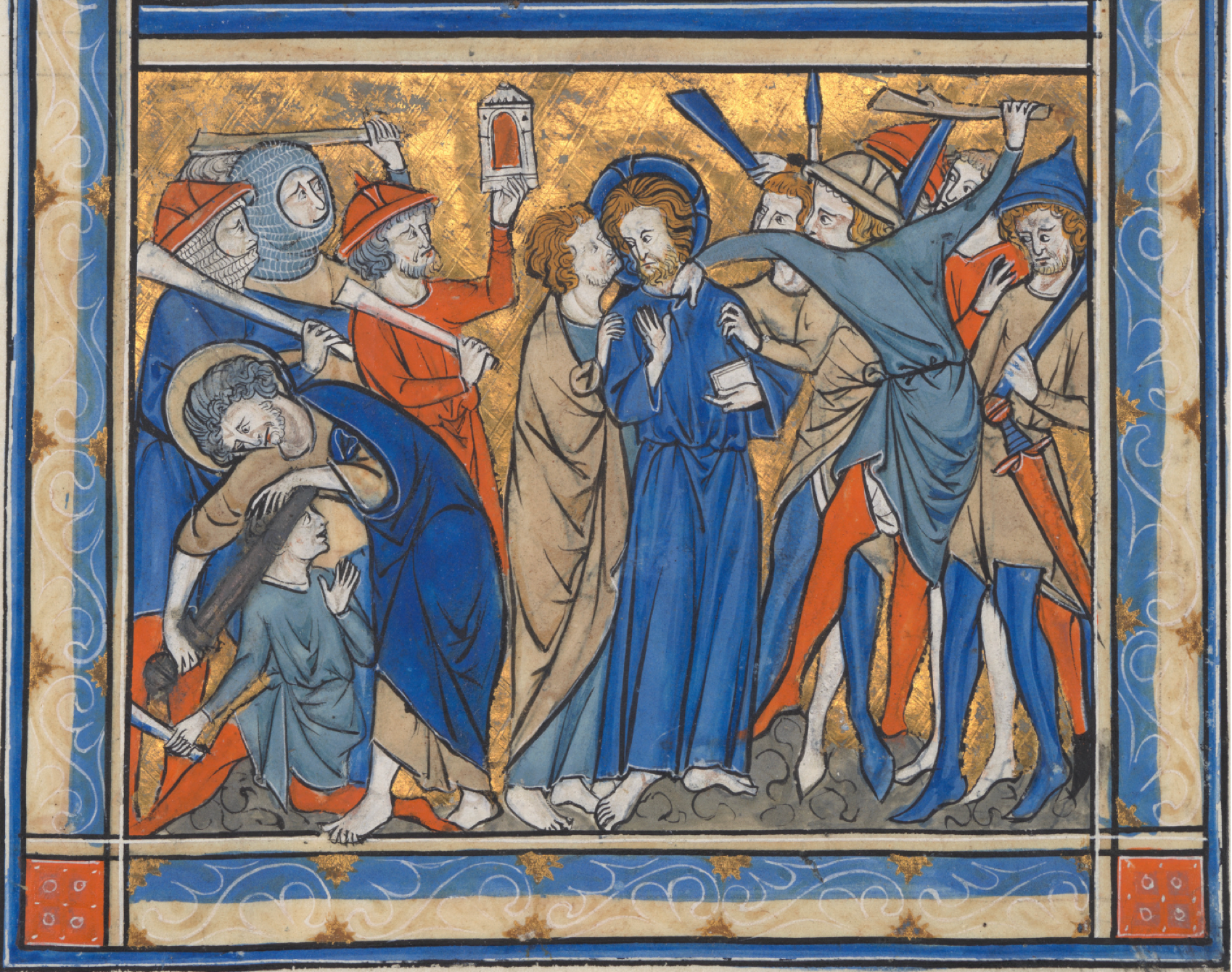
This is less surprising than it might first appear. At this time, England was still governed by a Norman ruling class and remained culturally tied to France, particularly among the aristocracy. Although by 1270 England had lost most of its territories across the Channel, only fifty years earlier the English crown had held something approaching half of what is now France. Artistically, the two countries were part of a single culture.
There is a further point, and it is the one that draws me to these images. Visual imagery has a capacity that written and spoken narrative does not: it can compress a sequence of events into a single moment. Provided we know what we are looking at, one glance at a scene such as the Amiens relief can instantly transmit a complex narrative. Similarly, imagery cannot communicate such a narrative on its own; no one looking at the image without any knowledge of the gospel would understand what they were looking at. The viewer needs to know the story first, in order to be able to ‘read’ the image. That story would be communicated initially either by reading or by hearing someone else read it aloud (which would apply to the illiterate).
This is precisely what makes such imagery so valuable in a liturgical setting, for the literate and illiterate alike. It draws information selectively from memory, reinforcing our participation in worship rather than distracting from it. A choir screen carved with the Passion did not interrupt the liturgy. It held the whole of it before the eyes of the congregation at once.
Credit for the historical information and the images to the website of the Metropolitan Museum of Art, New York; here, and here.