


The second of two related articles on the iconographic tradition. In the first, I set out the history of the style, the modern myths surrounding it, and the theology that accounts for its visual language. Here I turn to a question that the tradition raises but cannot settle from within: does an icon actually resemble our heavenly destiny, or is it only a consistent system of symbols? The strongest evidence, I will argue, comes from the images said to be “not made by human hands” — and above all from Our Lady of Guadalupe.
As I described the various elements of the visual vocabulary of icons in the previous article, a question naturally arises: does what we see in these images correspond to what Christ and the saints actually appear to be in heaven? Or might it be an internally consistent system of visual symbolism that successfully communicates an idea of the eschaton without actually resembling our heavenly destiny? We cannot know that for certain until we arrive there.
However, the strongest argument for a genuine visual correspondence comes from the existence of icons “not made by human hands.” In the East, we have the Mandylion, whose legendary origin involves a cloth that received the image of Christ’s face through direct contact with him during his public ministry. In the West, the Veronica cloth serves as its parallel: a separate tradition holds that Saint Veronica offered her veil to wipe the sweat and blood from Jesus’ face as he carried the cross, miraculously imprinting his features upon it. Both relics are said to be acheiropoieta (images not made by human hands), and although their originals are now lost, numerous later icons and copies based on these prototypes survive. What is striking is how closely each corresponds to the same iconographic type. The name Veronica, incidentally, derives from the Latin vera icon, meaning “true image.”
Among these revealed images is another Western example: the famous Our Lady of Guadalupe. It contains details clearly derived from Aztec culture, others from traditional Christian culture, and some not normally associated with the Spanish Christian culture of the time. What is remarkable is how these disparate elements are combined to form a unified image that has retained its power of appeal across centuries. The image, given to St Juan Diego, a poor Aztec man in 16th-century Mexico, caused millions to convert. It persuaded both the Aztecs and the occupying Spaniards, and continues to draw devotion from Christians around the world.
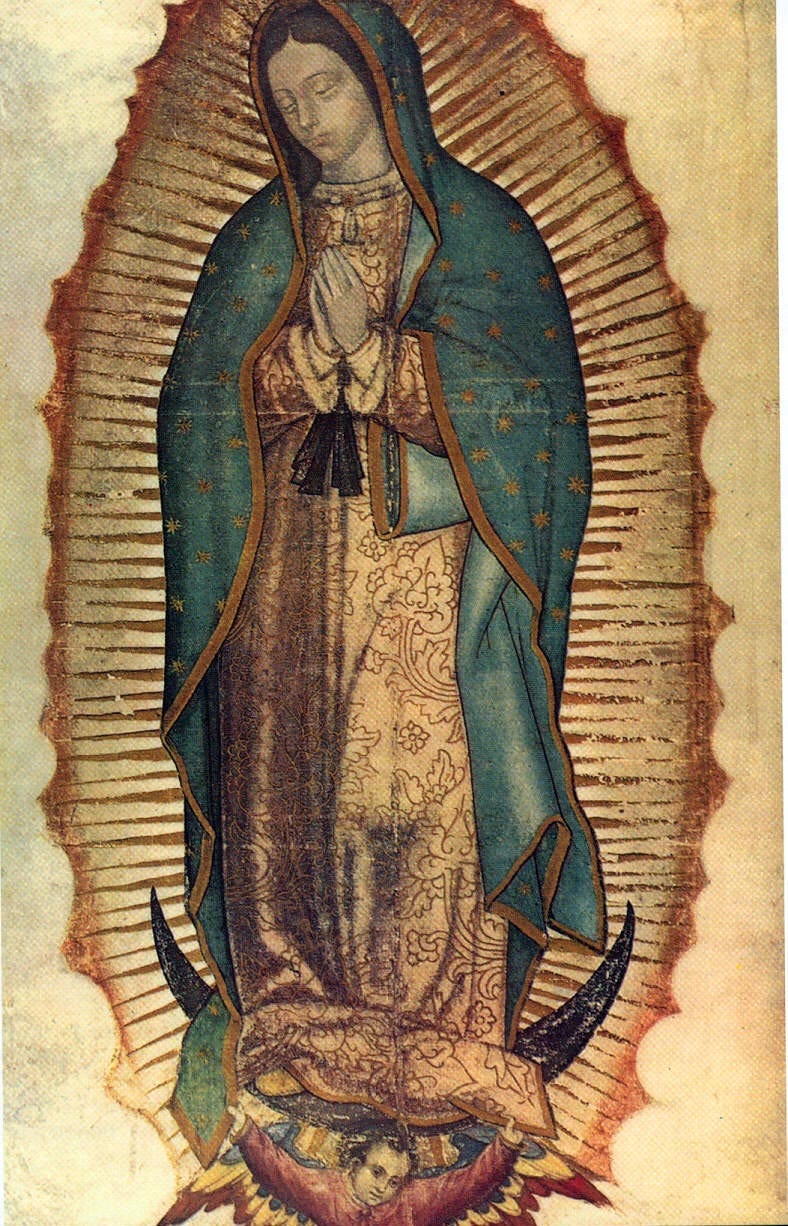
[Image: Our Lady of Guadalupe.]
The elements related to Aztec culture are as follows. Our Lady’s hairstyle, with the central parting, was the sign of a maiden and a virgin. The ribbon and bow around her waist signified pregnancy. The quatrefoil roses articulated in sepia lines on the pale brown-ochre shawl signified royalty. Aztecs looking at this image would have recognized the meaning of these features immediately.
But the image spoke to the Aztecs about more than their own culture, because it also contained elements drawn from traditional Christian iconography — elements that are universal, speaking to all people of Christ. These were noticed by the 16th-century Spaniards and have connected with Christians from all over the world ever since.
The blue shawl, for example, is a common color for Mary’s outer robe, said to denote royalty; Marian chapels have traditionally had their walls painted blue. The eight-pointed stars represent her connection with the ‘eighth day’ of Creation, her Son, Jesus Christ, who rose on the eighth day of the week. Stars are not the only heavenly bodies represented; the moon appears as well, in accordance with the description of the woman of the Apocalypse, who stands upon an upturned crescent moon.
Another feature of particular interest is the nimbus of light surrounding her whole person. The account of the woman in the Book of Revelation describes her as ‘clothed in the sun,’ and the golden nimbus might correspond to this. But I would suggest that its presence here indicates more specifically Christ’s presence within her womb: it is there not so much for the God-bearer as for God himself, whom she bears. This is the visual means of indicating that Our Lady is with child, the divine child, and it complements the Aztec symbolism of pregnancy, the bow and ribbon. Had this image not also spoken to the Spanish occupiers, no one would have taken St Juan Diego seriously.
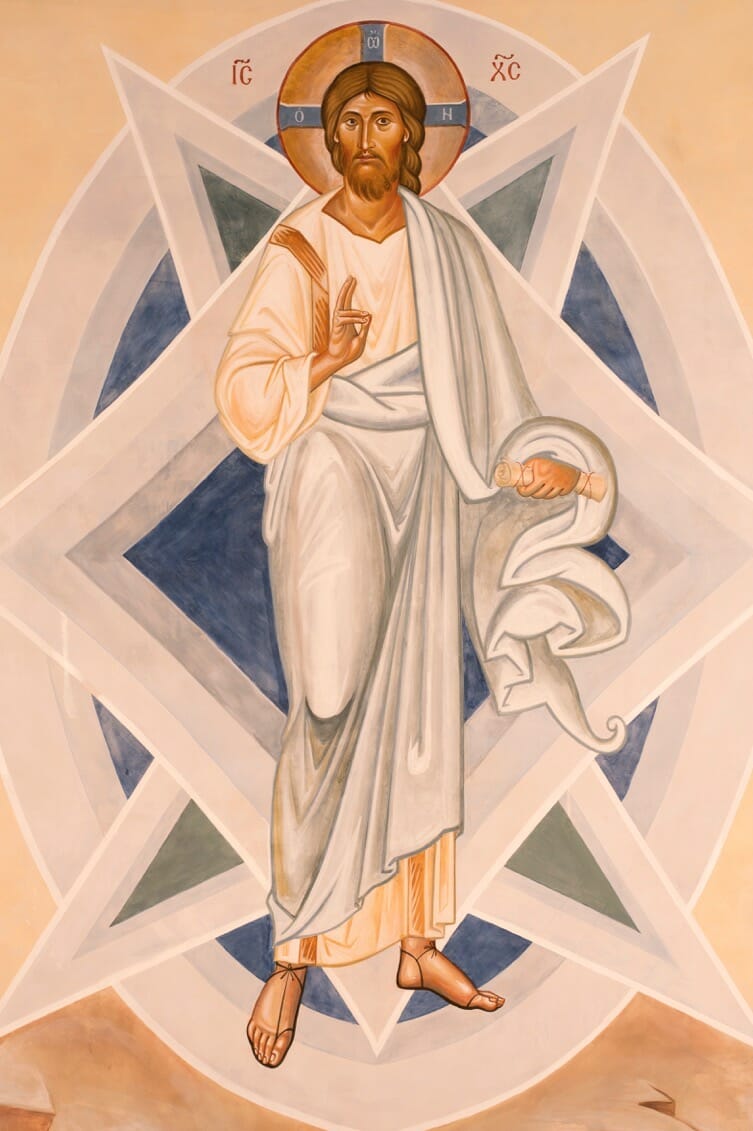
Look closely at the gold field that surrounds her. This is not, as one might first suppose, a series of bright gold rays emanating from Our Lady. Rather, it is a series of dark rays on a gold background, the outer limits describing the mandorla shape, a smooth almond. This mandorla darkens as we move toward its center, exactly as the mandorla around Christ in the Transfiguration icon does. It is worth noting that some later copies of this icon get this detail wrong, inverting the shading direction. Here, for comparison, is one painted around 1700:
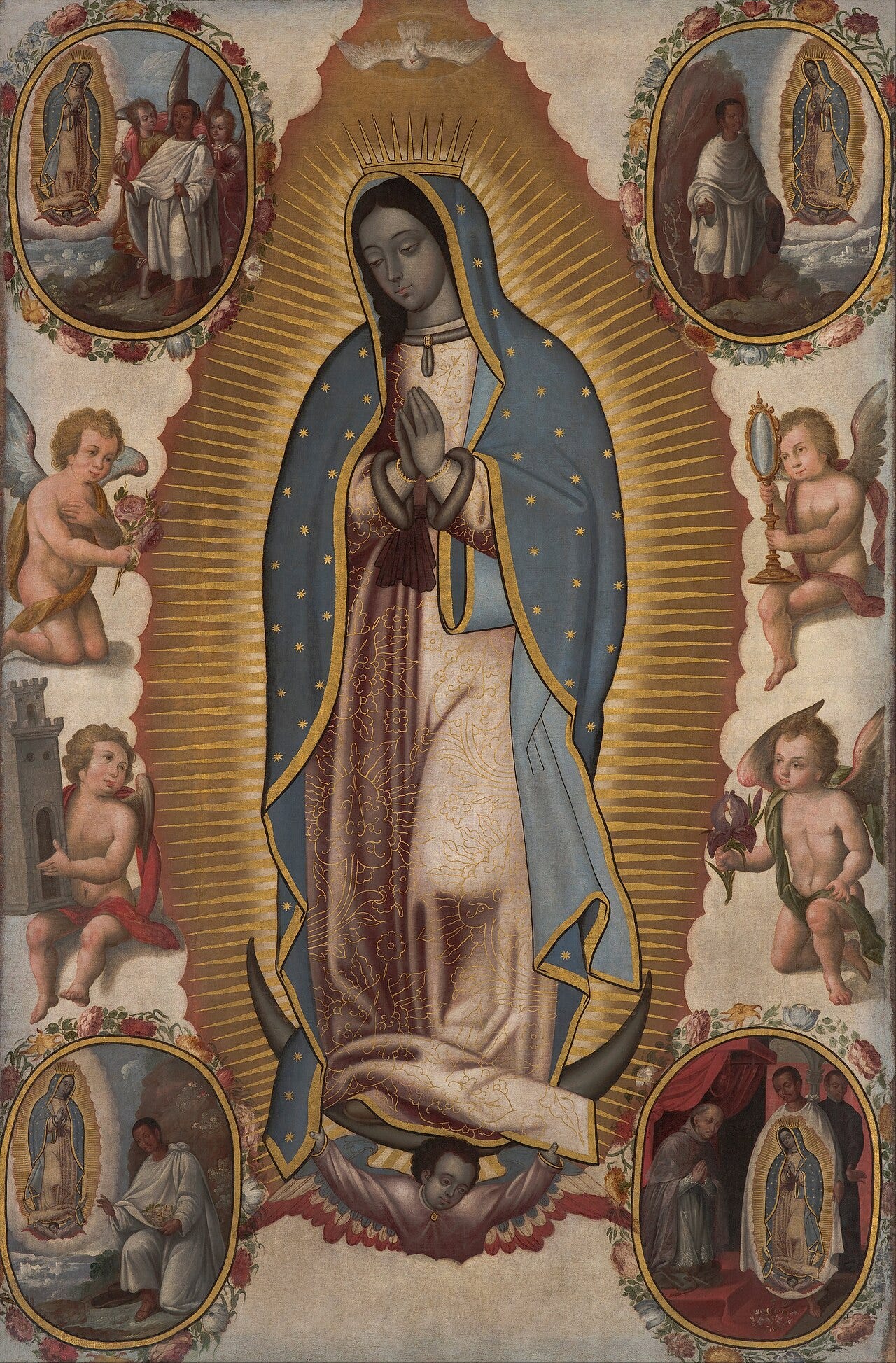
[Image: Copy of Our Lady of Guadalupe, c. 1700. Note the inversion of the mandorla shading compared with the original.]
All the constituent elements of the image — including aspects not described here, particular to time and place as well as universal in their appeal — are combined to create a composition of remarkable persuasive power. Their presence together creates a paradox: if the artist is not divine, then we have indeed a mortal artist of extraordinary gifts, one simultaneously conversant with Aztec culture, Scripture, and the traditional Christian iconographic tradition that was not then fashionable in 16th-century Spain. Someone with this particular profile would have been very difficult to find in Mexico in 1531.
Considering the style of the image: although it could never be mistaken for a Greek or Russian icon, it is nevertheless broadly in accordance with the iconographic prototype. This makes theological sense, since the iconographic style is the style of eschatological man, and Our Lady is portrayed in glory in heaven; it would be a most appropriate style for her apparition. In accordance with the iconographic tradition, there is no strong cast shadow; the image is defined predominantly by line rather than tone. If this were not a revealed image, our hypothetical artist would be not only a painter and a theologian of considerable insight, in addition to everything else already noted, but one who understood that the iconographic tradition was the most fitting for her representation, and who had sufficient mastery of its principles to apply them with legitimate modifications suited to the Spanish and Aztec context. His familiarity with the iconographic prototype in the case of the mandorla was, it seems, greater than that of at least some of his contemporaries, judging from the errors made in later copies.
If, on the other hand, we accept the tradition that this is an authentic icon not made by human hands, painted in a manner of speaking by the hand of God, then its remarkable degree of conformity to the iconographic tradition is itself evidence of how authentic and true a reflection of reality that tradition is. This, together with the other acheiropoieta, is among the strongest arguments for the authenticity of the iconographic style. The tradition was developed by faithful Christians in the first centuries of the Church, and we have every reason to believe they were divinely guided in that work.