


Last week I set out the problem: most buildings put up since the Second World War follow one of two design principles, even spacing or random spacing, and both produce ugliness. The traditional alternative was harmony, achieved through the appropriate proportioning of parts. I also described the relationship between the mathematics of beauty and natural science as one of synthesis and analysis: two complementary ways of describing an order that number itself gives. This week I want to explain where that tradition came from and to define its basic terms.
The Method Behind the Tradition
The traditional proportions that characterize Ditchley House, the Georgian building I showed last week, were used, in one form or another, by architects from the ancient Greeks through the early 20th century, and are based on an analysis of how we see the world around us.
We all perceive that there are objects around us that are beautiful, and the traditional assumption was that they are beautiful because they possess particular properties. Those properties can therefore be analyzed much as a scientist might examine any physical property. The criterion for deciding which objects were worthy of analysis was that there must be a broad consensus that the object is beautiful.
For example, it seems fair to say that most people find the natural world beautiful. I have barely met a person who does not. We can examine the countryside or the night sky and ask what makes them beautiful. Similarly, in music, regardless of culture or era, most people hear notes an octave apart and perceive them as related. They also hear harmony between the first and fourth notes of a musical scale, and between the first and fifth: intervals known as a ‘fourth’ and a ‘fifth’.
The ancient Greeks looked at the array of beautiful objects and sounds around them, those for which there was a consensus of delight, and analyzed them to identify what beautiful things have in common. Plato articulated a mathematics of harmony in his book The Timaeus and attributed its development to Pythagoras. Plato died in 347 BC, aged 80; Pythagoras lived earlier and is thought to have died around 495 BC.
The Early Church Fathers later incorporated these Greek ideas about harmony into the Christian tradition. The two figures who did most to reconcile them with the Faith were St Augustine and Anicius Manlius Severinus Boethius (died c. 526), usually referred to simply as Boethius, who is also venerated as a saint. In his De Institutione Arithmetica, Boethius lists 10 harmonious proportions, mathematical relationships which he says derive from Plato, Aristotle, and various unnamed later thinkers.
Proportions and Ratios
In the mathematics of beauty, proportion and ratio have specific, distinct meanings. A ratio is a relationship between any two magnitudes, for example, 2:3. A proportion, on the other hand, is a consonant relationship between two or more ratios. ‘Consonant’ means literally ‘sounding together’ and is used here to apply to things that sound or appear good to most people when placed in proximity to each other.
Returning to Ditchley House, the features that most strongly express proportion are the differently sized windows. The architect chose those sizes because he believed they corresponded to a consonant relationship between two ratios: the magnitude of the first window to the magnitude of the second, and the magnitude of the second to the magnitude of the third. We might characterize this, if we agree with the architect, as follows: the first relates to the second as the second relates to the third, and each does so in a pleasing way.
While there is a narrow range of mathematical operations from which proportions can be generated (10 in Boethius’s system), there is an infinite range of proportions that can be generated from those 10 operations. An arithmetic proportion, for example, is defined as having equal intervals between each magnitude. The series 3:5:7 is an arithmetic proportion: the starting term is 3, and subsequent terms are generated by adding 2 each time. One could instead start with 3 and add 3 each time to produce 3:6:9, or start with 2 and add 7 each time to produce 2:9:16. In mathematical notation, the symbol :: indicates a consonant relationship between two ratios, so 3:5:7 would be written 3:5::5:7. A colon alone, as in 2:3, indicates a ratio. Once a particular proportion is established, one convention also places commas between its terms: (3, 5, 7).
The choice of proportion is not arbitrary. The architect must use judgment to determine which proportion is appropriate for the building he is designing, and this will vary according to its purpose. One of the necessary qualities of beauty, as St Thomas Aquinas observed, is ‘due’ proportion: proportion that is appropriate to what it is. The ultimate test of whether the architect has chosen well is the same criterion by which the numbers were first generated: do most of the people for whom it is intended find it beautiful over time? I suggest that Ditchley House has stood the test of time precisely because many people have found it beautiful since it was built. The Radcliffe Camera in Oxford and the Duomo in Florence have passed this test, too.
What Proportions Can the Architect Choose From?
I will not describe all 10 proportions listed by Boethius, but a few examples will illustrate the principles at work.
The first is the geometric proportion. This is a sequence in which a common multiplication factor exists between terms. In the series 1, 3, 9, each term is found by multiplying the previous one by three: 1:3::3:9. Another geometric proportion is 1, 2, 4, where the common factor is 2, also written as 1:2::2:4. A proportion is not limited to three terms; it is a consonant relationship between two or more ratios, so while three is the minimum number of terms needed to create two ratios, there is no maximum. These series could extend as far as useful: 1, 2, 4, 8… or 1, 3, 9, 27… They need not begin at 1; any magnitude may serve as the first term.
Plato describes these two geometric proportions, 1, 2, 4, 8 and 1, 3, 9, 27, in The Timaeus as the foundations of both the structure of the universe and musical harmony. They are called geometric because this operation allows the dimensions of squares and cubes to be derived from a single line. Subsequent classical and early Christian commentators, including Augustine and Boethius, wrote commentaries and further developed Plato’s and Pythagoras’s initial ideas over several centuries. This body of thought became the foundation of the Western theory of proportion.
Since a proportion requires three or more terms to create two ratios, the three numbers 1, 2, and 3 create two relationships: one between 1 and 2, and another between 2 and 3. The relationship between 1 and 3 is not considered here; only those between adjacent terms are.
Returning to our building example, this is why people who could afford it would typically build three-story buildings. Music offers a parallel: basic music theory holds that a chord is incomplete until it has three notes. Two notes together can create pleasing intervals, but the consensus is that the combination sounds unresolved until the third note is added. For this reason, composers sometimes use two-note combinations deliberately to create tension, generating in the listener a desire for resolution.
Another common proportion in Boethius’s list is the arithmetic proportion: a sequence in which the interval between successive terms is constant. In the series 1, 3, 5, 7, the interval between each number is 2; in 3, 6, 9, 12, 15 the interval is 3. In a fundamental proportion of three terms, for example 1:2::2:3, the first and third terms are called ‘extremes’ and the middle one the ‘mean’. So 2 is the arithmetic mean of extremes 1 and 3. Similarly, 2 is the geometric mean of extremes 1 and 4 in the proportion 1:2::2:4.
The Tradition Preserved: The School of Athens
This approach to mathematics was preserved and further developed during the centuries following Augustine and Boethius. We see evidence of its enduring importance in Raphael’s great fresco, The School of Athens, painted in the Vatican in the 16th century, in which Plato is shown holding a copy of The Timaeus. The fresco was intended to emphasize the importance of non-Christian, Greek philosophy to the Christian worldview. Plato stands at the center of the composition, beside his great student, Aristotle: Plato on the left, pointing upward to the world of ideals; Aristotle on the right, pointing downward to the world of the senses.
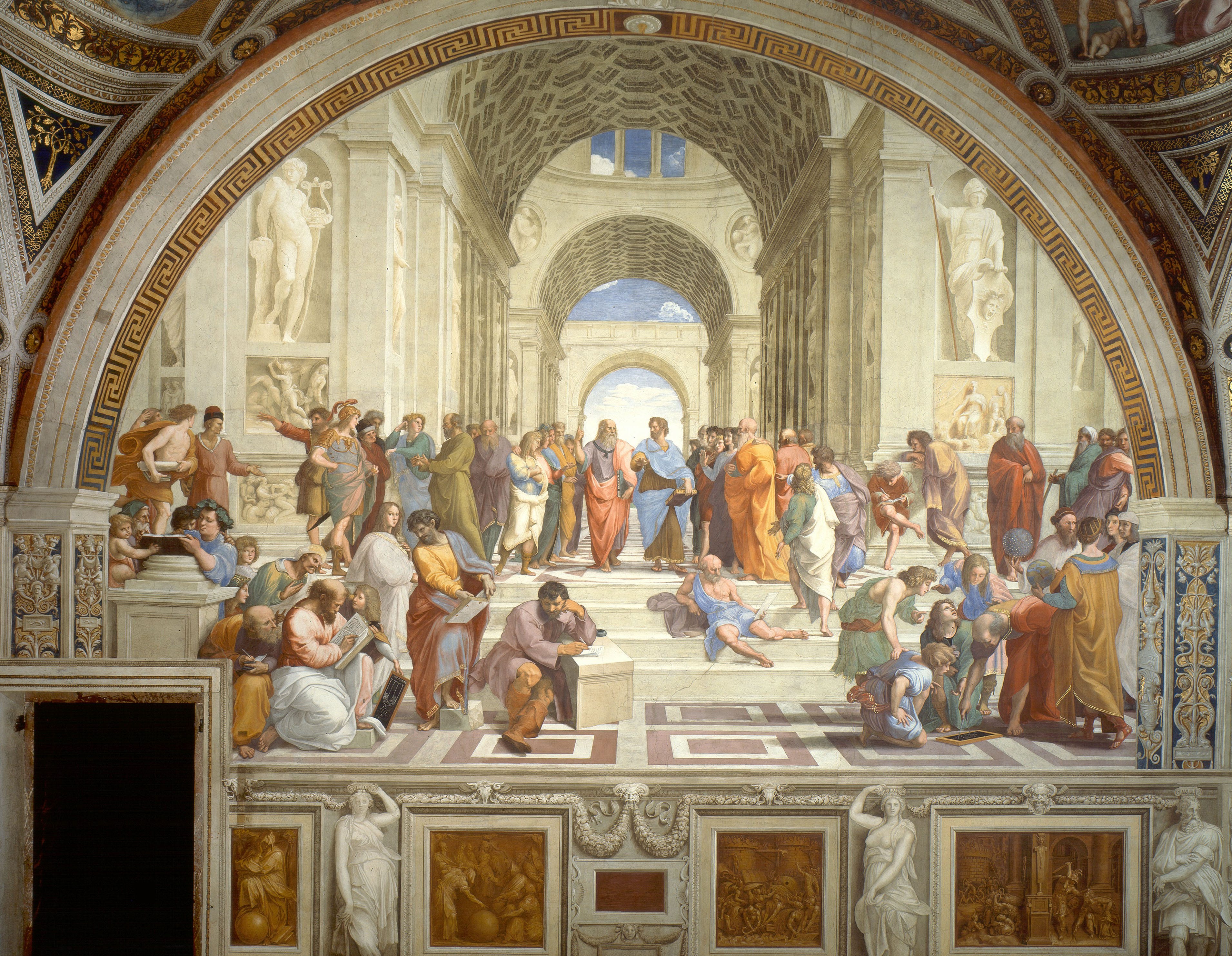
The School of Athens, Raphael, Vatican, 16th century.
Down the spine of the book Plato holds is the word ‘Timeo’:
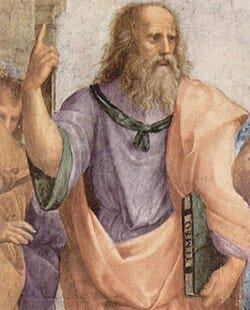
Detail: Plato holding The Timaeus. Raphael gave Plato the facial features of Leonardo da Vinci.
Kneeling in the foreground on the left, with a chalkboard showing a diagram of the numerical pattern of musical harmony (1:2:3:4), is Pythagoras. In his book The Spirit of the Liturgy, Benedict XVI refers to this tradition of mathematical study and its importance to Christian culture. These analyses, he says, reflect the beauty of Creation, which points to heavenly beauty and the beauty of God. All Christian culture, he suggests, is an assimilation of this heavenly beauty.
— — —
Next time I begin to describe the five traditional fields of study that make up the mathematics of beauty, starting with the two that concern music and man: instrumental music, where the whole system originates, and ‘human music’, the harmony of the proportions of the human person.