


The first of two related articles on the three authentic liturgical traditions of the Church — what makes them sacred, and how sacred art is the template for mundane or profane art. This first article asks what sacred art is for, how style communicates theological truth, and introduces the three traditions Benedict XVI identifies. The second will consider what governs the style of each, drawing on the anthropology of John Paul II’s Theology of the Body, and will explain why the High Renaissance is not among them.
What should the content of sacred art be?
Every time an artist paints, he asks three fundamental questions: What do I paint? How do I paint it? And why am I painting it? All three are interconnected, but his answer to the first question — ‘What?’ — governs the content; and his answer to the second — ‘How?’ — governs the style. The third question, ‘Why?’, establishes the purpose that both content and style must serve.
The content and style of sacred art must accordingly serve its sacred purpose. By tradition, that purpose is to show us what we could not otherwise see, in such a way that it deepens our participation in worship and prayer. An image of Christ on the Cross is vital to our worship, for example, because it tells us something about what is happening at the Mass. Paintings of saints and angels reveal to us that there is a heavenly host who worship God alongside us. Paintings of the feasts and Gospel narratives connect these events to specific points in the liturgical year.
In this sense, sacred art makes the invisible visible. It does so in two ways. First, as one might expect, through its subject matter. Second, through the style in which it is painted. So, in the case of sacred art, how the subject is painted is just as important in communicating theological truths as what is painted. This second point is less immediately obvious and warrants careful explanation.
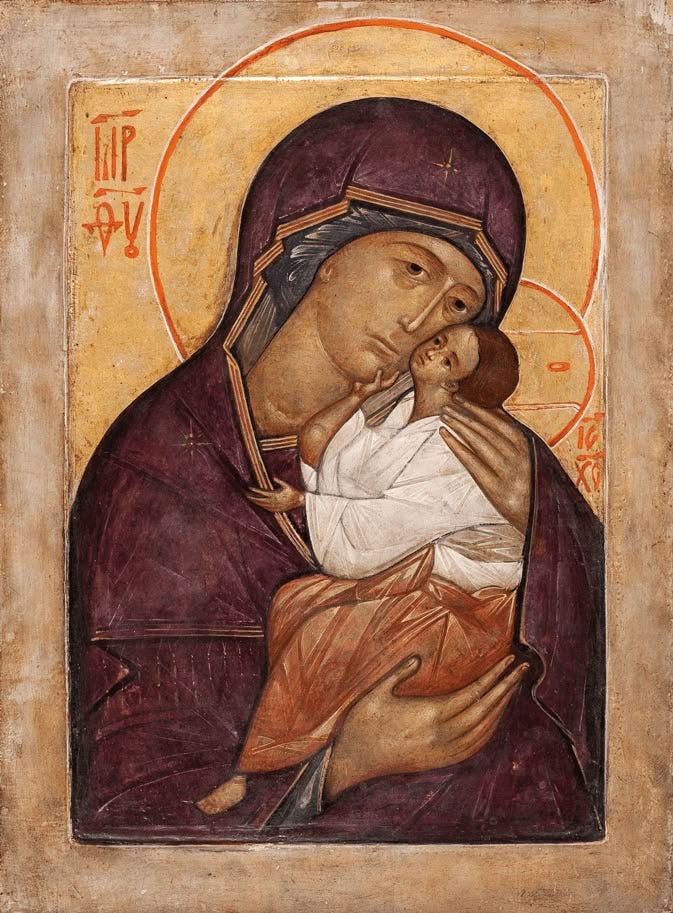
[Image: The Theotokos, Mary the Mother of God and the Christ Child by Gregory Kroug, Russian, 20th century, in the iconographic style. Egg tempera on panel. Three stars on her outer garment, on each shoulder (one is hidden) and her forehead are symbols of perpetual virginity, i.e. before, during and after the birth of the Savior.]
What governs style in art?
Most people coming out of fine art departments in the West today would assume that style is a purely personal choice, needing no stronger justification than the artist’s own preference. The Christian artist, however, should approach things differently. Every artist makes personal choices, but a Christian artist makes those choices in light of an end that aligns with his faith, and, as a result, Christian art should be as recognizably Christian by virtue of its style alone as the Christian life.
If an artist wants to paint Our Lady, he will not only represent her visible appearance as faithfully as he can; drawing on tradition, he will also seek to communicate truths about her that would not be visible even if she were standing before us — that she is a saint in heaven, that she is the Mother of God, that she is a virgin in perpetuity, and that, in common with all humanity, she is a person with an invisible soul as well as a visible body. These truths are abstracted — literally ‘drawn out’ — and made visible through a controlled and partial modification of natural appearances, which creates a characteristic style. It takes great skill to do this, but when done well, the resulting stylization conveys a deeper reality than a strictly naturalistic representation could and communicates many of these aspects to people who intuit these truths, even though they are often unaware of precisely how the artist uses style to communicate them.
To describe this in more detail, it is worth establishing the meanings of the terms I will use here. When I want to describe conformity to natural appearances, I use the word ‘naturalism’. Some other commentators will use the word ‘realism’ here, but I generally prefer not to, since it implies that natural appearances constitute the whole of reality, which is not true.
The tendency to deviate from natural appearances, on the other hand, is called by other commentators and me variously and interchangeably ‘abstraction’, ‘symbolism’, or ‘idealism’.
Both tendencies — that is, heightened naturalism or heightened abstraction (symbolism or idealism) — taken to their extremes, mask reality rather than reveal it. Too much abstraction risks an ugly distortion that hides the truth. The artist risks distorting appearances to the point that the viewer cannot recognize what he is supposed to be looking at. Alternatively, the artist can misapply distortion to convey the wrong message — for example, an overly erotic representation of the female figure, as seen in advertising and superhero comics. This quality of heightened eroticism is communicated as much by the style of the painting as by the pose that the figure adopts.
Too much naturalism, as we see in the style known as ‘photorealism’ (which I consider a misnomer for the reason stated above), often produces a cold sterility that fails to convey the full Christian understanding of what it means to be a person, including the presence of an immortal soul.
Christian figurative art has always navigated a course between these two poles. Because doing so is genuinely difficult, the Christian artist is wise to conform to traditional, tried-and-tested styles and to depart from established stylistic conventions only when the needs of a particular community or time clearly require it. This principle is sometimes called the ‘hermeneutic of continuity’, and can be summarized simply: don’t change things unless you have to.
Pope Pius XII addressed this balance directly in his 1947 encyclical, Mediator Dei. (In the passage below, Pius is using the word ‘realism’ to refer to what I would call naturalism, and ‘symbolism’ to refer to the degree of abstraction or idealization):
Recent works of art which lend themselves to the materials of modern composition, should not be universally despised and rejected through prejudice. Modern art should be given free scope in the due and reverent service of the church and the sacred rites, provided that they preserve a correct balance between styles tending neither to extreme realism nor to excessive ‘symbolism,’ and that the needs of the Christian community are taken into consideration rather than the particular taste or talent of the individual artist. (Mediator Dei, 195)
Most of the recognizable artistic styles that have developed since the beginning of the 20th century depart radically, in my opinion, from the traditional balance of naturalism and idealism — but that should not surprise us, since most modern artists had no intention of conforming to Christian tradition, actually quite the reverse; and they have a different understanding of the human person and the world around us. To consider two examples: photorealist painting, at one extreme, reflects a denial of anything beyond surface appearances. By reproducing the visible world with photographic precision and deliberate emotional flatness, it presents the human figure as a mere object among objects, stripped of any evident interior life or soul and seen as having no greater value than a cigarette butt on the sidewalk. Abstract Expressionism, at the other extreme, largely abandons the material world and the body as meaningful subjects. It instead seeks to convey pure inner states — emotions and feelings — through gesture, color, and non-representational form. For many of these artists, the essence of humanity lies in thoughts, feelings, and subjective experience rather than in the embodied person. Abstract Expressionist art, such as that of Jackson Pollock or Mark Rothko, although it seeks to communicate essential aspects of human nature as they see it, does not convey any sense of the human body. There is no figure shown that we would recognize as having two arms, two legs, and so on. Each approach runs contrary to the Christian understanding of the human person as a unity of body and soul.
The three authentic traditions of liturgical art
In his book, The Spirit of the Liturgy (p. 129), Pope Benedict XVI identifies three authentic traditions of liturgical art. Each in its own characteristic way strikes the balance between naturalism and abstraction that Pius XII called for. Here is an introduction to them and to what unites or distinguishes them from one another.
The first is the iconographic tradition. This style developed in the early centuries of the Church, reaching a distinctive form around the 4th century AD. It remained the dominant form of Christian sacred art, albeit in many different variations, until the 12th century, and continues to characterize the sacred art of Byzantine and Eastern Orthodox churches to this day. When we speak of ‘icons’, the images of Russian and Greek Orthodox churches naturally come to mind first — for example, the holy icons from the Monastery of St Catherine on Mt Sinai dating to the 6th century, or the works of Andrei Rublev and Theophanes the Greek in the 14th and 15th centuries. However, it is less well known that the iconographic style is also part of the Western, Roman tradition. In the West, after the style’s first development in the 4th century, all artistic styles up to and including the Romanesque remained fully consistent with the same iconographic prototype. The figurative art of the Book of Kells, made in Ireland in the 8th century, and the Celtic style, for instance, conform to the iconographic prototype. Though they may look very different from a Russian icon, they share the same underlying principles that define iconographic art.
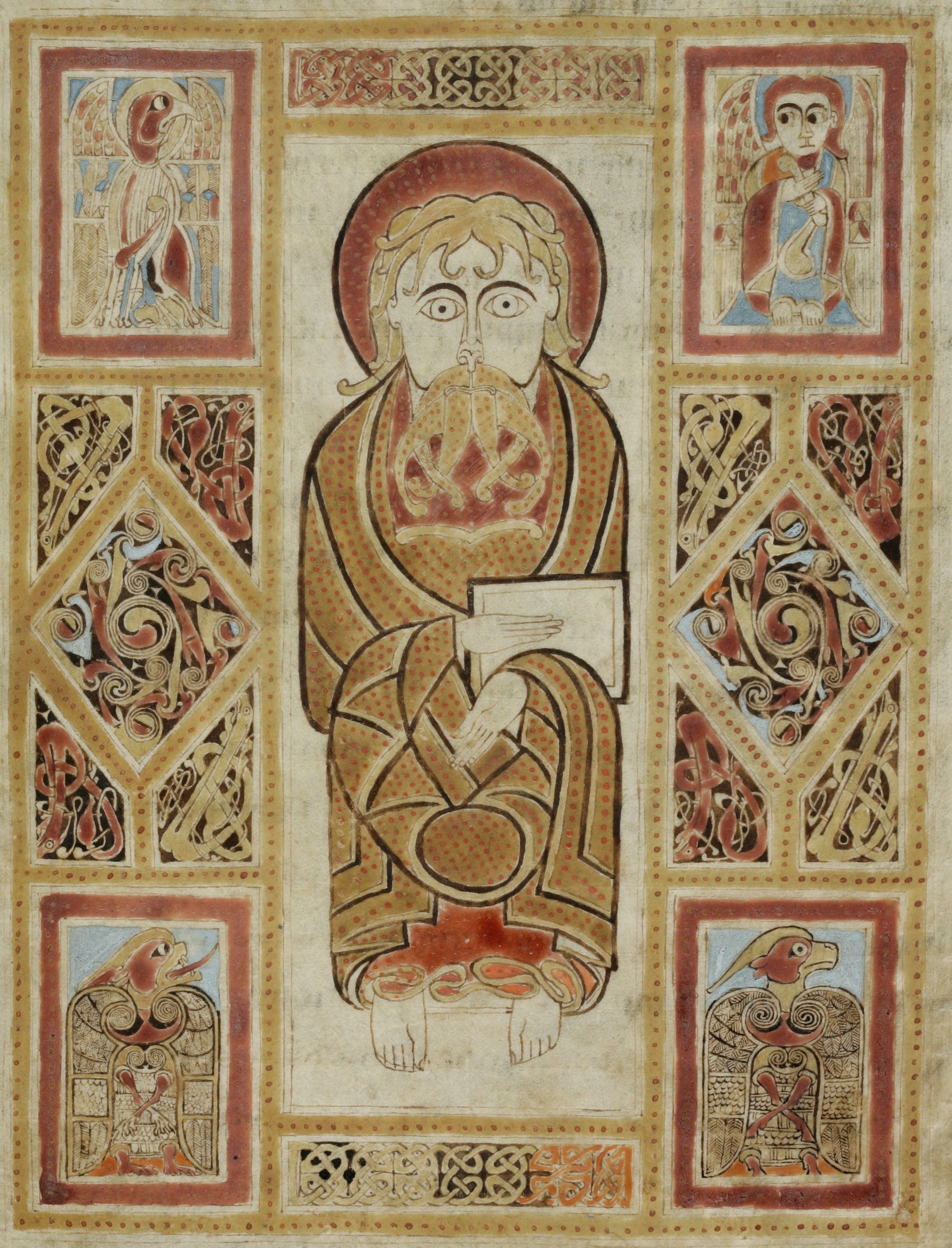
[Image: An 8th-century illumination of St Mark in the Celtic style from the Gospel of St Gallen. It looks very different from a Russian icon, yet the two share the underlying principles of the iconographic tradition.]
The second authentic tradition is the Gothic. This term is generally applied to a style that emerged in the Western Church around the 12th century, replacing the earlier Romanesque style, and died out by the 16th century. Duccio, the 13th-century Italian painter, is a representative example: his work is characterized by greater naturalism than the iconographic tradition, though it remains highly abstract in comparison with later Western styles. Over time, the degree of naturalization steadily increased, while maintaining the essential formal elements of this newly established Gothic style. I would include artists such as Fra Angelico and Flemish painters such as Jan van Eyck and Rogier van der Weyden in this category, considering them late-Gothic.
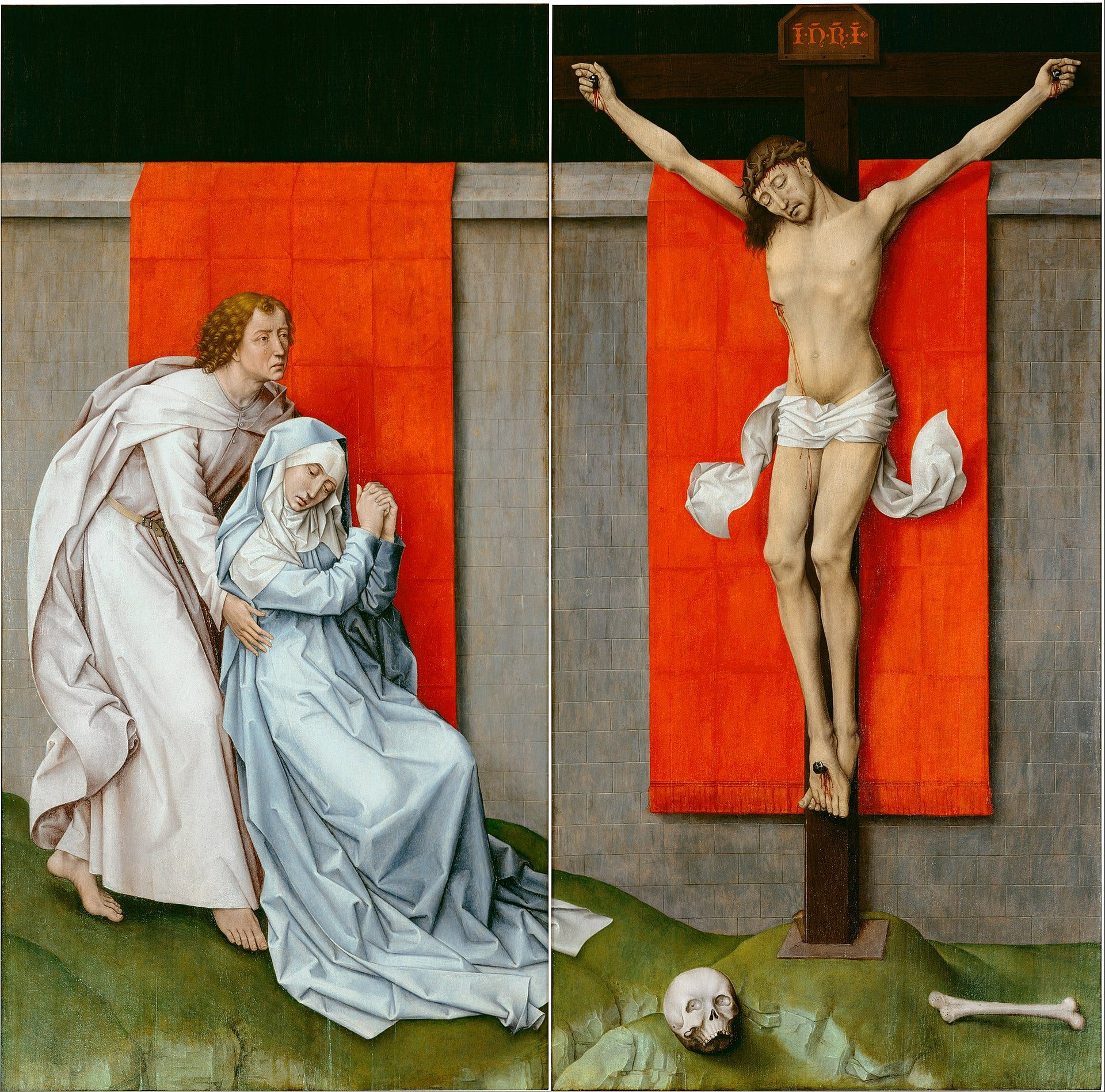
[Image: Crucifixion Diptych by Rogier van der Weyden, 1460]
One explanation for this transition from the iconographic Romanesque style is the influence of the ideas of Aristotle, the ancient Greek philosopher of the 4th century BC, whose works were rediscovered and incorporated into Christian thought by the medieval scholastics beginning around the 12th century and gathering pace thereafter — among them St Bonaventure and St Thomas Aquinas, who lived in the 13th century AD. Through this renewed study of Aristotle, integrated into Christian thought by these great medieval figures, there was now greater confidence in the senses’ capacity to yield reliable knowledge and a deepened appreciation of the created world, which could be accurately observed and understood through the information they provide. It was not a wholesale reversal of earlier assumptions — Christians had always trusted the senses to some degree and believed in the reality of the world around us — but rather a significant shift of emphasis. As a result of this greater stress on the intelligibility of the natural world, there was a greater curiosity about it and a desire to understand the order that pervades it. An outcome of this is an increased naturalism in art. Artists studied and copied nature more rigorously than before. Many today associate high naturalism in Christian art with the Italian High Renaissance, with artists such as Leonardo and Michelangelo, but the development of naturalistic art did not begin with them. Rather, it is the culmination of a process of systematic observation of nature that began much earlier, in the Gothic period. A second outcome of this movement toward a more intensive and systematic study of nature and the natural order, incidentally, was the emergence of what would eventually become modern natural science and the scientific method.
The third tradition considered authentically liturgical and sacred is the Baroque — or, as Benedict XVI puts it, the Baroque ‘at its best’. This is the strongly naturalistic style that developed in Italy as part of the Catholic Counter-Reformation and characterizes the art of 17th-century Western Europe. The artists who established it include Federico Barocci and Caravaggio; other well-known Baroque painters include Velázquez, Georges de La Tour, Zurbarán, Van Dyck, Rubens, Guido Reni, and Ribera. Though strongly naturalistic, the style employs a carefully worked-out, if subtly applied, abstraction. Later commentators, drawing on Platonic terminology, would call this partial abstraction ‘idealization’ in connection with Baroque art.
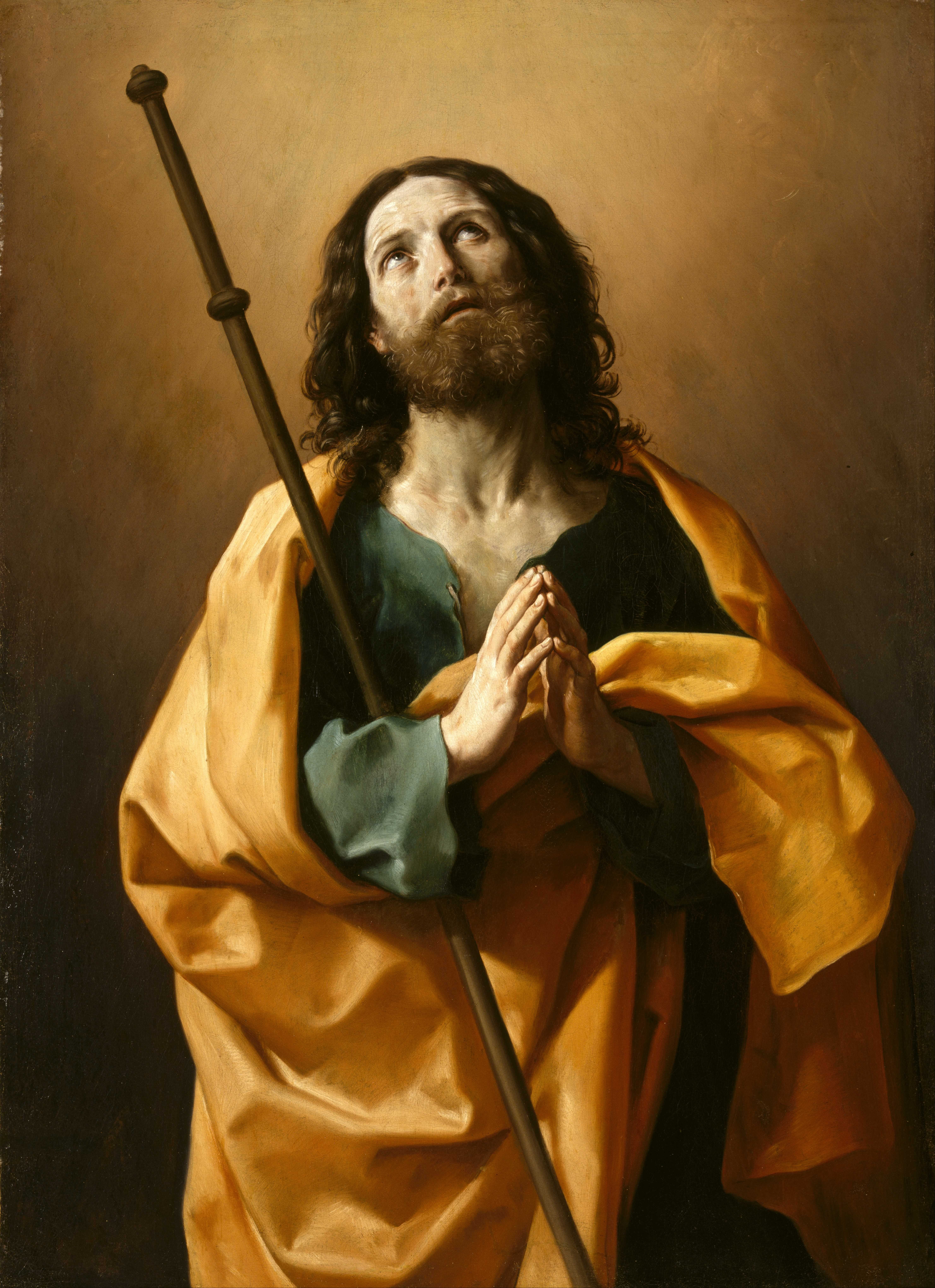
[Image: St James the Greater, by the Italian artist Guido Reni — an example of 17th-century Baroque sacred art.]
These, then, are the three traditions: the iconographic, the Gothic, and the Baroque. We have seen what unites them — each strikes, in its own way, the balance between naturalism and abstraction proper to sacred art. What we have not yet seen is what accounts for the differences between them, and why these three, and not others, are the traditions Benedict identifies. In the next of these two articles, I will turn to that question, drawing on the anthropology of John Paul II’s Theology of the Body, and will explain why the High Renaissance, so often regarded as the summit of Catholic art, does not belong on the list.