


The first of two related articles on the iconographic tradition of sacred art. This first article addresses what icons actually are, where the tradition came from, the modern myths that have grown up around it, and the theology that accounts for its distinctive visual language. The second will examine the revealed images “not made by human hands” — above all Our Lady of Guadalupe, which I take to be among the strongest arguments for the authenticity of the tradition.
When people today talk of ‘icons’ or ‘holy icons,’ what many have in mind is the style commonly associated with the Eastern Church, especially that of the Greek and Russian Orthodox Churches. In fact, the iconographic tradition took root across the Christian world, East and West, before Russia existed, and was not limited to the Greek Orthodox Church.
As Christianity became the dominant religion of the Late Antique classical world, a distinct style of art, an adaptation of contemporary Roman art, emerged, and by the early 5th century AD it had become the universal standard for liturgical art across the Christian world. This is the style that became known as icons today and, broadly speaking, is associated today with the Orthodox and Byzantine Catholic churches.
As with so much of Christian culture, the liturgy is the driving force behind the tradition, in that what gives it authenticity as a style is its role as a complement to right worship. Yet, as with Christian culture more broadly, we see variants responsive to particular local cultures and times, all consistent with the broader principles that characterize it and make it authentically liturgical. In the Latin West, sacred art up to about the 12th century — encompassing, for example, the Anglo-Saxon, Celtic, Ottonian, Carolingian, and Romanesque styles — was all consistent with the iconographic prototype. Most non-Roman Churches in the Christian East have their own styles, too. Beyond the Greek and Russian Orthodox traditions, one thinks, for example, of Coptic iconography from Egypt as a particularly distinctive variant. Not only are these national styles distinguishable from one another, but within each there are typically distinct regional variants as well.
It is important to distinguish between the use of the word ‘icon’ as a generic term for any work of sacred art that is worthy of veneration, as we might use it in considering the decrees of the Seventh Ecumenical Council, and its use to denote a particular style of sacred art. In translations of the writings of St John of Damascus and the deliberations of the Seventh Ecumenical Council in the 8th century, and of Theodore the Studite in the 9th century, the word ‘icon’ is best understood as interchangeable with the English word ‘image.’ It is not being used to denote a particular style of sacred art or to elevate any one style above another. Everything the Council documents about, for example, the necessity of having sacred art in our churches and the criteria by which that art is worthy of veneration applies to all liturgical art. The theology the Council articulates is therefore a general theology of images.
In what follows, when I refer to icons, I mean sacred art in the iconographic style. Before considering how to identify that style and distinguish it from the other legitimate forms of liturgical art, the Gothic and the Baroque, I want to address a few misunderstandings and myths about icons so that we are clear about what we are discussing.
The Creative Retrieval of Iconography
The theology of the iconographic style, developed to account for the stylistic elements that characterize the tradition, is a relatively recent development. It may surprise many to learn that, to my knowledge, no such formulation appears in the writings of any Church Father, East or West, until theologians in the 20th century began to develop the theology of icons. This does not necessarily mean there was no shared understanding of the governing principles prior to that; there may well have been. Yet if there was, no record of it has come down to us.
A group of Russian Orthodox expatriates living in France in the mid-20th century developed what is now generally accepted as the theology of the iconographic style. This group included prominent figures such as the theologians Paul Evdokimov, Vladimir Lossky, and Leonid Ouspensky, who was both a painter and a theologian, as well as the icon painter Gregory Kroug. They were responding to what they saw as the steady degeneration of the iconographic tradition in the Eastern Churches over centuries and wished to reestablish it authentically.
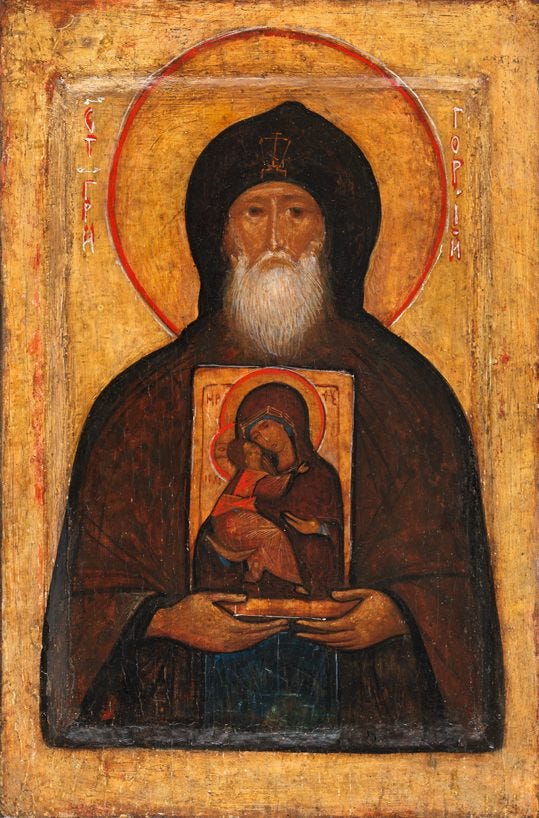
Unlike the West, which saw the development of Gothic and then Renaissance traditions from the 11th to the 16th centuries, the art of the Eastern Church did not undergo these transitions. However, the effects of the Enlightenment, which came after the Renaissance, were felt in the East, particularly in Russia, through the efforts of reforming rulers — Peter the Great and Catherine the Great especially — who looked to Western Europe as their model for modernization. Arising from this, there was an increased naturalism in iconography which, unlike the naturalism of Gothic art, was not carried out in accordance with a truly Christian understanding. The result was a style that is neither properly naturalistic nor properly iconographic.
Russian painters of the 19th century noted this degeneration, and arguments were made to abandon the iconographic style altogether in favor of Western naturalism in sacred art. For a while, Orthodox churches were adorned with 19th-century naturalistic styles. While this may have produced fine results in secular painting — the Russian traditions of portraiture and landscape in this period were indeed spectacular — they jarred with many Orthodox Christians, who felt that this naturalistic style of art undermined their worship. By the turn of the 20th century, commentators once again argued for the reestablishment of a purer, more authentic iconographic tradition. This process of creative retrieval, begun in that period, was interrupted by the Bolshevik Revolution, and it was not until the mid-20th century that the expatriates based in Paris who had escaped from Russia, including those already mentioned above, were able to work toward a change.
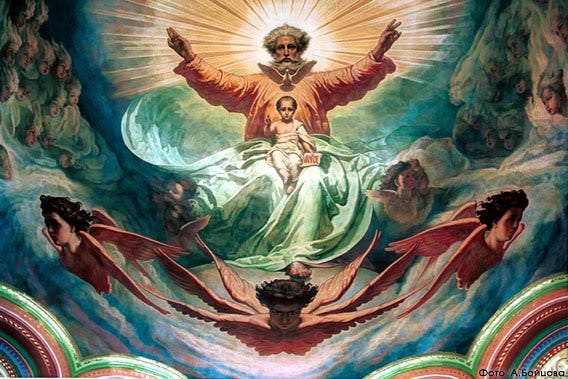
Their approach was first to establish a canon of imagery they considered the epitome of the style (generally Russian icons from the 15th century). By analyzing the common features within this canon, they developed a theology to explain them, hoping to define a set of principles that would allow both conformity to the tradition and the legitimate organic development of styles within it, as needed by the Church in particular times and places.
It is a tribute to the work of this small group of pioneers that the painting of icons has developed so authentically that many people today wrongly assume that the iconographic tradition of the Eastern Churches has been passed down through an unbroken line since St Luke painted the first icon of the Theotokos. We are now in the third or fourth generation of icon painters who have passed these principles down from teacher to pupil since those 20th-century pioneers, and the best of them are creating work today that is as beautiful and significant as that of the great iconographers of the past.
Because of the success of the pioneering Russians based in Paris, iconographers from other Orthodox and Eastern Rite churches were influenced by their work. Among these were the Greek painter Photis Kontoglou, who contributed to the reestablishment of a flourishing Greek iconographic tradition, and the Egyptian Isaac Fanous, who did the same for the Coptic style.
I have long felt that their approach should serve as the template for Roman Catholic Christians to reestablish their Western traditions of Gothic and Baroque art today. My own analysis of those traditions is based on the work of those 20th-century Russian theologians and is my attempt to begin that process.
The Modern Myths of Iconography
The mystique that so many contemporary Roman Catholics and Protestant Christians associate with iconography has also emerged from this recent period, and bound up with this are several modern myths about icons. These include the ideas that you have to be Orthodox to paint icons well, that you have to be a monk to paint icons, that you must ritually fast and pray before painting an icon, and that the true iconographer does not paint icons but only ‘writes’ them.
Is it true that only Orthodox Christians can paint icons successfully? I would certainly agree that someone who regularly worships with sacred art is more likely to paint it well. This does place Roman Catholics at a disadvantage. Unless a Roman Rite Catholic prays the Divine Office with an image corner at home, he will almost certainly not have the opportunity to do so in the Roman liturgy as it is generally celebrated today, even if there is beautiful art in the church. This therefore greatly favors Orthodox and Eastern Rite Christians, although in principle it does not preclude others from painting icons well; in fact, there are several excellent Catholic iconographers today.
Can only monks paint icons? While a monk’s spiritual life is likely to be compatible with that of an artist who wishes to pursue his vocation, it is not the only form of Christian life that can offer such formation. A devout and sincere layman might flourish as an artist too, and there are many fine icon painters today who are not monks.
On the question of fasting and praying: while there is no accounting for whom God may choose to inspire, or which individual will respond well to that inspiration, the greatest chance of a good response lies with those who lead good and holy lives, and typically this involves regular fasting and prayer. However, this principle is not uniquely applicable to artists; it applies to every aspect of the Christian life and to every Christian. Icon painters should fast and pray regularly, as all Christians should, but this is not a special requirement peculiar to icon painters.
On whether we ‘write’ or paint icons: this question arises from the fact that the Greek and Slavonic words for creating an icon carry no distinction between the two activities, and could legitimately be translated as either writing or painting. One well-known Orthodox iconographer told me that he considered the insistence on the word ‘write’ to be ‘a bit precious.’ As far as he was concerned, if someone uses a paintbrush to apply paint, the English word for that activity is painting, and it does not diminish the standing of the profession to say so. On the contrary, when the icon is beautiful, and we venerate it as we should, that elevates the role of the painter of icons to one of the highest importance, regardless of what we call the process of creating them.
There is also an associated myth that overstates the role of a theology of method, as distinct from the theology that governs the style of the finished image. Some, for example, hold that the image must be created by starting with a dark base and adding layers of lighter color, because God created Light out of darkness. There is no basis for this. A painting is as good as it looks, and if the finished work is good, the method by which it was made is of secondary importance. This is confirmed by modern X-ray analysis of authentic and ancient icons, which shows that painters of the past used a wide variety of methods to produce authentic work.
A Short Summary of the Theology of Iconographic Style
So what is the theology of icons? The iconographic style expresses a desire to present man in full union with God, that is, eschatological man. Consider the Transfiguration icon below, painted in Yaroslavl, Russia, in 1516.
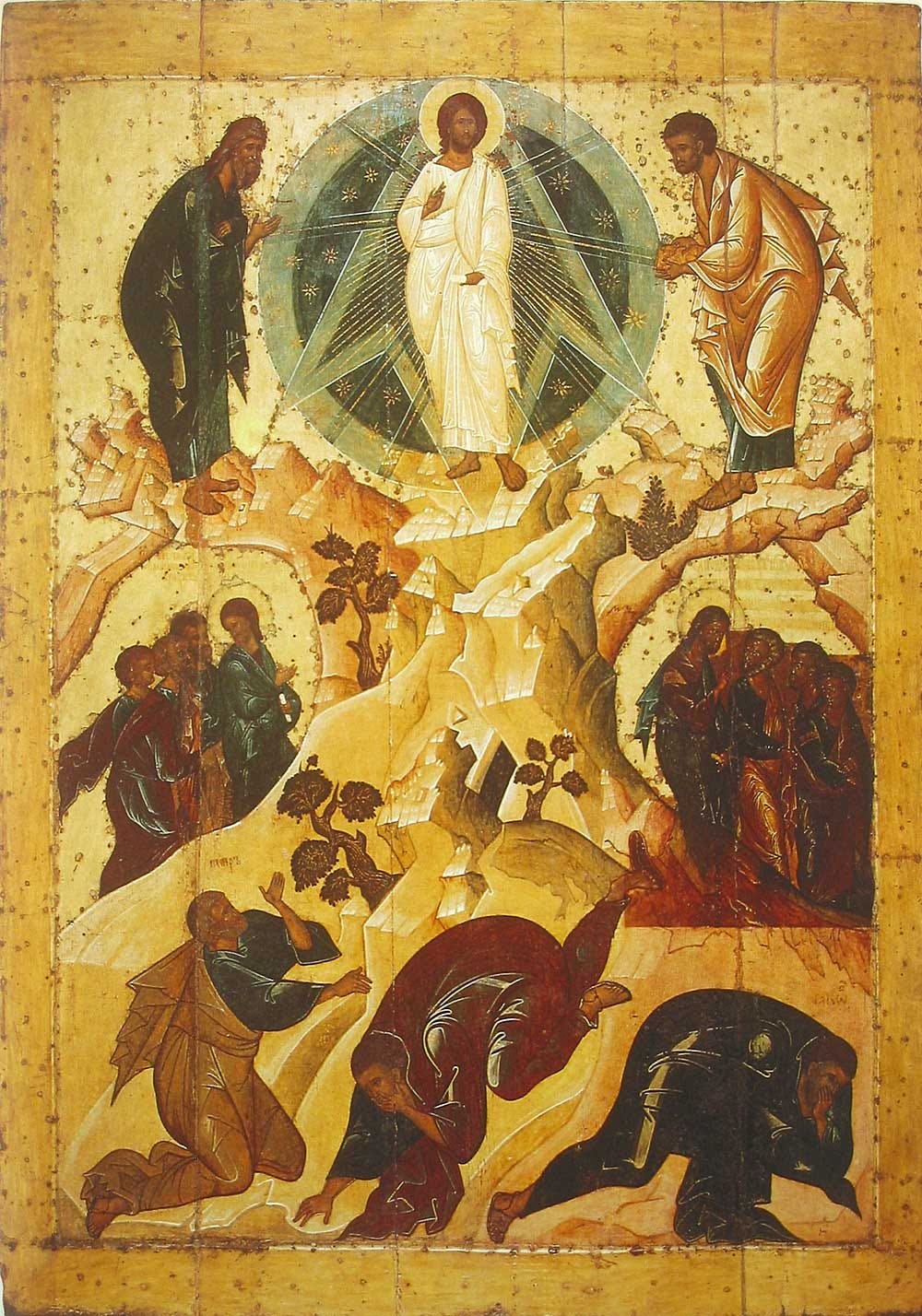
The nimbus around Christ darkens toward its center, reflecting a theological point about the nature of divine light. Christ in the Transfiguration is understood as the prototype for all iconographic imagery, and the principle extends further, since all saints shine with the light of Christ because, as baptized Christians, they have ‘put on Christ’. The halo, typically a gold disc around the head, is a stylized representation of the light emanating from the person. In the Transfiguration icon, the prophets and Christ bear halos, while there is a convention that before Pentecost the apostles do not, though they are still portrayed as saints in other respects: there is no cast shadow from any figure, since each is his own source of light, and we see the floating sparkles of uncreated light on their clothes and bodies.
To convey the heavenly dimension, which is outside time and space, the image avoids creating the illusion of depth. The artist paints the image so that it lives, as it were, in the plane of the surface. Rarely does an iconographer use single-point perspective, in which things diminish with distance; he will often use inverted perspective instead, in which things appear wider as they recede.
The size of the beings and creatures portrayed varies according to the hierarchy of being, a feature often referred to as hierarchical perspective. Christ is the largest figure, while trees and mountains are shown smallest relative to their natural size. Even inanimate objects, such as trees and mountains, can be shown bowing toward Christ, indicating that each owes its existence to him and further reinforcing our sense that each has its place in the hierarchy of being. The negative space around the figures is usually a single color, often gold leaf, with minimal indication of the location. The gold or other single-color background reinforces the sense of flatness, and the environment is suffused with light, an effect accentuated by gold leaf that reflects candlelight, causing it to shimmer as though it were a source of light in itself. Some variants, particularly Western variants, have complex patterned backgrounds that achieve the same end — the sense of flat negative space around the figures.
The sense of another world is further heightened by placing the figures in the middle distance. No matter how near we approach the image, there is always some sense of distance between us and the closest figures depicted; they seem to recede as we draw closer. Even with our faces pressed against the surface, they remain some way from us. This creates a dynamic between us and the icon when we pray with them, for it instills in us a longing to be with the saint. This is a longing that finds its fulfillment only in heaven.
All icons aim to portray heavenly realities. Heaven is a realm in which time is compressed into a single moment; past, present, and future are perpetually in a single moment. It is difficult even to imagine this, but it is possible to reflect this mystery. A way to do so is to present a full narrative with different scenes from a story portrayed simultaneously in the image, even though, in real time, they happened sequentially. What took place over an extended period appears in a single image. This might be useful in an icon of the life of a saint, for example. It is common for an important event in the saint’s life to be the largest image, with several miniature scenes of other events from his life around the periphery.
Consider now another image. This icon of the Mother of God with Christ is known as the Vladimir Mother of God. It was painted in Constantinople around 1100 AD, brought to Russia, and became the prototype and model for Russian iconography.
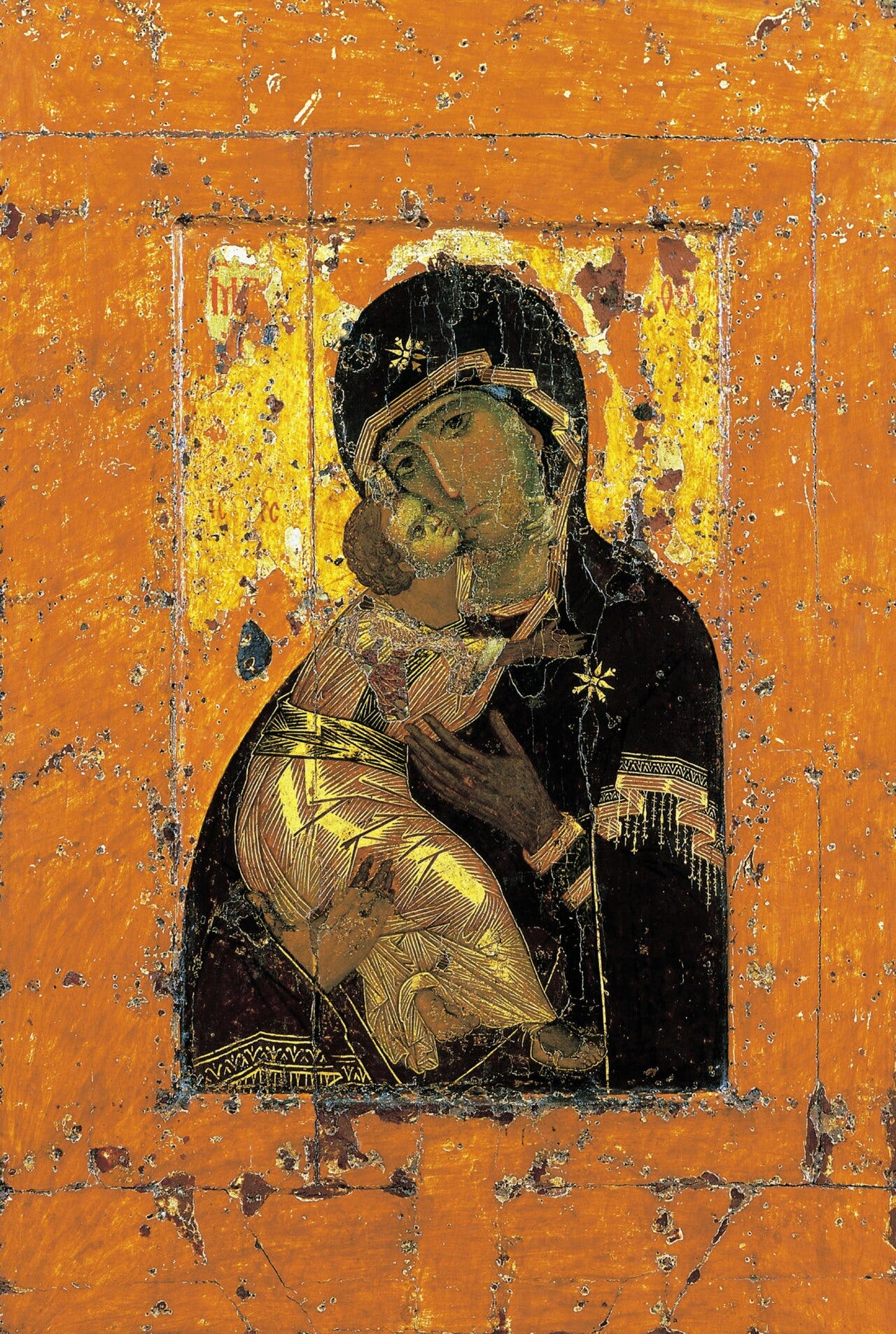
[Image: The Vladimir Mother of God, Constantinople, c. 1100 AD. The prototype for Russian iconography.]
The first thing to notice is how the Theotokos, who bore and gave birth to God, expresses a contentedness tinged with melancholy. This is called ‘bright sadness’ and is intended to convey that the saint lives in eternal bliss but nonetheless feels compassion for those who are not yet with God. The saints want us to join them, and they are happy to intercede for us so that it might happen.
The proportions of the person's features are subtly modified to communicate holy wisdom. The wise man reflects on God’s will before acting. To convey this aspect of wisdom, the receptive organs are relatively large, while the active ones are smaller. Therefore, the eyes are enlarged, and the nose, which inhales the fragrance of heaven, is elongated slightly, and the ears, if they are visible, are slightly larger than they would be naturally. (Typically, we don’t see Our Lady’s ears.) In contrast, the mouth and hands are made smaller. This is not to say that saints are inactive; when they act, their actions are effective. Rather, it speaks of an economy of effort in which nothing is wasted. And similarly, while there is no superfluous word coming from the mouth of a saint, every word that is spoken is golden.
We also see that Christ, though a child in his mother’s arms, appears as a little man. This indicates the paradox that, though human and physically immature, he is still fully God.
Another feature of icons is that the faces of saints are always portrayed in either a full or three-quarter view, so that both eyes are clearly visible. This symbolizes the idea that in heaven we can behold another and know them fully; nothing is hidden, and we are fully known to all others. Only the devil would be shown in full profile. (This is one feature that differentiates early Gothic art from iconographic art. Gothic artists, in order to portray a more naturalistic three-dimensional setting and the sense of a more lifelike interaction between the figures in the composition, gradually begin to place some of those key figures in profile.)
These stylistic devices in icons draw out realities that would otherwise be invisible. The modification of natural appearances, therefore, produces a greater realism than any naturalistic painting or photograph could achieve.
It is common for people who cannot draw well to want to learn to paint icons, assuming that draftsmanship matters less in this tradition, but this is not the case. The artist must not be tempted to use the style to conceal a lack of drawing ability. It takes great skill to reflect visible and otherwise invisible realities in the same painting, so that the two aspects support rather than undermine each other. Our figures must both sparkle with the uncreated light of Christ and read anatomically, just as the drapery must hang and fold as it would naturally around the figure.
Here is another common image of Christ, known as the Mandylion.
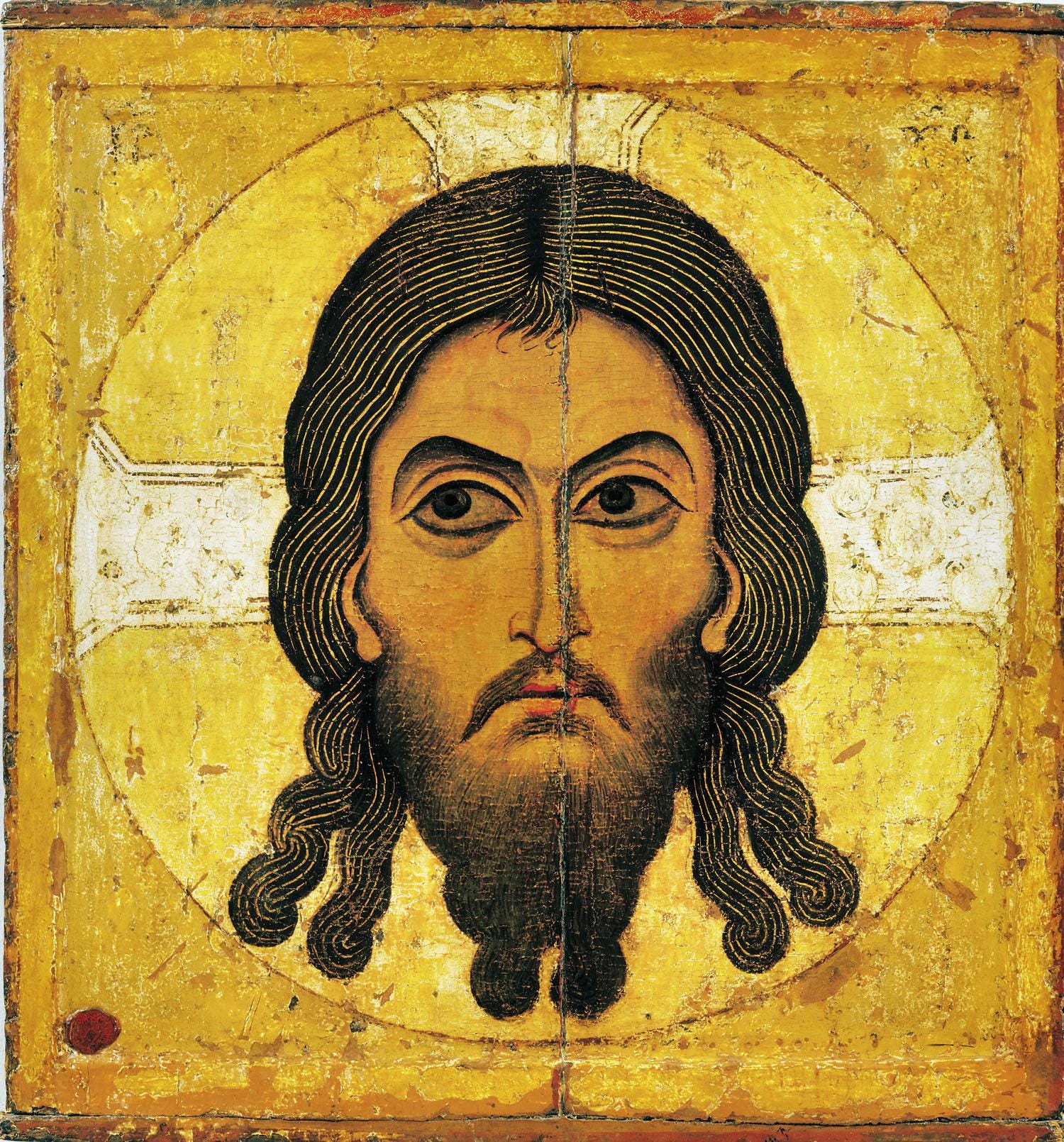
[Image: The Mandylion (Christ Acheiropoietos), 12th century, Russia.]
The name comes from the archaic Greek term for ‘cloth’ or ‘towel’ and refers to the tradition that the prototype of this icon was a cloth pressed against the face of Our Lord, and that the image was miraculously transferred to it. It is perhaps the most famous of the icons called acheiropoietos, meaning ‘not made with human hands,’ images that are revealed rather than painted. Notice how stern Christ appears. This sternness is sometimes employed in the depiction of Christ to indicate that he is a judge. It must never be excessive, because we also wish to convey that he is a just judge and that divine justice is always tempered with great mercy.
In common with all authentically liturgical art, there is a general disposition against innovation and originality for their own sake. New icons are created only as needed by the Church, for example to portray a newly canonized saint. The icon painter always reproduces the prototype with an understanding of the ideal it is intended to express and always aims to portray the ideal as best he can rather than a simple copy of another work of art. Accordingly, the goal is to create something greater than that which he copies.
These revealed images — the ones said to be “not made with human hands” — raise a question that goes to the heart of the whole tradition: does what we see in an icon actually correspond to what Christ and the saints are like in heaven, or is it simply an internally consistent system of symbols? That question, and the most remarkable of these revealed images, Our Lady of Guadalupe, are the subject of the second of these two articles.
Thank you for sharing.