


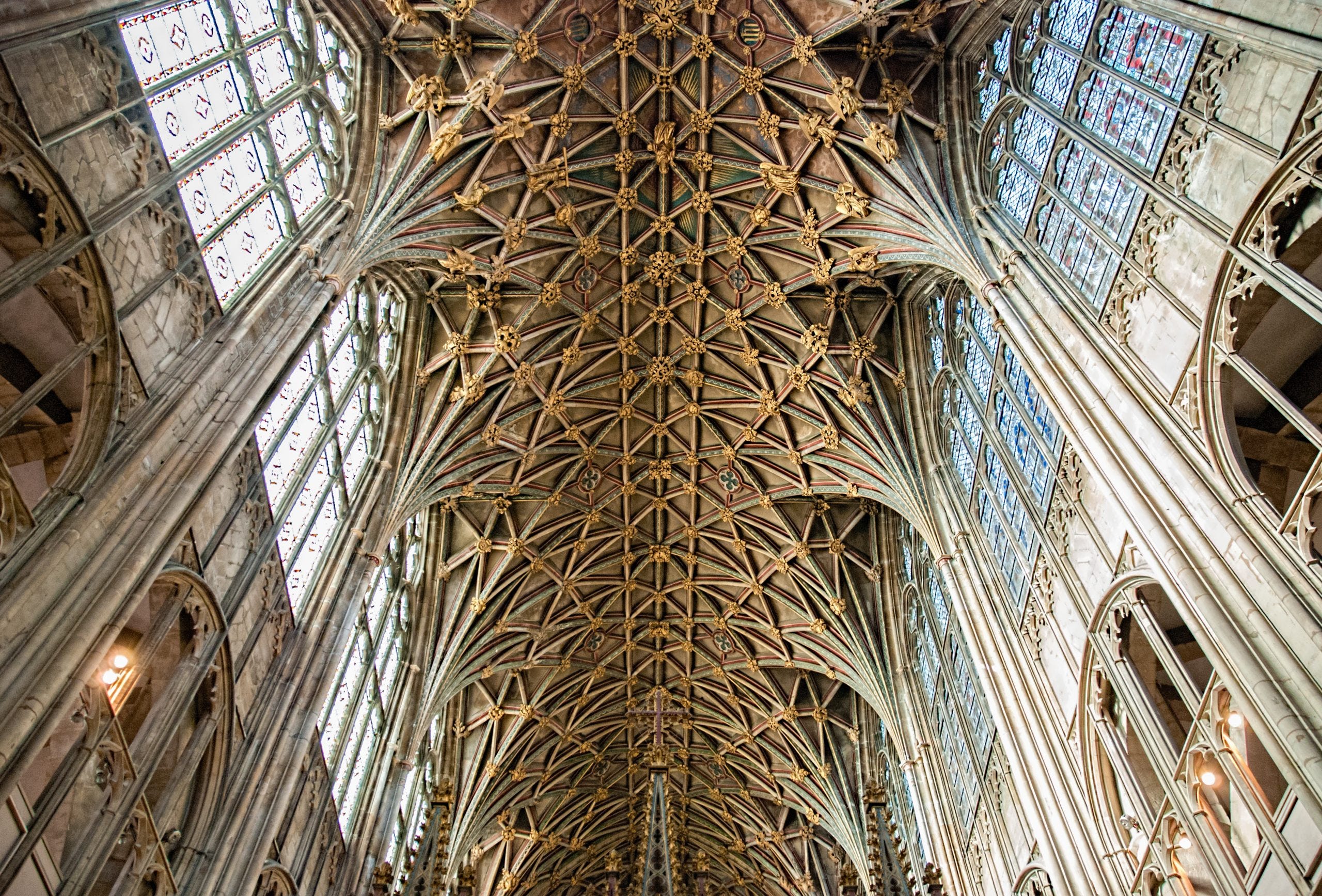
This is the first of six posts on the mathematics of beauty1: the traditional body of knowledge, running from the ancient Greeks through the Church Fathers and into the design of Western art and architecture, which held that beauty has a mathematical structure and that this structure can be studied, learned, and applied. It was a standard part of an artist’s and an architect’s formation for centuries. Today it is virtually unknown, and I think its recovery is essential if we are to build beautifully again.
As six posts devoted to a single subject is a lot to post on consecutive weeks, I will post them on alternate weeks.
In this first post, I want to establish the problem by looking at some buildings, and to say something about how this tradition relates to natural science, which is the other great tradition of describing the world by number. The posts that follow will set out where the tradition came from, what it consists of, how it is used in practice, why it was abandoned, and what its recovery would mean.
If you examine almost any building constructed since the Second World War, the chances are that it will conform to one of two simple guiding principles of architectural design, and in both cases, the results are often bad. These two principles are even spacing and random spacing. The first generates visual monotony; the second generates visual cacophony. I have chosen these terms deliberately to set them against what traditional architecture always sought to achieve instead: harmony.
The goal of an architect working within the traditional approach was to create visual harmony through the appropriate proportioning of parts. This harmony is achieved by relating parts of differing magnitudes so that there is a discernible conformity to a pleasing pattern. The intention was for the pattern of the building’s parts to reflect, or in philosophical language to participate in, the beauty of the cosmos. For the Christian, if his work participates in the idealized beauty of the cosmos, it participates in turn in the pattern of divine beauty itself, for God is the Creator who made the cosmos and left his mark upon it. And it was always assumed that this beauty could be expressed mathematically. This assumption is captured in a famous passage from St Bonaventure’s Itinerarium Mentis in Deum, written in 1259:
Therefore, since all things are beautiful and in some way delightful; and since there is no beauty or delight without proportion; and since proportion resides first of all in numbers, all things must involve number. From this, we conclude that number is the principal prototypical form in the mind of the Creator, and in creatures it is the principal vestige leading to Wisdom. [St Bonaventure: The Journey of the Mind into God, Chapter II, S,ection 10.]
The traditional mathematics of harmonious proportion has its origins in ancient Greek mathematics and was used, in one form or another, as the foundation of design in art and architecture in the Christian West, largely unquestioned, until the modern period. Around the end of the 19th century, architects, artists, and composers who considered themselves part of the avant-garde began deliberately to reject traditional forms as part of a wider rejection of traditional Western values, and by the mid-20th century, the mathematics of beauty as a principle of design was no longer taught and is today largely unknown.
An understanding and appreciation of the traditional mathematics of beauty are, in my view, vital to re-establishing a culture of beauty today. A deep grasp of these principles will allow architects who do not wish to conform to the anti-Western, anti-Christian orthodoxy of the modern age to create works of art and architecture that are simultaneously beautiful, traditional, contemporary, and innovative. These attributes are not, as some might suspect, mutually exclusive.
Two Ways of Describing the World by Number: Analysis and Synthesis
Before going further, it is worth addressing a question that will occur to many readers. If beauty has a mathematical structure, how does the study of that structure relate to the other great tradition of describing the world by number, which is natural science? The two are not rivals. They are complementary approaches to the same created order, and both rest on the same foundational assumption: that the world is intelligible to the human mind and ordered according to number. That assumption is not a modern discovery. It is stated plainly in the Book of Wisdom, where it is said of God that he has ‘ordered all things by measure and number and weight’ (Wisdom 11:20). The natural scientist and the student of the mathematics of beauty are both, in different ways, taking that verse seriously.
Where they differ is in method, and the difference is best described as one of analysis and synthesis. Natural science proceeds characteristically by analysis. It isolates a part of the cosmos and describes it in detail; where it cannot describe what it has isolated, it isolates something smaller still, and then, by inductive reasoning, concludes that the whole behaves as its parts do. This has proved an extraordinarily powerful method, and I do not raise the point in criticism. It is the right method for its object. (It is worth noting in passing that the assumption behind it appears to break down at the quantum level, where the whole is not, so far as we can tell, simply the sum of its parts; but that is a subject for another discussion.) The traditional mathematics of beauty works in the opposite direction. It is a principle of synthesis. It orders the parts to the whole, helping us to describe the relationships between things and their relationship to the totality of which they are members. Science takes the whole apart to understand it; the mathematics of beauty puts the parts together so that the whole is well made.
These two movements of the mind are not in opposition, and in practice they depend on one another. The impulse to analyze does not arise from analysis. It arises from curiosity, and curiosity arises from awe and wonder at the beauty and order of what the scientist is looking at. And at the far end of the process, when the analysis is complete, scientists routinely take the beauty of a solution as an indication that it is likely to be true. Neither the beginning nor the end of scientific work is itself an act of analysis. Both are acts of aesthetic perception.
There is a further point, which concerns the symbolic dimension of number. The mathematics of beauty, as I will describe it in these posts, treats number not only as a quantity but also as a sign. In doing so, it connects the mathematical order of the universe, however that order is described, to what lies beyond the physical. This does not undermine natural science or contradict any of its findings, and it does not ask the scientist to accept anything his own discipline forbids. What it does is add a dimension of meaning to what he is already doing. A scientist who understands his equations as descriptions of an order that is itself a sign of its Author is doing exactly the same science as one who does not, but he is doing it in a world that makes sense. I return to this comparison at greater length in the final post of the series.
We Recognize Traditional Harmony and Proportion When We See It
Ask a random selection of people what they know about the mathematics of beauty, and you are likely to get blank stares. On the other hand, show them a selection of buildings and ask which ones they would prefer to live in, work in, or pray in, and most will pick the designs that incorporate traditional harmony and proportion, provided that your sample group is not dominated by people whose training in art, music, or architecture at a modern university has instilled in them a deep distaste for traditional forms.
To demonstrate, consider two cities: Oxford and Florence. Both have a large number of traditionally proportioned buildings in their historic centers and many modern buildings, often fulfilling the same functions, on their outskirts. According to the respective city websites, Oxford attracts something like 9 million visitors annually, and Florence slightly more, around 10 million. The vast majority of tourists to either city go to see the older buildings in the center, not the newer ones on the periphery. While historical interest draws many, the beauty of the buildings and the overall environment they create is the real attraction. Whether they know it or not, visitors are responding to the traditional design principles that govern famous buildings such as the Radcliffe Camera in Oxford and the Duomo in Florence.
Harmony: Ditchley House
Once we know what to look for, we can usually recognize traditional proportions. Consider first Ditchley House, built in 1722 in Oxfordshire, England:
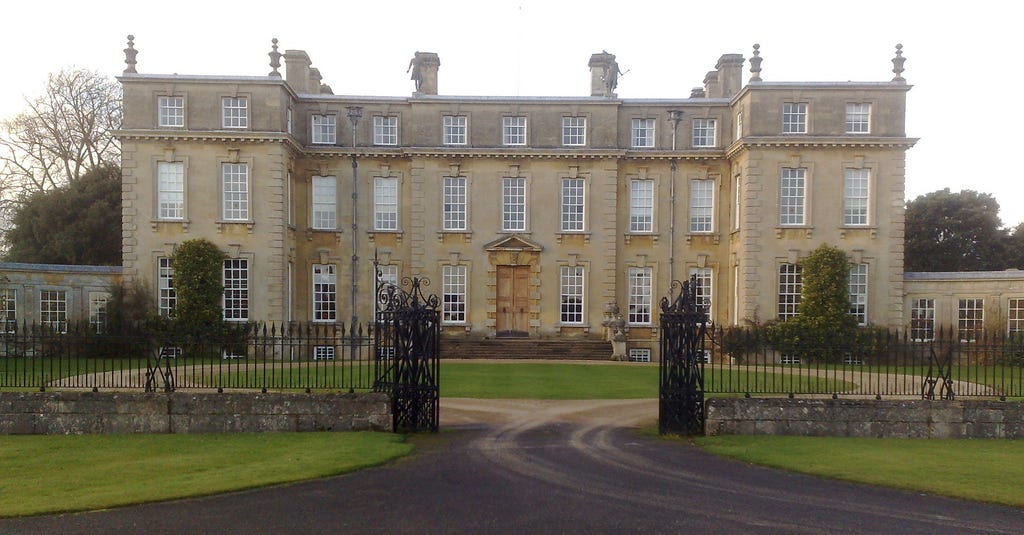
Ditchley House, Oxfordshire, built 1722. A classic example of harmonious proportion in Georgian architecture. [By jeffjarvis - originally posted to Flickr as ditchleyfront2, CC BY 2.0, https://commons.wikimedia.org/w/index.php?curid=6249801]
What we see here is a classic manifestation of visual harmony: like a musical chord comprising three different notes, each story has a different magnitude, and the combination is, to my eye at least, pleasing. If it pleases you, too, then you are responding to the traditional mathematics of beauty. The architect who designed this certainly intended to employ these principles.
Monotony
Contrast this with the following building, a multi-story parking garage built more recently, in which every story is evenly spaced.
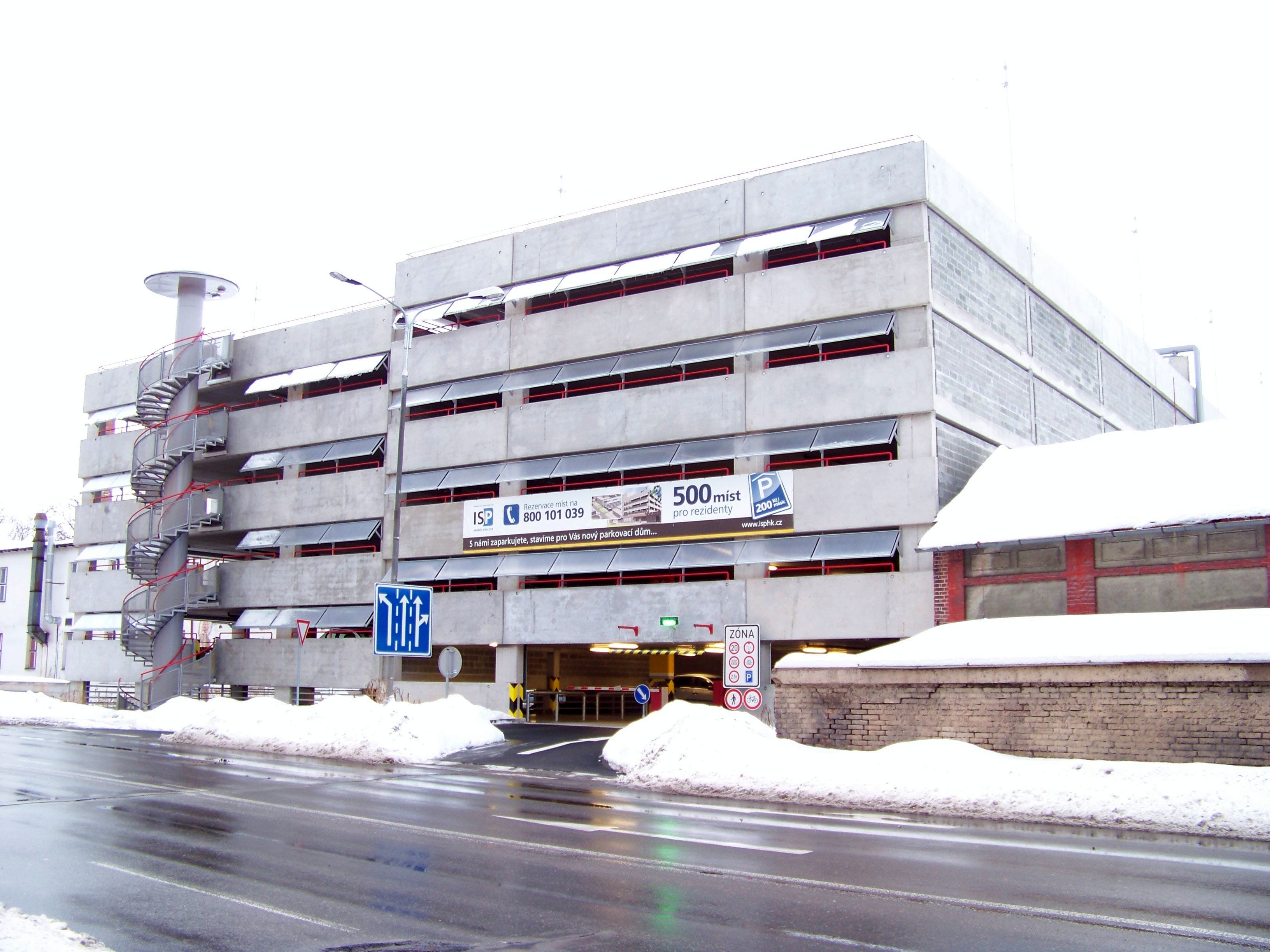
Multi-storey car park. [Attribution: By cs:ŠJů – Own work, CC BY-SA 3.0, https://commons.wikimedia.org/w/index.php?curid=9390088]
I would characterize this building’s design through another musical analogy. It is a visual manifestation of a string quintet in which five identical violins play the same note. However clean and pure that note might be, however perfectly rendered, it quickly becomes dull. It is, quite literally, monotonous: the word means ‘one tone’ or ‘one note.’
The building below operates on the same design principle but on a grander scale, producing the visual equivalent of a vast Mahler-scale orchestra consisting of a single instrument: a hundred violins all playing the same note. Replicating that note a hundred times does not make it less monotonous. When it is blasted at us through a megaphone, as it is here, we cannot ignore it, and it obliterates whatever might be beautiful around it. It becomes aggressively bland to the point of being offensive.
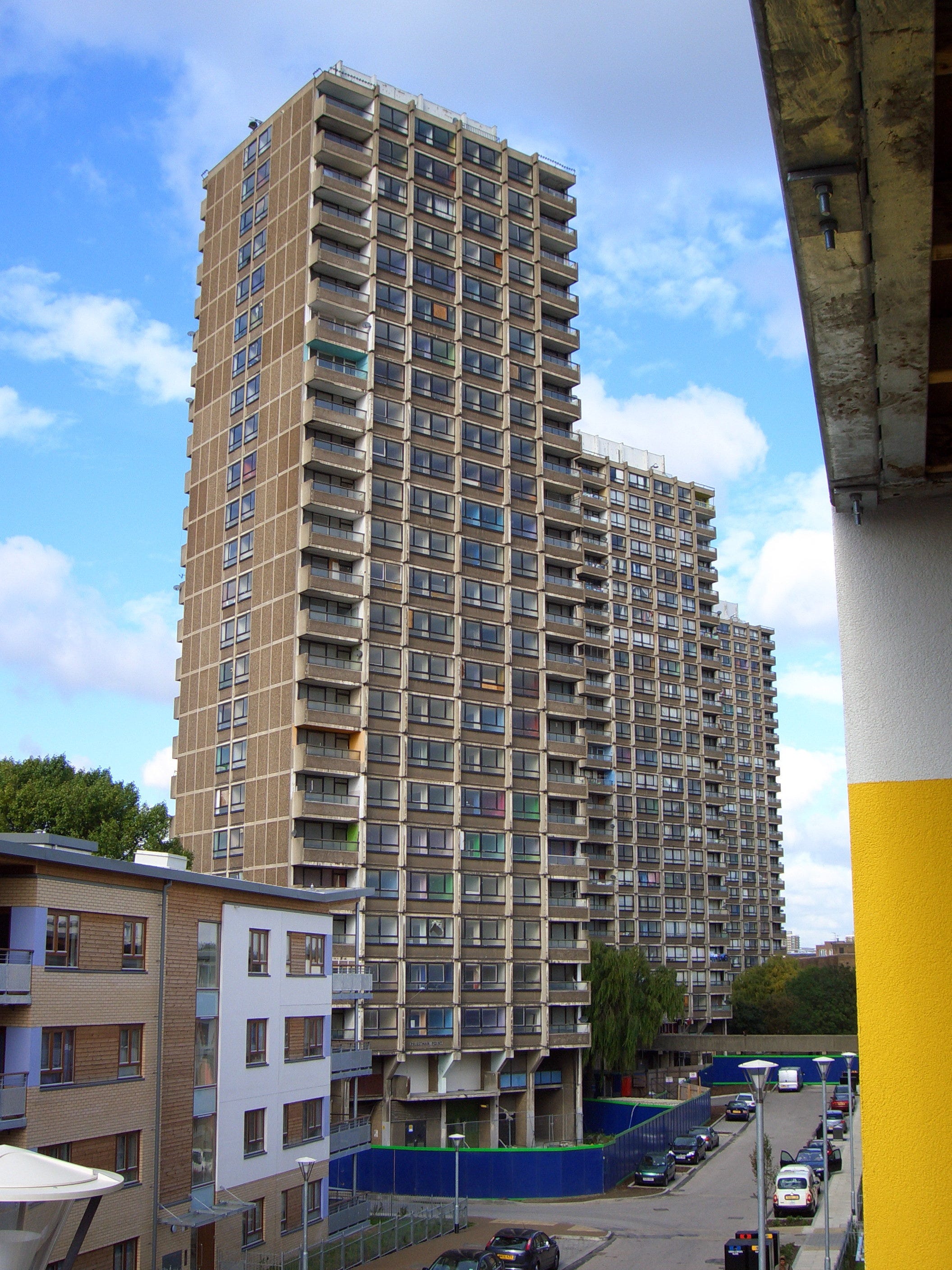
Crossways Estate – an example of visual monotony achieved through even spacing at scale.
Cacophony
Here is an example displaying a different design principle:
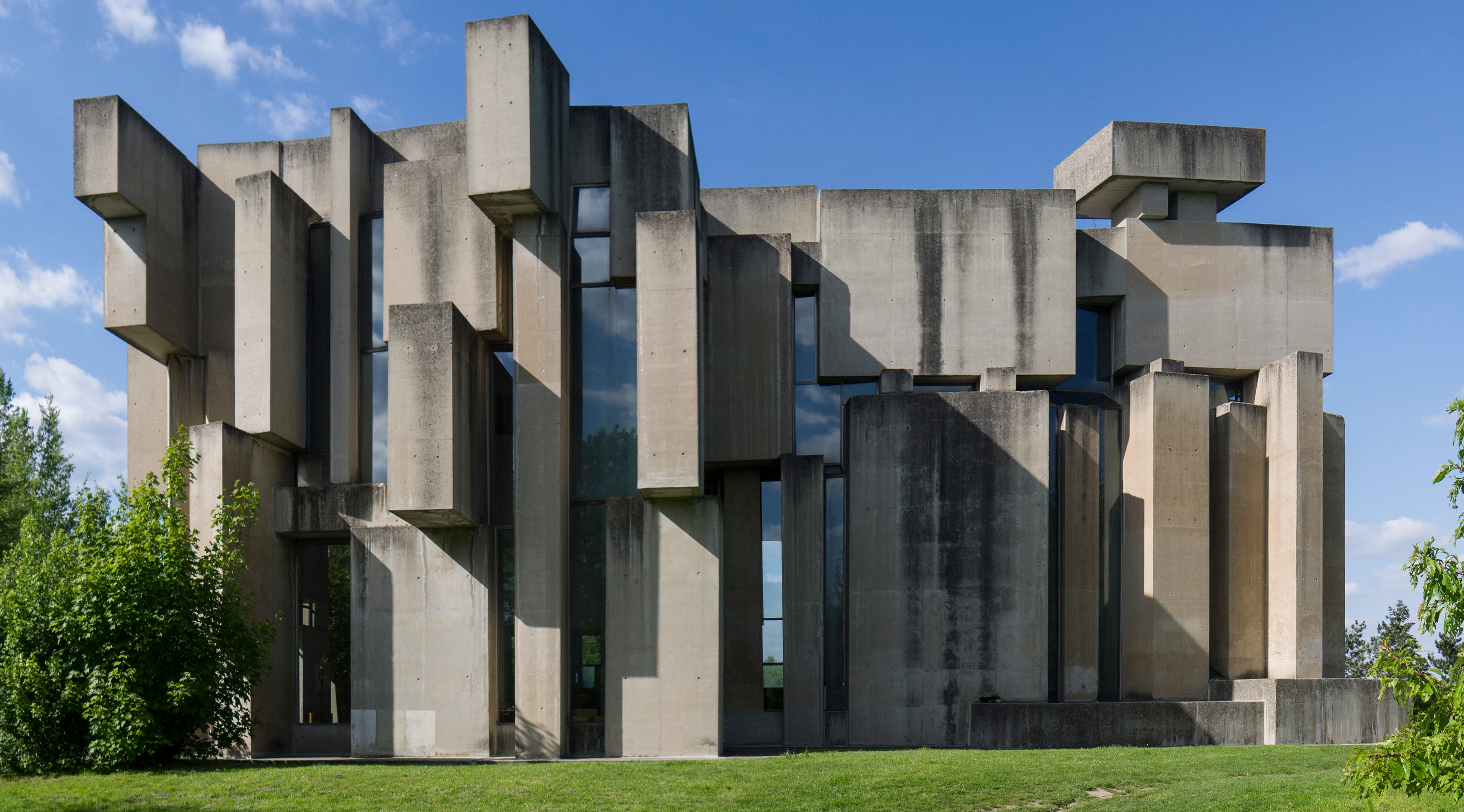
The Wotruba Church, Vienna. Could you guess its purpose before being told?
It is a church in Vienna. Even more surprisingly, this random design was reportedly inspired by a visit to Chartres Cathedral. It is difficult to see how exactly, unless the architect was inspired to create something as unlike Chartres as possible. The randomness of its dimensions is the visual equivalent of cacophony in music: random, unharmonious notes played together. It could not be further from the design principles of Chartres.
Does this building speak of the most noble activity a person can engage in? Does it look like a building made to house chant, polyphony, and the worship of God? I would say not. The piece of music that best corresponds to its design, as far as I can think of, is Stockhausen’s Helicopter String Quartet. See what you think…
Next time I turn to where the tradition of harmonious proportion came from: how the ancient Greeks analyzed beauty in the world around them, how their findings were taken up into Christian thought by St Augustine and Boethius, and what the terms ‘ratio’ and ‘proportion’ actually mean in this context.
There is a longer, and complementary presentation of this subject in Section II of my book The Way of Beauty