


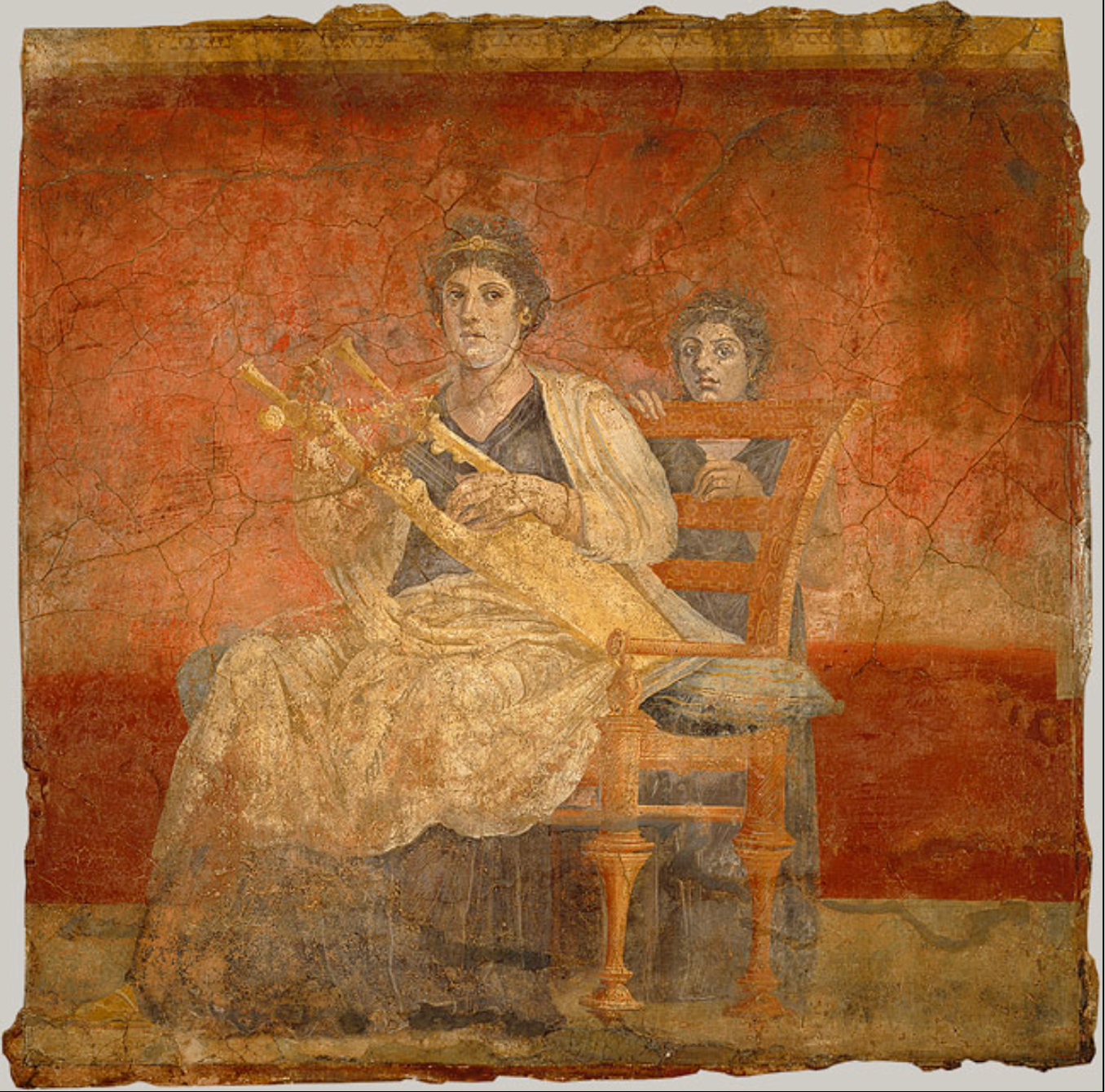
A Roman woman playing the kithara, fresco painting, c. 30-40 BC
In the previous two posts I set out the problem of modern design and traced the origins of the traditional mathematics of beauty from the Greeks through Augustine and Boethius. This week and next I want to describe the five fields of study that made up this tradition.
The Approach of the Ancients
The ancients’ analysis, enriched over centuries, was fuller and more complex than the simplistic account heard today, which tends to focus on a single proportion called the Golden Section. Traditionally, there were five main areas of study. In each case, I chose examples to highlight parallels and common elements across the fields. Christians saw similar patterns across fields as evidence that each was a manifestation of a unifying, divine, and invisible order that existed in perfection in the heavenly dimension and permeated all that exists.
The goal of the Christian was therefore not primarily to describe the cosmos or man as he is, but to look to the higher, heavenly mathematical ideals to which the analysis points. Given that man and the cosmos are affected by the Fall, one would expect some variance from these ideals in the mathematical patterns of beauty as observed in the world. The animating question in each case was not ‘What is it?’ but rather, ‘What ought it to be?’
This meant that small anomalies in observation were not troubling. Numbers were rounded to the nearest whole number, and values were adjusted to fit within a broader pattern. The calendar of days, weeks, months, and years is itself such a reconciliation: a system of numerical patterns modified to fit together, closely but not identically matching the patterns of the sun and moon that give rise to our division of time in the first place.
One further thing to note: while the ancients did observe the material world and based much of this system on its analysis, the mathematics of beauty was not restricted to the study of time and space. They were equally willing to analyze spiritual truths and abstract ideas mathematically. In his account of virtue and vice in the Nicomachean Ethics, for example, Aristotle referred to some of the same proportions Boethius later described. For Aristotle, virtue is a temperate mean between two extremes of behavior. He cites justice as the arithmetic mean between the excess of giving someone more than his due and the deficiency of giving too little: the good judge in a court of law is the mediator who discerns that mean and makes just judgments.
The five fields of study that contribute to the mathematics of beauty are: instrumental music, the proportions of man, the beauty of nature as observed in the motions and patterns of the stars, Scripture, and the symmetrical patterns embedded in the structure of mathematics itself. The ancients considered the first three categories of music, a word whose meaning was then broader than it is now. In addition to instrumental music, there was ‘human’ music, the harmony of the parts of man that gives rise to human beauty, and ‘cosmic’ music, the harmony observable in the cosmos.
Instrumental Music
Instrumental music is auditory music in the modern sense. Modern music theory confirms the ancient analysis, continues to use it, and builds on it. For example, we can examine the relative lengths of the strings on a violin or the pipes of an organ that produce notes and intervals. The fundamental harmonious intervals heard by most people as pleasing, an octave, a perfect fifth, and a perfect fourth, create ratios of string or pipe lengths of 1:2, 2:3, and 3:4, respectively. The pre-Socratic Pythagoreans were fascinated by the fact that the fundamentals of musical harmony could be expressed using only the first four numbers: 1, 2, 3, and 4. (Zero was not yet considered a number.) They believed this series contained the key to all harmony, including the harmony present in the order of the cosmos.
To represent this insight, they devised a symbol: an arrangement of four rows of dots called the tetractys, from the Greek tetra, meaning four. They also noted that the sum of these first four numbers is 10, a number they regarded as significant to man, partly because we have 10 fingers and toes.

The tetractys: four rows of dots representing the numbers 1, 2, 3, and 4, whose sum is 10.
This symbolic representation of harmony and order passed into the Christian tradition and is described by Boethius in his De Institutione Musica. A thousand years later, in The School of Athens, Raphael portrayed Pythagoras looking at a chalkboard on which the tetractys is drawn alongside a diagram of musical harmony identical to one found in a manuscript of Boethius’s De Institutione Musica.
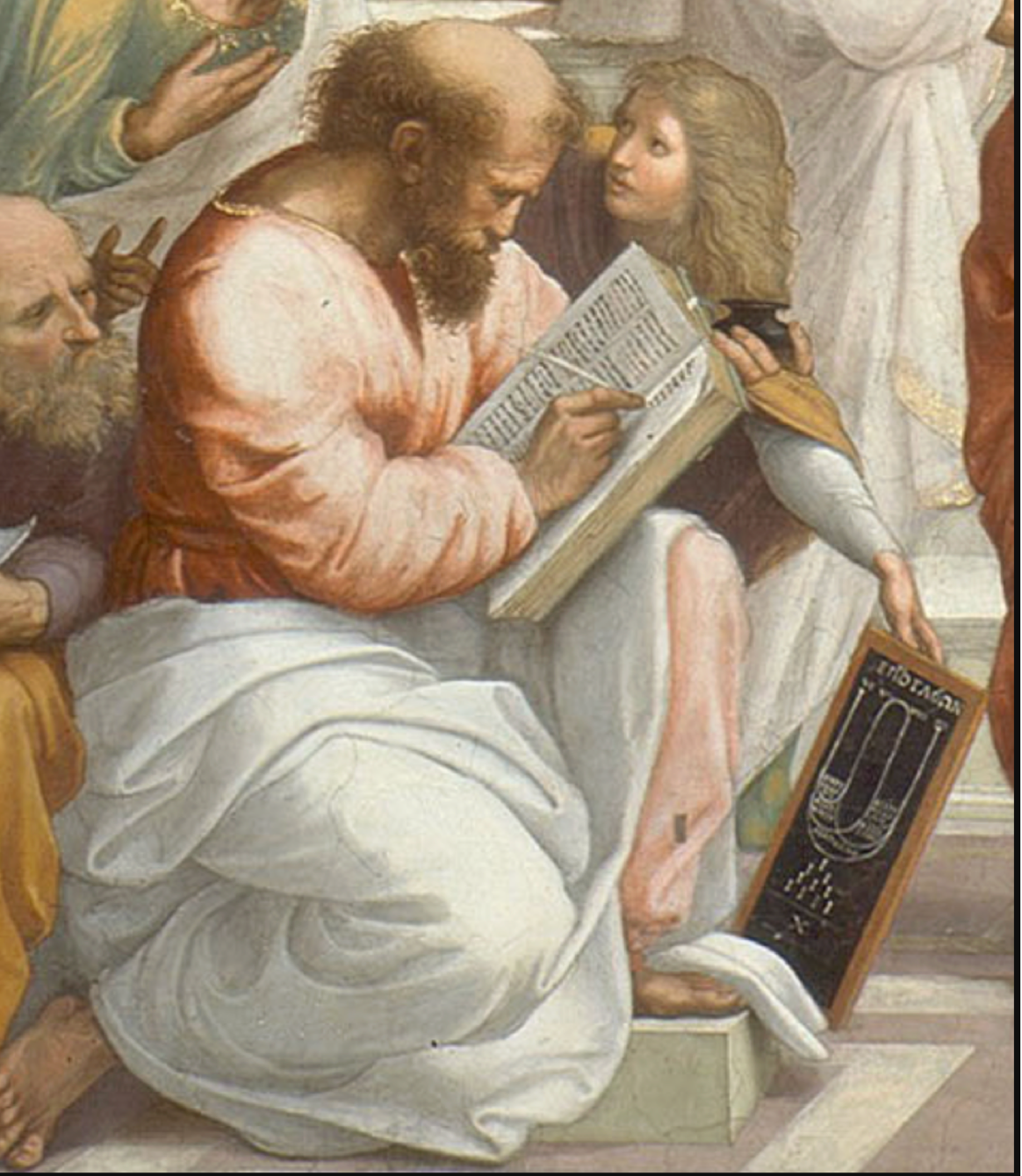
Detail of Pythagoras in The School of Athens, with chalkboard showing the tetractys and musical harmony diagram.
In Western musical theory, the standard scale contains seven notes from which those fundamental harmonies are created. The eighth note, which completes the octave, is simultaneously the last note of the previous scale and the first of the next. This parallels the pattern of the week, in which Sunday, the day of the Lord, is simultaneously the last day of the previous week and the first of the next.
We can see the fundamental musical harmony of the Pythagoreans built into architecture in Attingham House, built in Shropshire, England, in the 18th century.
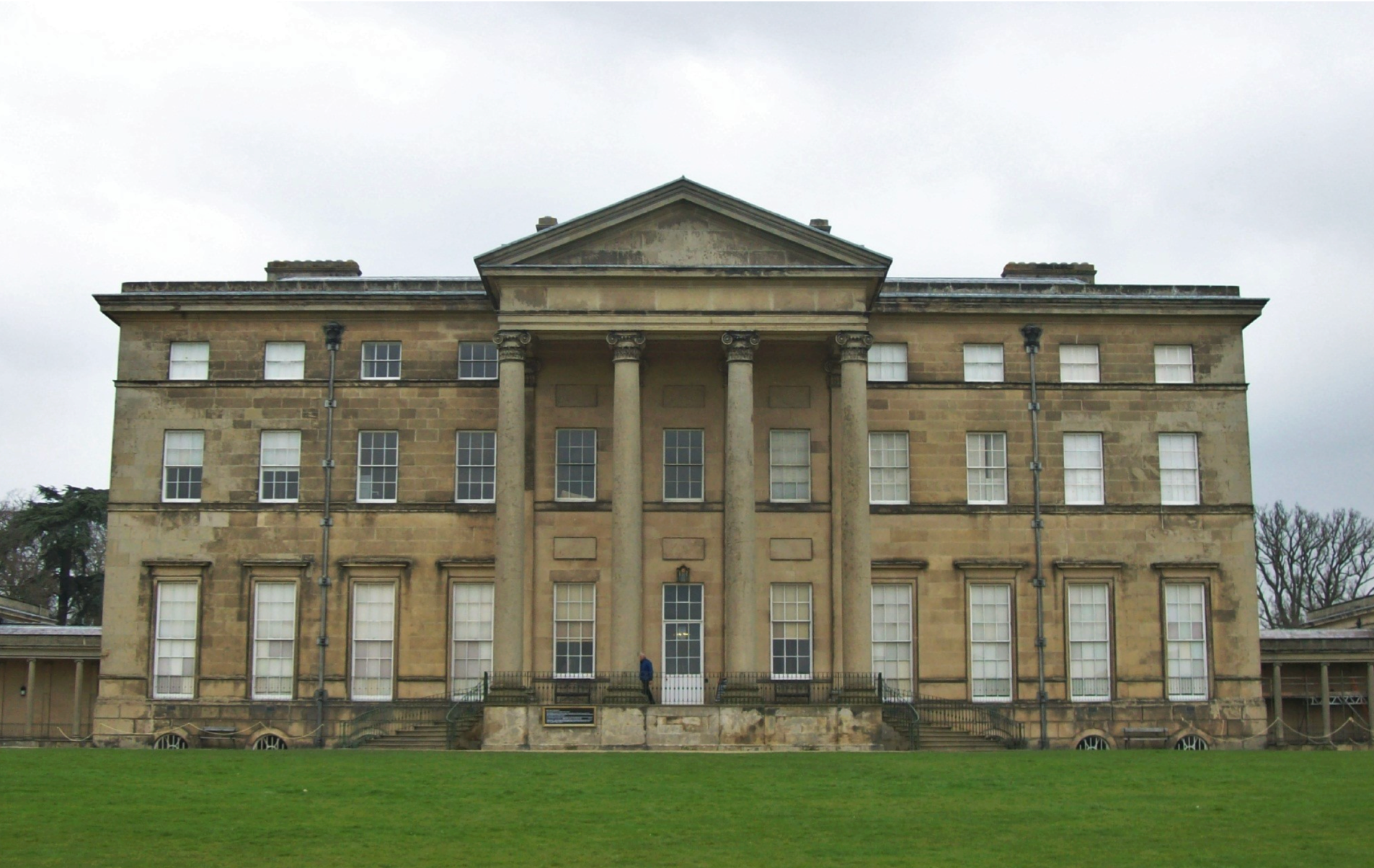
Attingham House, Shropshire, 18th century. An example of Palladian architecture incorporating musical proportions.
Look at the number of panes in the windows, counting from the top story down: 2, 4, and 6. This gives the proportion 1:2:3, which represents the octave and the perfect fifth. We can reasonably be confident this was the architect’s intention, since this style is a British version of Palladian architecture. The Palladian style was developed in Italy in the 16th century by the architect Andrea Palladio, who wrote a four-volume treatise on architecture describing how to incorporate these and many other proportions, drawn from developing ideas of musical harmony, into buildings. A famous example designed by Palladio himself is the Villa Capra, also known as ‘La Rotonda’, built in 1565.
Mankind: Human Music
‘Human music’ describes the harmony of the structure of man. This encompasses not only his physical dimensions but also his spiritual nature, in accordance with Christian anthropology. St Bonaventure noted, for example, that there are five bodily senses and five spiritual senses, giving a total of 10 in accordance with the Pythagorean principle.
The proportion 3:5:8 is connected in particular to Christ. The number 8 represents Christ, whom the Church Fathers call the ‘Eighth Day of Creation’, whose life, death, and resurrection usher in the new covenant (the old covenant being represented by 7 and the seven days of Creation described in Genesis). Sunday is simultaneously the eighth day of the previous week, on which Christ rose from the dead, and the first of the next. This mirrors the pattern of the musical scale, in which seven distinct notes are followed by an eighth that is simultaneously the last note of the previous octave and the first of the next.
Because there are five senses in each category, spiritual and physical, 5 represents Christ’s humanity, and the five wounds indicate the suffering and death of his human body. And because the person of Christ is both God and man, the second person of the Trinity, the number 3 represents his divinity. We thus have a series of three related numbers: 3:5:8. Crucifixions bearing the five wounds of Christ and the three arms of the cruciform halo indicate, through this proportion, that this is the divine person. We also note that 3 and 5 sum to 8, the number for Christ, one person, divine and human.
This symbolism can be present in other ways. Raphael’s Mond Crucifixion, for example, contains the number eight embedded in its layout: if one follows the line of the heads of the angels to the feet of one, then on to the heads of the four observers, and back to the feet and head of the second angel, a regular octagon is traced. Fonts and baptistries are traditionally designed in the shape of an octagon for the same reason.
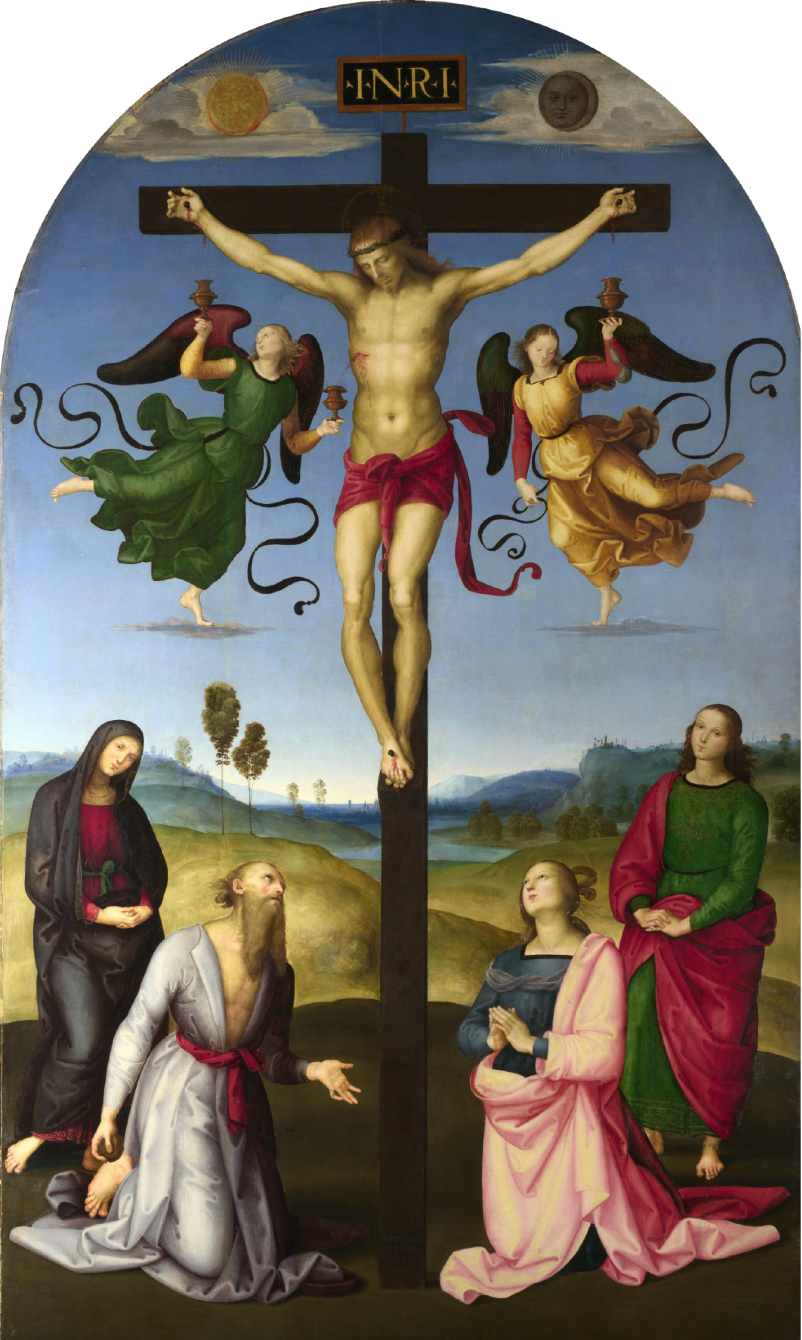
The Mond Crucifixion, Raphael. The layout traces a regular octagon, embedding the Christ-number 8 into the composition.
A word of clarification is useful here. The artist’s purpose in employing this octagonal geometry is not that the observer should consciously decode it and think ‘eight: the eighth day, therefore Christ.’ Rather, the assumption is that the geometry, when skillfully used, will make the painting more beautiful than it would otherwise be, and that this beauty is experienced directly, without analysis. It is this beauty that makes the subject of the painting, the person of Christ, more likely to be grasped intuitively. The mathematics works first on the eye and the imagination, and only afterwards, if at all, on the reasoning intellect.
— — —
Next week I complete the survey of the five fields with cosmic music, the numerical patterns of Scripture, and the symmetry of number itself, where I will show how one of Boethius’s proportions arrives at the Christ-number 3:5:8 by an entirely independent route, and how the same series was later named after an Italian mathematician, Fibonacci, born seven centuries too late to have discovered it.