


Last week I described the first two of the five traditional fields of study within the mathematics of beauty: instrumental music, from which the whole system takes its origin, and ‘human music’, the harmony of the proportions of man. This week I complete the survey with the remaining three.
The Beauty of Nature: Cosmic Music
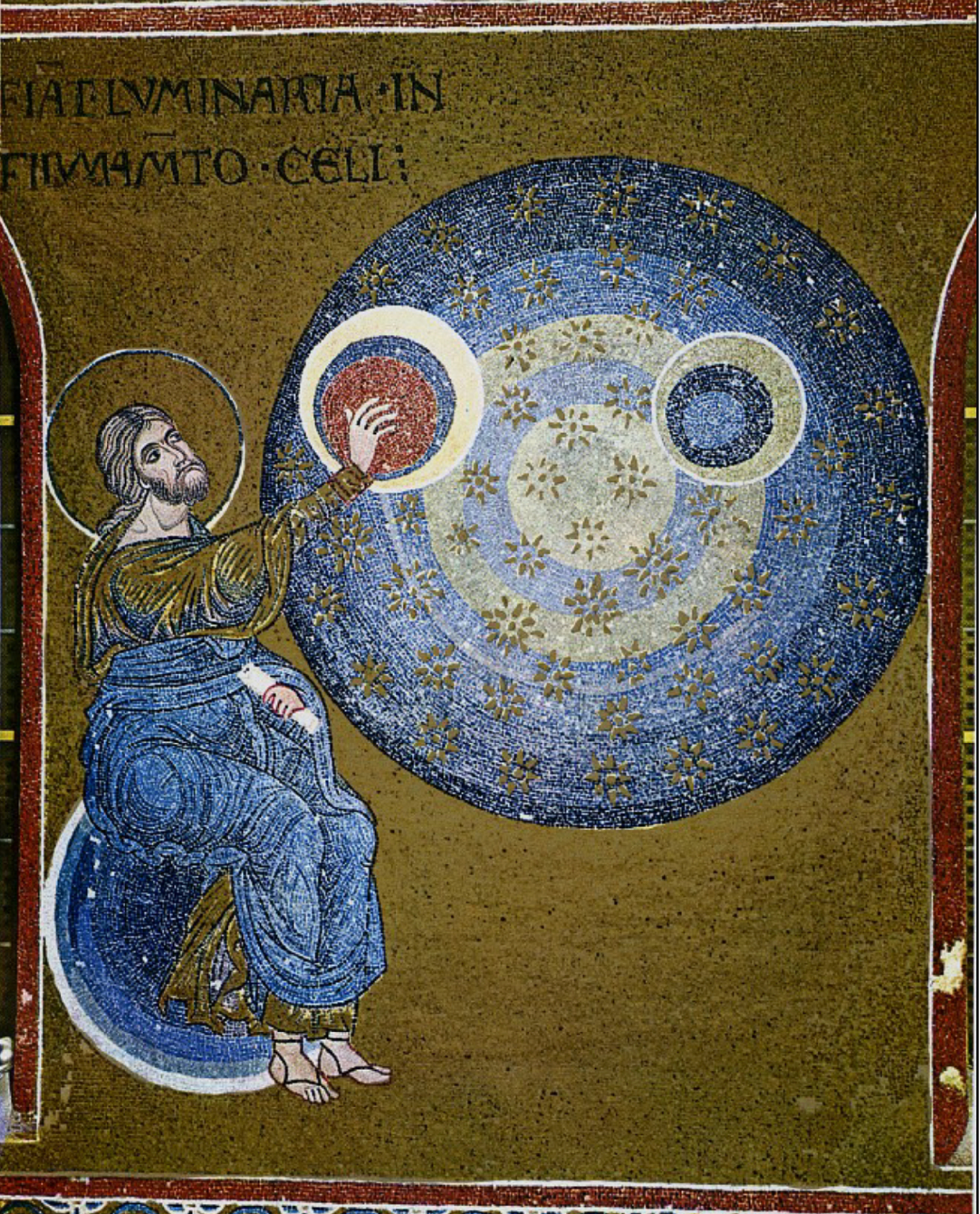
Cosmic music, otherwise known as the music of the spheres, traditionally focuses on the patterns of planetary motion. It was observed that seven heavenly bodies, visible to the naked eye, move independently of the fixed canopy of stars: the Sun, the Moon, Mercury, Venus, Mars, Jupiter, and Saturn. The number seven was considered significant by Christians, particularly in relation to the seven days of creation, the seven days of the week, and the seven distinct notes of the musical scale. Even today, the days of the week are named after these planets in Romance languages: the French Mercredi, for example, derives from the Latin Mercurii dies, ‘day of Mercury.’ In English, only Saturday and Sunday retain their planetary roots.
One might ask whether advances in modern science, such as the discovery of additional planets, undermine this symbolism. I would say not. If God made the universe for us to observe, it seems reasonable to attach greater symbolic importance to what is visible to the naked eye, since those were the only heavenly bodies anyone could observe for most of human history.
Scripture
Christian and Jewish writers noted the proportions of the ark and the temple and commented on the significance of certain numbers. I have already mentioned the seven days of creation, which govern the weekly cycle. The number seven appears throughout Scripture, denoting the Old Covenant. In the 6th century AD, St Benedict of Nursia quoted Psalm 118 (119) in his monastic Rule as justification for praying the Office seven times a day and rising at midnight to praise God. This eightfold pattern (articulated by Benedict in the form of 7+1) is reflected in the daily pattern of the Benedictine Hours: Matins, Lauds, Prime, Terce, Sext, None, Vespers, and Compline. The 7+1 pattern thus appears in both daily and weekly prayer, mirroring the musical scale. It is noteworthy that attempts to create different weekly cycles have historically failed: the 10-day week introduced in France after the Revolution was abandoned because people simply could not adjust to such an unnatural rhythm.
The Church Fathers’ commentaries on Scripture, such as those of St Augustine, are replete with references to the significance of numerical patterns. Jewish commentators of the period, among them Philo of Alexandria, who lived around the time of Christ, drew heavily on numerical symbolism in their work. Number can be used to connect truths symbolically. If an action is performed 10 times, for example, it may suggest a parallel with the authority of God, who issued 10 commands in creating the universe. In Genesis, the phrase ‘God said’ appears 10 times in the account of creation (Ch 1: vv. 3, 6, 9, 11, 14, 20, 24, 26, 28, 29), and the essence of God’s law was given to Moses in the 10 commandments. This, in turn, connects to the governing number 10 in the musical pattern of the cosmos, as first discerned by the Pythagoreans and expressed in the tetractys.
This raises a general point about how number relates to meaning in design. The use of number and proportion does not impose a meaning onto an object arbitrarily, as if repeating something ten times could confer the authority of God by sheer force of design. The causation runs the other way. Because an action genuinely possesses a certain quality, because the act of creation in Genesis genuinely has the authority of God, it is appropriate and harmonious to express that through the number 10. The number does not create the meaning; it reflects and deepens it. When number is used in harmony with the true nature and purpose of what is being made, it imparts beauty. When it is imposed without that underlying harmony, it produces at best a clever contrivance and at worst a distortion.
The Symmetry of the Relationships between Numbers Themselves
One of the special properties of number is that it can be abstracted from matter and conceived as a pure idea. We can have seven apples, but we can also think of the number 7 as an idea in itself, detached from any material thing. This abstract world of ideas, of which mathematics is a category, was seen as significant because it was thought to bridge the gap between the spiritual and material realms. Furthermore, once a number is identified as carrying a particular symbolism, as 7 and 8 do, it can be used to order time and space so that whatever is structured according to that number participates in its symbolism.
In his De Institutione Arithmetica, Boethius describes 10 proportions, that is, 10 series of numbers generated by different mathematical operations, the number 10 being, for him, the number of completion. In each case, the operation by which the numbers are generated has its own internal symmetry, which was considered as beautiful as the series it produces.
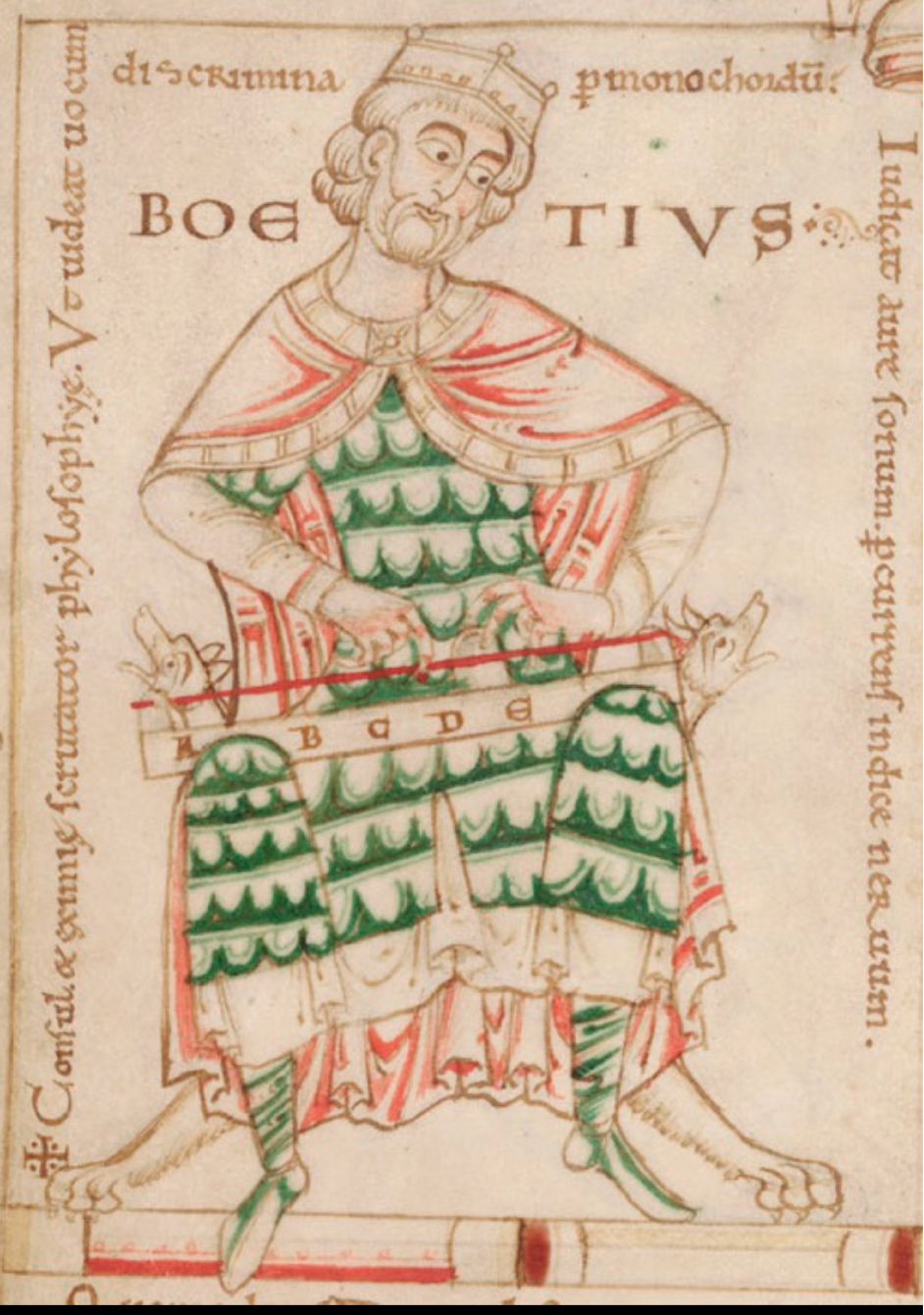
The tenth of these proportions, which Boethius calls the ‘Fourth of Four’ for reasons we won’t go into here, was derived from mathematical argument alone, quite independently of any consideration of the proportions of man or of Christ. Yet it establishes the Christ-like proportion 3:5:8 by a different route altogether. Each number in the series is generated by adding the two preceding terms. Beginning with 1, there is no previous term, so the second term is also designated as 1. The third term is 1 + 1 = 2. And so the series continues: 1, 1, 2, 3, 5, 8, 13… The proportion 3:5::5:8 is contained within it. Some readers will recognize this description of the Fourth of Four series as corresponding also to the Fibonacci series, named after the Italian mathematician Leonardo Fibonacci, who died in 1250. Fibonacci is commonly credited today with introducing this series to Western mathematics, but those who believe this have evidently not read Boethius.
Historically, patterns in mathematics were seen as reflected in the material world as evidence that both emanate from the same source: God. Philosophers still grapple with why mathematics is such a powerful language for describing nature in the natural sciences. For those who look at this with the eyes of faith, however, the connection seems entirely natural.
— — —
Next week I turn from theory to practice: how a designer chooses a proportion and applies it, including how I use these principles in my own painting. I will then look at why the tradition was abandoned in the modern era, and at the Golden Section, which most people today think is the sum total of the mathematics of beauty.