Many readers will remember my earlier post about reordering the sanctuary at St Mary’s Catholic Cathedral in Aberdeen under the patronage of Bishop Hugh Gilbert. I described it then as a model that other Roman Rite churches would do well to study. I still think so. I am writing again because the project is now open to donations from anyone who wishes to support it, including readers in the United States who want their gift to be tax-deductible. I would like to encourage you to give by going to https://secureddonation.com/give/Beauty_for_God
Why this project is important for all Catholics
I believe there is a crisis of imagery in the Roman Rite. The Byzantine Churches have a largely standardized arrangement of images in the sanctuary, which draws the worshiper into the mysteries being celebrated. The Roman Church has never had one. Instead, it relied on a general understanding of how imagery conveyed the themes of the liturgy, without mandating much in the way of specifics. When tradition is strong and well understood, this freedom allows for rich variation, and in the past it was a great strength of Catholic culture. Today, however, we are disconnected from that tradition. Few understand how the Church has communicated Eucharistic themes through images, or how to engage with those images in worship. We could ask the Church as an institution to step in and mandate schemas for every church, but that is as likely to stifle creativity as to encourage it.
A better answer, I think, is to create exemplary schemas that others will want to emulate once they see them. The reordering of the sanctuary at St Mary’s is one such project. It is rare to see a commission where the bishop, the artists, the architect and the craftsmen work this closely, and where the theology of the liturgy so clearly governs every decision. The result will serve the people of Aberdeen. It will also, I believe, give many in the wider Church a working example of what a Roman Rite sanctuary can be. Projects like this need patrons. With the matching gift in place, now is the best time to become one.
How to give
The diocese has established a fund with the Chapel & York Foundation called the “RC Diocese of Aberdeen Charitable Trust.” US tax-deductible donations can be made through the online form for Beauty for God here:
https://secureddonation.com/give/Beauty_for_God
Fundraising is going well. Nearly two-thirds of the £685,000 (about $900,000) target has now been pledged or given. One generous donor has offered to match all remaining donations, so every gift will be doubled. A $100 gift becomes $200 for the cathedral.

Where the project stands
The final sanctuary designs are underway. In early November, Martin Earle will visit the cathedral with full-scale wood and card mock-ups of the new elements: the altar, ambo, cathedra and tabernacle. He will test them in the space itself, and what he learns will inform the final design adjustments. This is how such work ought to be done. A design that looks right on paper has to be proven in the building where people will pray.
More on the East Wall painting
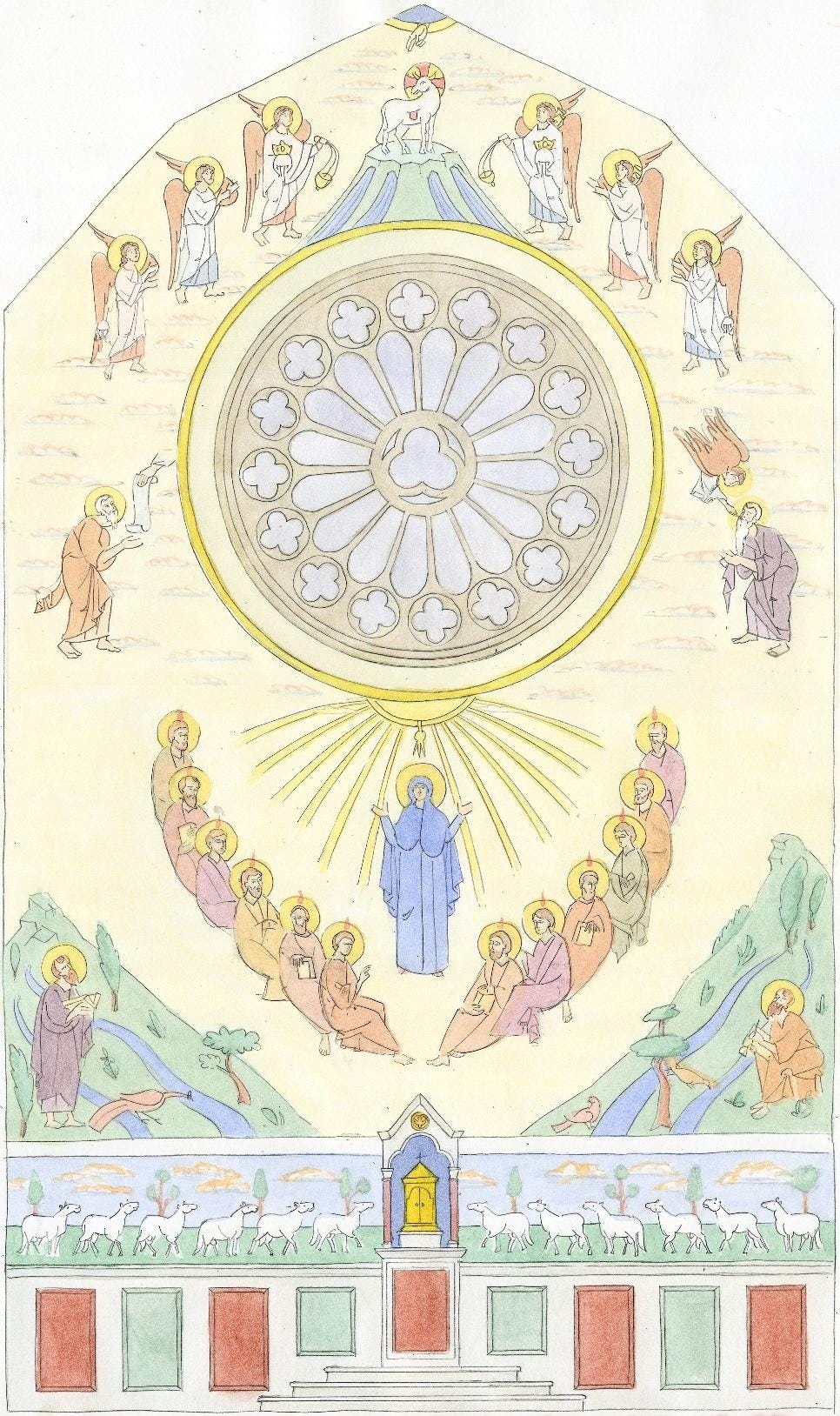
Since my first article, Martin has shared his notes on the design of the east wall mural. They add a good deal to what I wrote before, and I think they are worth sharing because they show how carefully every element has been considered.
He starts with four aims. The painting should be beautiful and contemplative, not visually overwhelming. It should be simple, yet unfold over time, so that the viewer keeps discovering meaning on return visits. It should be mystagogical, revealing what happens invisibly when the Word is proclaimed, and the Eucharist is celebrated. And it should speak of life and hope, which is why the landscape is green, recalling the just man of the first psalm, who is “like a tree planted by streams of water” (Ps 1:3).
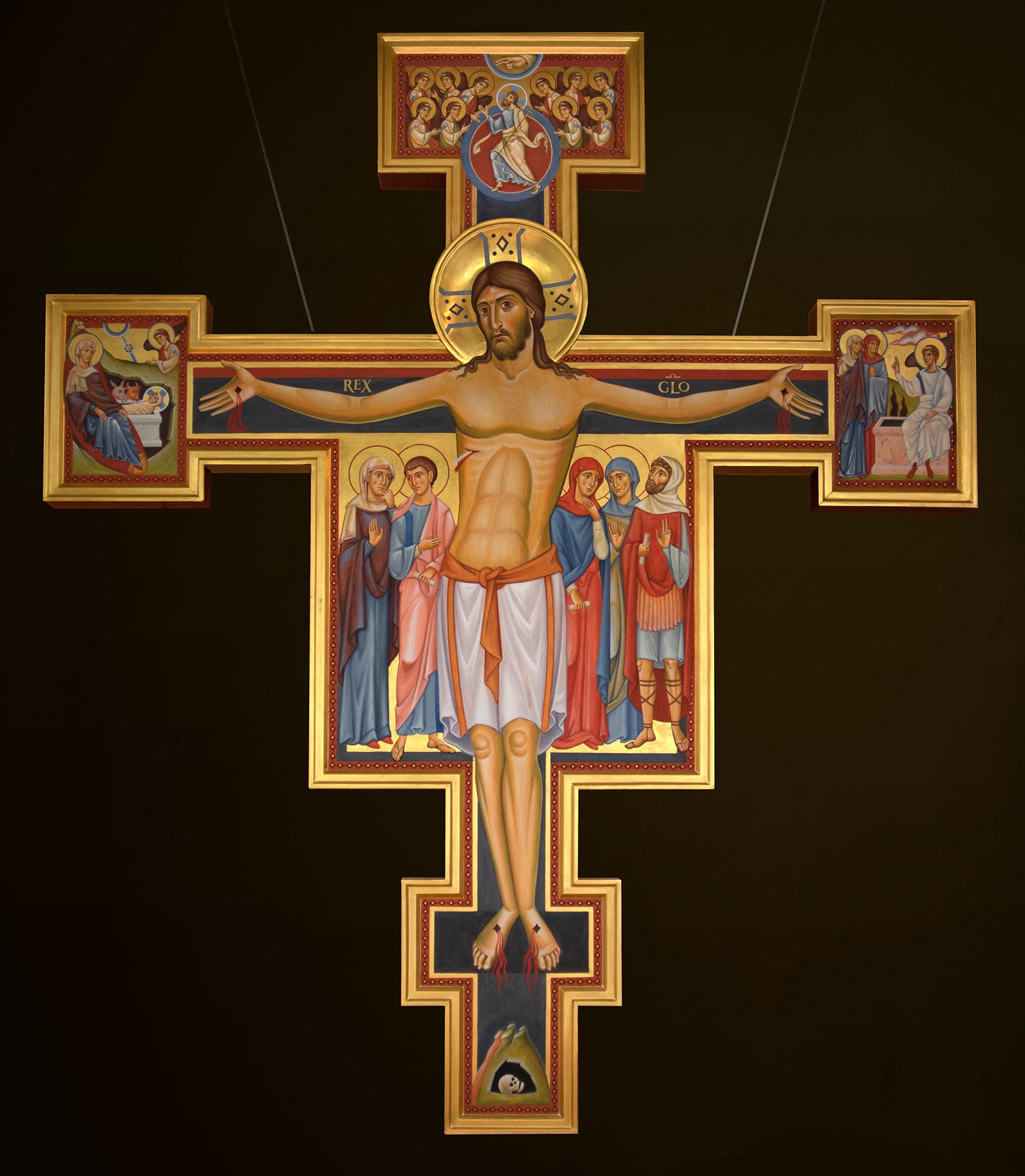
The structure has two levels, the Church on earth and the Church in heaven. Below is Pentecost. Mary stands at the center with the Apostles around her. This connects directly to the crucifix above the altar, especially to the moment when Christ “bowed his head and gave up his spirit” (Jn 19:30). The Spirit Christ gives up on the cross is the Spirit poured out on the Church.
Above is the heavenly liturgy. The Lamb stands on the mountain from which flow the rivers of paradise (Rev 22:1; Gen 2:10–14). Angels minister around him, and the Father’s hand blesses from above. The two levels form a single circle of worship. As the Letter to the Hebrews puts it, “you have come to Mount Zion and to the city of the living God, the heavenly Jerusalem” (Heb 12:22). We do not go to heaven after Mass. At Mass, we are already there.
The prophets occupy the middle level. Isaiah receives the burning coal on his lips (Is 6:6–8). This purification prefigures both Pentecost and the Eucharist. It is also the vision in which the seraphim cry “Holy, Holy, Holy,” words we take up in the Sanctus at every Mass. Ezekiel is given the scroll to eat (Ez 2:8–3:3), the Word he must then proclaim. Both prophets, having received, are sent out. In this they prefigure the dismissal at the end of Mass: Ite, missa est.
On the lower level, St Paul stands on the left and St John on the right. They carry the prophetic mission forward after Pentecost. The entrance antiphon for the feasts of the Apostles comes to mind: “Their voice has gone out through all the earth” (cf. Ps 19:4). Through their preaching, the earth is made a paradise. Martin links them visually to the prophets above: Paul to Isaiah and John to Ezekiel. Both Apostles look through Mary. This expresses how the Church reads the Old Testament through the Incarnation, as Christ himself did on the road to Emmaus, “beginning with Moses and all the prophets” (Lk 24:27).
The rivers tie the whole together. They flow down from the heavenly mountain, and two of them run through the books the Apostles hold: the Torah in Paul’s hands and the scroll John is writing. This is the Word of God carrying heavenly grace down to nourish the faithful. Below, the lambs, representing the Apostles, process toward the tabernacle, as in so many early Christian mosaics.
Martin also considered the visual connections the color scheme can create. Blue links Mary, the tabernacle, the rivers of paradise, and the heavenly sphere. Green signifies new life, the “green pastures” of Psalm 23 and Psalm 1, as mentioned before. The clouds around the rose window are painted to evoke dawn light. This is an eschatological image: the Church, in prayer, facing east, awaiting Christ's return.
US-based donors, please consider giving here: https://secureddonation.com/give/Beauty_for_God
For UK-based donors, please use https://www.beautyforgod.org/donate/
More images and information are available at www.beautyforgod.org.
As an aside, it is particularly gratifying to see this project moving forward as Scala Foundation had a small part to play
Bishop Hugh Gilbert, the Bishop of Aberdeen and former Abbot of Pluscarden Benedictine Monastery (where I am an Oblate) said:
“I approached David, looking for an artist who would be able to develop ideas for St Mary’s Cathedral, Aberdeen, having worked with him before. He made a recommendation that proved to be exactly who we were looking for. David’s work has enabled us to move closer to realizing the vision for the Beauty for God sanctuary reordering project, now entering its final phase.”
Here is the famous award-winning crucifixion already created by the artist, Martin Earle that will be at the heart of the design: