

 Nearly every artist I meet acknowledges a need for inspiration to guide creativity. The application of every stroke of charcoal or paint must be guided by a picture in the mind of the artist of what he is aiming to create. Sometimes the creation of the work of art involves a carefully thought out, obviously reasoned approach and sometimes it is or more intuitive and spontaneous. However, as long as the process is the realization of an idea and not just a random process without any thought of what the result will be (as with a chimpanzee throwing paint at a canvas) then the artists is employing his intellect and is making decisions about the form he creates. Artists need inspiration in both the formation of the original ideas; and in the decisions about how it will be best achieved.
I have read a number of books claiming to have the secret to creativity and the inspiration of the imagination, a number of them best sellers. Steeped in high emotion and cod psychotherapy, I found them all unconvincing. I have met quite a few people who read them and thought they were wonderful. While it was clear that reading the book made them feel good, none seem to be able to point to visible results in their art (that I could discern at any rate). I was looking for something that actually seemed likely to contribute to my producing better art, rather than something that relieved my anxiety.
Nearly every artist I meet acknowledges a need for inspiration to guide creativity. The application of every stroke of charcoal or paint must be guided by a picture in the mind of the artist of what he is aiming to create. Sometimes the creation of the work of art involves a carefully thought out, obviously reasoned approach and sometimes it is or more intuitive and spontaneous. However, as long as the process is the realization of an idea and not just a random process without any thought of what the result will be (as with a chimpanzee throwing paint at a canvas) then the artists is employing his intellect and is making decisions about the form he creates. Artists need inspiration in both the formation of the original ideas; and in the decisions about how it will be best achieved.
I have read a number of books claiming to have the secret to creativity and the inspiration of the imagination, a number of them best sellers. Steeped in high emotion and cod psychotherapy, I found them all unconvincing. I have met quite a few people who read them and thought they were wonderful. While it was clear that reading the book made them feel good, none seem to be able to point to visible results in their art (that I could discern at any rate). I was looking for something that actually seemed likely to contribute to my producing better art, rather than something that relieved my anxiety.
 It seems to me now that the answer is so much simpler than most of these books suggest. This was to use the methods of the Old Masters of the past. All it requires of me is sufficient humility to follow the traditional forms of Western culture. A traditional art education will engender that humility by requiring me to follow the precise directions of the teacher, and by following in the footsteps of the Old Masters by regularly copying their work. (See here for me details on this aspect). No self-expression here! (This incidentally is a lot of the problem, that I could see, with many of the modern methods of trying to generate creativity. Although they might even acknowledge the need for an external source of inspiration, all the popular ones that I read in fact suggested techniques that engendered self-centred self examination that in fact did the opposite - very-loosely based, as far as I could work out on 20th-century psychotherapy methods.)
Regular prayer for inspiration is part of this, and I would say that the traditional prayer of the Church is the best. This comes back, once again to active participation in the liturgy in the fullest sense of the word. Participation in the liturgy, especially when it includes the liturgy of the hours (I have written a series of articles about the Liturgy of the Hours, here) is not only an education in beauty it is the greatest training in creativity and the most powerful prayer of inspiration and guidance.
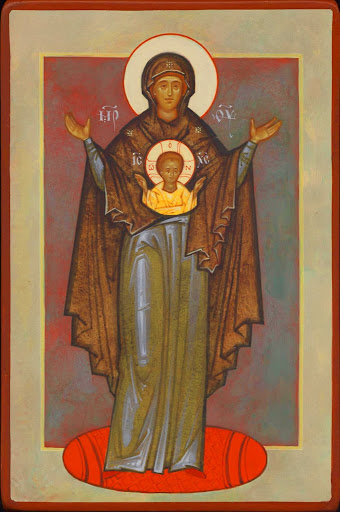
I have spent much time with Eastern Christians. My initial contact came through learning to paint icons. One of the things that struck me about them was the way they prayed with visual imagery. It seemed to straightforward: they would stand and turn to look the icon in the face, addressing the person depicted directly. Also, they were inclined to sing their prayers in full voice. I might be with a family, for example, and before the meal, they all stood, faced the icon of Christ that was in the dining room and sang an ancient hymn. My reflections on this are in another article called Praying with Visual Imagery.
 Upon further reflection, and coming back to this issue of creativity for artists, something that struck me is how unlikely it is that an artist who is not habitually praying with visual imagery is going to be able to produce art that nourishes prayer. If I am habitually making that connection between the prayer and the image, then I will instinctively produce art that nourishes my own prayer. If I am praying well, then that art will be beautiful and will, in turn, nourish the prayers of others. This practice of praying with visual imagery is developing my instincts for what is beautiful. It is also engaging my vision in the prayer, and conforming it to the liturgical practice. This is an act of humility therefore that opens the person as a whole to inspiration and guidance , with a particular focus on that faculty of the visual.
It has been said that historically, that all the great art movements began on the altar. Think of the baroque. It began in the 17th century as the sacred art and architecture of the Catholic counter-Reformation, but this set the style for all art, architecture and music, sacred and profane in both Catholic and Protestant countries.
Therefore the prayer with visual imagery in the context of the liturgy, is a hugely important factor in developing our instincts as to what is beautiful and is the bedrock for the visual aspects of all culture. Just as the liturgy, with the Eucharist at its heart, is the source and summit of human life, so liturgical art is the source of inspiration for and the summit to which all other art participates and directs us to.
 I try to do the same when I am participating in the Mass. Once a month we have the Melkite Liturgy at the college and the priest very obviously turns to face the large icons of Our Lady, or of Christ when addressing them in the liturgy. I do my best to take this lesson into my participation in the Roman Rite. Similarly, at the end of Mass on weekdays we say the Angelus, and we all turn and face the statue of Our Lady which is in our little chapel.
The Liturgy of the Hours is a place in which, as a layman, I can do much to adopt these practices. If I pray the Liturgy of the Hours at home, I can use an icon corner to orientate my prayer. When we pray the Liturgy of the Hours at Thomas More College, we finish with invocations special to the community including addressing Our Lady and the Sacred Heart of Jesus. We turn and face these images as we pray. At Vespers and Compline we set up the icon of Our Lady because each has a strong Marian content. At Vespers we say the Magnificat, the song of Our Lady every day and at Compline we always finish with a Marian antiphon.
Of course, the use of imagery is just one aspect of engaging the whole person in prayer – appropriate use of incense, chant and posture allows for the active conformity of the whole person to the prayer and so greater openness to inspiration in any human activity. So this prayer of the artists is really a prayer by which any can hope to discover their personal vocation and flourish in it.
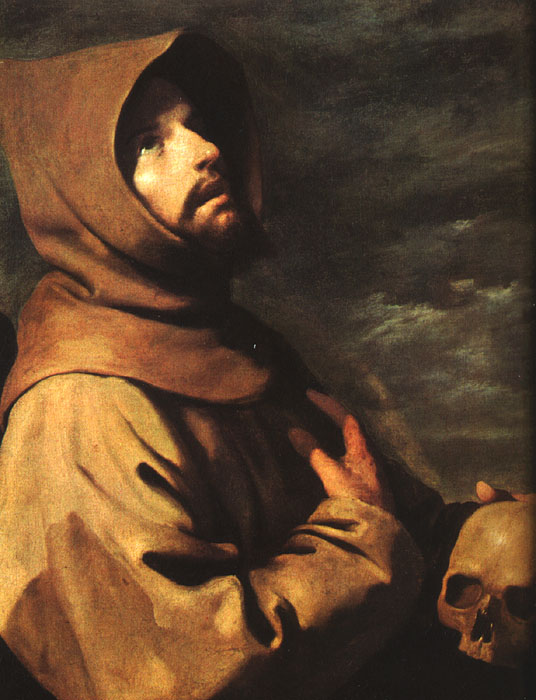
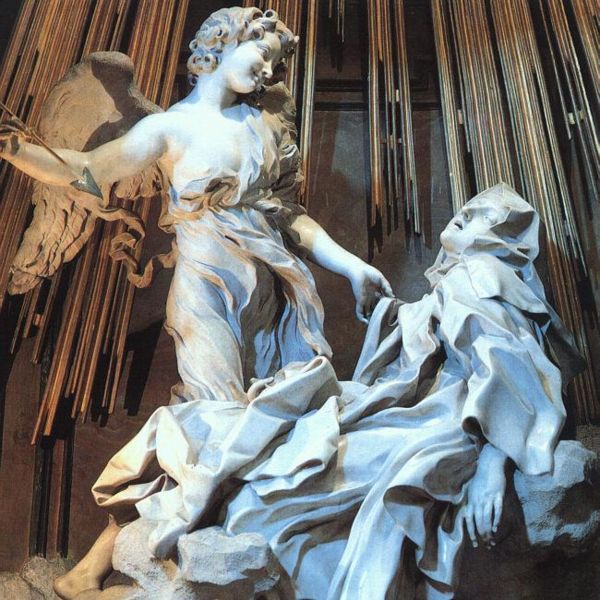 What does inspiration feel like? We can be transported in ecstacy, as in the painting of St Francis by Caravaggio, below, or St Theresa of Avila, right; but more commonly, the inspiration of the artist is not felt at all. We know it is has been there not because of how we feel during the painting process, but rather by the quality of the work at the end of it. Even if the painting of it felt like hard work, God might have been guiding our decision making processes. And frankly, it's going to be hard to paint if you are fainting into the hands of an angel like St Francis did!
And one final point that was made to me in this regard. Inspiration is given by God and He inspires whomsoever He pleases. It is not something demanded or taken by the artist. These methods are ways that develop our ability to cooperate with Him. In the end, if it is not my vocation to be an artist then all prayer and training in the world will not make a great artist of me. However, we can take heart, it will develop everybody's ability to cooperate with the inspiration that He gives to all of us in order to carry out our personal vocations whatever they may be. So we may find that this training leads some of us to something that is, in these cases, even more fulfilling than art.
This is one of series of articles about prayer and creativity through the liturgy, the most powerful and effective form of prayer: the others are here.
Anyone wishing to learn the traditional methods of art and prayer mentioned in the article can come to the summer programme of the Way of Beauty Atelier at Thomas More College of Liberal Arts. We have traditional art and chant classes that teach the methods in conjunction with the practice of prayer. Alternatively there is a weekend retreat which teaches the principles of the prayer with the art classes. All programmes are open to people of all ages (not just high-school students).
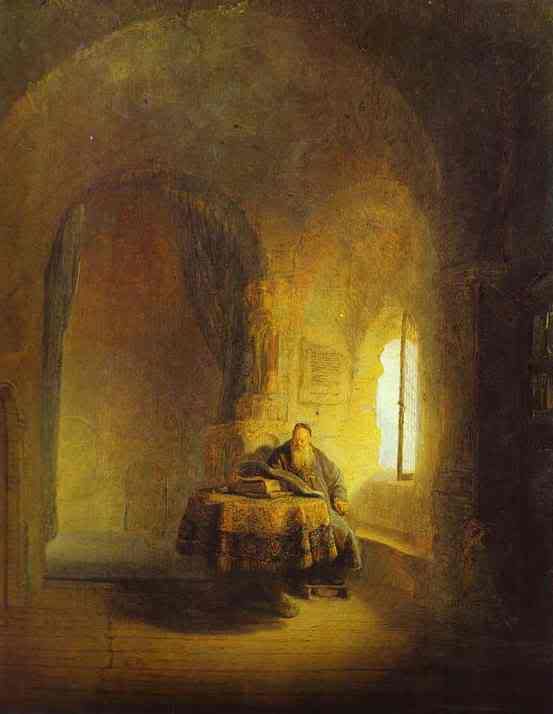
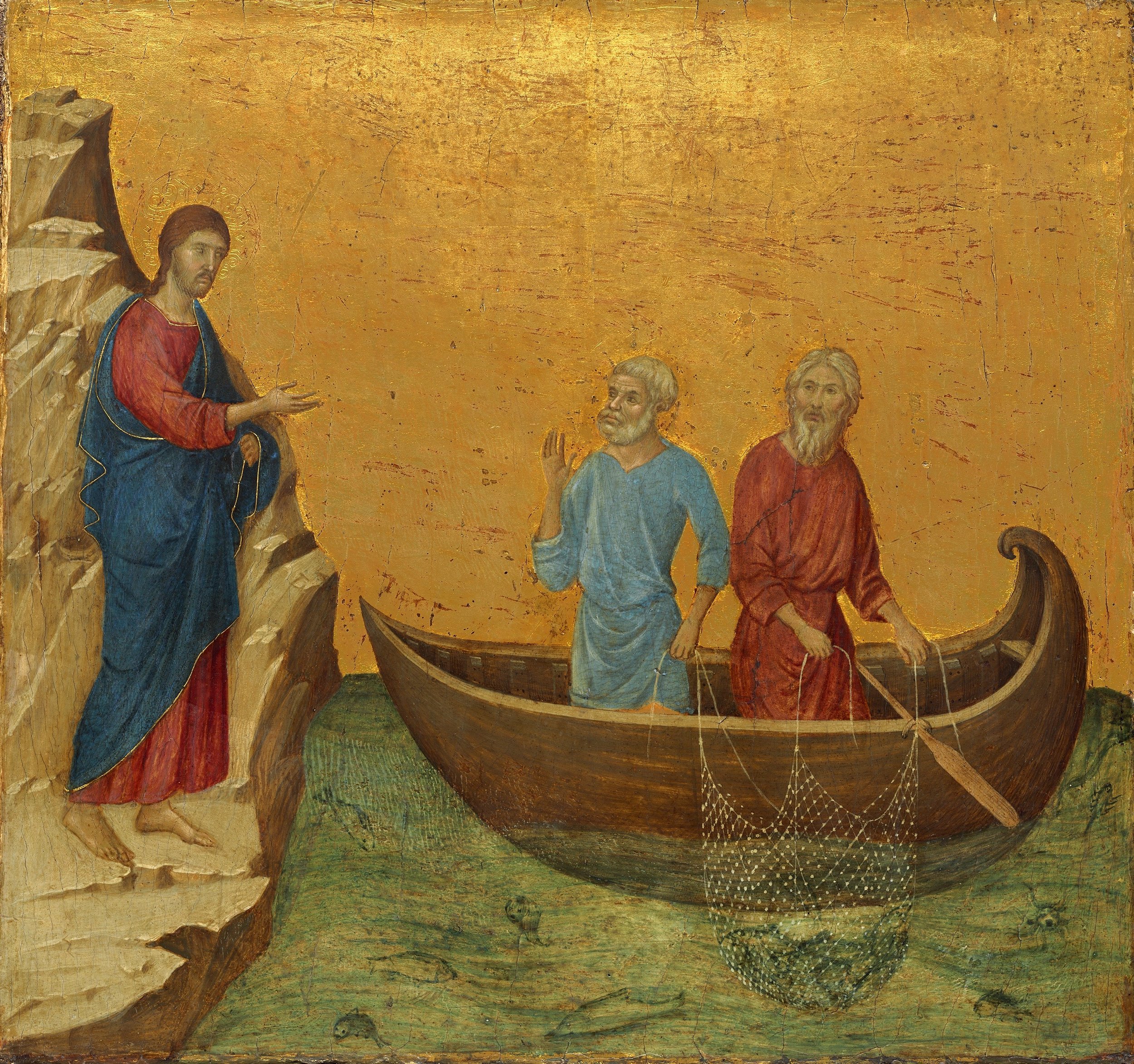
The painting at the top is by Vermeer (17th century baroque). Other images described below each one.
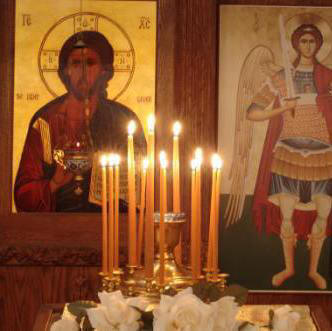
 The Melkite Liturgy at Thomas More College of Liberal Arts, Merrimack, NH. Chaplain, Fr Boucher turns to the icon of Christ at a point when he is addressing Him directly.


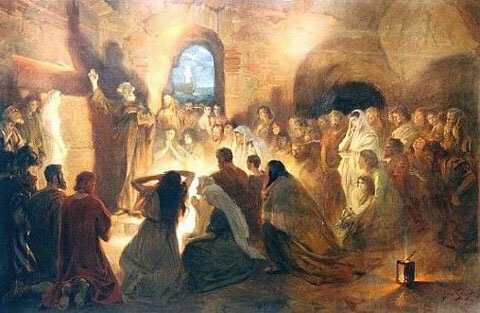
Pentecost (Jean Restout, French, 1732).




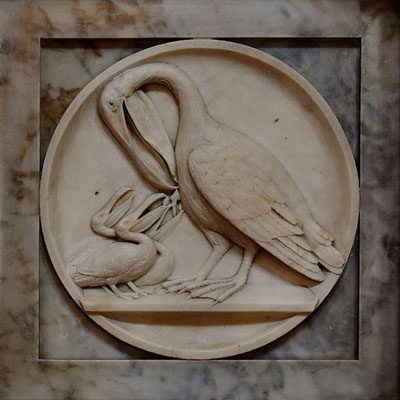 Is there a danger that trying to reestablish traditional Christian symbols in art would sow confusion rather that clarity? Lots of talks and articles about traditional Christian art I see discuss the symbolism of the iconographic content; for example, the meaning of the acacia bush (the immortality of the soul) or the peacock (again, immortality). This is useful if we have a printed (or perhaps for a few of you an original) Old Master in church or a prayer corner as it will enhance our prayer life when contemplating the image. But is this something that we ought to be aiming to reinstate the same symbolism in what we produce today? Should we seek to educate artists to include this symbolic language in their art?
If symbols are meant to communicate and clarify, they should be readily understood by those who see them. This might have been the case when they were introduced – very likely they reflected aspects of the culture at the time – and afterwards when the tradition was still living and so knowledge of this was handed on. But for most it isn’t true now. How many would recognize the characteristics of an acacia bush, never mind what it symbolizes? If you ask someone today who has not been educated in traditional Christian symbolism in art what the peacock means, my guess is that they are more likely to suggest pride, referring to the expression, ‘as proud as peacock’. So the use of the peacock would not clarify, in fact it would do worse than mystify, it might actually mislead. (The reason for the use of the peacock as a symbol of immortality, as I understand it, is the ancient belief that its flesh was incorruptible). So to reestablish this sign language would be a huge task. We would not only have to educate the artists, but also educate everyone for whom the art was intended to read the symbolism. If this is the case, why bother at all, it doesn’t seem to helping very much, and in the end it will always exclude those who are not part of the cognoscenti . This is exactly the opposite of what is desired: for the greater number, it would not draw them into contemplation of the Truth, but push them out.
Is there a danger that trying to reestablish traditional Christian symbols in art would sow confusion rather that clarity? Lots of talks and articles about traditional Christian art I see discuss the symbolism of the iconographic content; for example, the meaning of the acacia bush (the immortality of the soul) or the peacock (again, immortality). This is useful if we have a printed (or perhaps for a few of you an original) Old Master in church or a prayer corner as it will enhance our prayer life when contemplating the image. But is this something that we ought to be aiming to reinstate the same symbolism in what we produce today? Should we seek to educate artists to include this symbolic language in their art?
If symbols are meant to communicate and clarify, they should be readily understood by those who see them. This might have been the case when they were introduced – very likely they reflected aspects of the culture at the time – and afterwards when the tradition was still living and so knowledge of this was handed on. But for most it isn’t true now. How many would recognize the characteristics of an acacia bush, never mind what it symbolizes? If you ask someone today who has not been educated in traditional Christian symbolism in art what the peacock means, my guess is that they are more likely to suggest pride, referring to the expression, ‘as proud as peacock’. So the use of the peacock would not clarify, in fact it would do worse than mystify, it might actually mislead. (The reason for the use of the peacock as a symbol of immortality, as I understand it, is the ancient belief that its flesh was incorruptible). So to reestablish this sign language would be a huge task. We would not only have to educate the artists, but also educate everyone for whom the art was intended to read the symbolism. If this is the case, why bother at all, it doesn’t seem to helping very much, and in the end it will always exclude those who are not part of the cognoscenti . This is exactly the opposite of what is desired: for the greater number, it would not draw them into contemplation of the Truth, but push them out.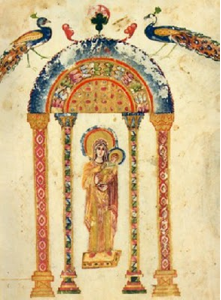














 The Liturgy is the most powerful and effective form of prayer.





 Engaging the Whole Person in Prayer Opens us up Further to Inspiration and Creativity - The Divine Office III,
  If in the context of the Liturgy our continuous prayer simultaneously engages the whole person then can we are opening ourselves up to the greatest degree possible to God’s grace. To the degree that we cooperate with grace this will help us make all our life decisions and help us to move towards the fulfillment of our personal vocation in life. This will be perfectly ordered also to the model of charity, that is, love of God. To the degree that we match these standards there will be perfect harmony with the objective standard of God’s will. This is the supernatural path to inner peace, peace with our neighbour and a life in harmony with creation.
 Chant:
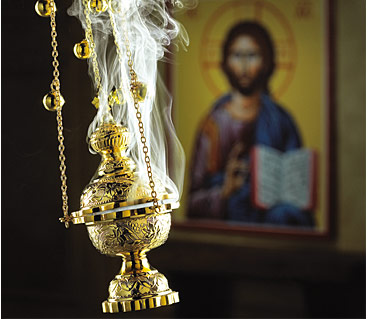 Incorporating the sense of smell






 How busy people can strive for the ideal of praying continuously. The Divine Office for lay people, part 2 (
 If all times in the day and all human activity (no matter how mundane) can be sanctified by praying the liturgy of the hours, as the Church tells us, then this is this is a wonderful gift by which we can open ourselves up to God’s inspiration and consolation in all we do, and the degree that we cooperate, all our activities will be good and beautiful; and will be infused with new ideas and creativity. And we will have joy.
 Even if we accept this and want to benefit from it, it is a huge problem for most lay people. If you get the full cycle of prayer of seven Offices in the day for seven days of every week in the year it adds up to a three or four volume set. Priests and religious who are obliged to pray it, devote a huge part of their lives to praying the liturgy of the hours. Benedictine monks can spend up to six hours a day singing the psalms in church. One might expect them to be able to cope as that is their special calling, but what about the rest of us?
 Mark the Hours
 So this is what I did: for the most part I tried to keep to the standard form of each Office as in the Liturgy of the Hours book I had been given (which was according the Roman Rite, it said in the front) and from that to the schedule of Compline at night and Lauds in the morning. However, in between I marked the hour with a short memorised prayer, sometimes just the Our Father, Hail Mary and Glory Be. If I could remember any, I tried to have just a line from a psalm. The ideal would be to memorise one psalm (and some are short!). This habit of continual prayer is what opens the door to the possibility of continuous prayer. The publication
  The experience of doing this has been so positive that I can't imagine not wanting to pray at least part of the Hours each day. As someone said to me recently, he found that the praying of the liturgy of the hours was like regular physical exercise: although it meant an investment of time, there was a sense that in doing so, time was created because work seemed more efficient and productive and things just seemed to go more smoothly during the day. We both felt the same. We couldn’t prove it, but once we had tried it, we were convinced of its value.


 An ancient beautiful prayer that leads us to joy, and opens us up to inspiration and creativity; part 1,
  If we pray in harmony with rhythms and patterns of the cosmos, especially the cycles of the the sun, the moon and the stars, then the whole person, body and soul, is conforming to the order of heaven. The daily repetitions, the weekly, monthly and season cycles of the liturgy allow us to do just that. In his book, the Spirit of the Liturgy, Pope Benedict XVI calls our apprehension of this order, when we see the beauty of Creation a glimpse into 'the mind of the Creator'. This conformity in prayer opens us up so that we are drawing in the breath of the Spirit, so to speak, as God chooses to exhale. It increases our receptivity to inspiration and God’s consoling grace and leads us more deeply into the mystery of the Mass.



 Scripture, Part of the Foundation of Joy (part three; part one
  And so whenever anyone discovers some part of the treasure, he should not think that he has exhausted God’s word. Instead he should feel that this is all that he was able to find of the wealth contained in it. Nor should he say that the word is weak and sterile or look down on it simply because this portion was all that he happened to find. But precisely because he could not capture it all he should give thanks for its riches.
 Scripture, Part of the Foundation of Joy (part two; read part one,
 This leads to the third stage, Oratio – prayer. So here I can ask God to show me how to act on something or help me in those areas that the meditation highlighted. The worry for me here was that sometimes I didn’t seem to have any profound lessons or thoughts to react to. This meant I didn’t know what to pray, except perhaps, ‘please give me some profound lessons or thoughts’. Here again I was given some helpful advice by someone with much greater experience than me. He said that quite often this happened to him and he didn’t think it was anything to worry about, he simply said some prayers in which he praised God for having this chance to hear his Word.
 Scripture, part of the foundation of joy (part one, part two tomorrow)
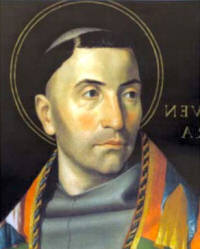 Here is St Bonaventure (whose picture is shown) from the Office of Readings of Monday Week 5 of the year: