

 Our own sense of who and what we are is based upon the relationships we have with others. If you go around a group of people and ask them to describe themselves, apart from their name they will talk about themselves in terms of their relationships with others: for example, ‘I work with this company’, ‘I am a father and I have three children’. This is the essence of a person, as distinct from an individual. A human person is always in relation with others, starting from birth. No one, by choice, disengages from society altogether (not even a hermit) and is happy.
This understanding of the human person has a profound effect on how we view what society is. A relationship of the sort we are now envisioning is always between two subjects, that is two people freely cooperating as moral agents. This is termed covenantal and is based upon mutual self-sacrifice on behalf of the other - love. This freedom to respond as a person is one of the essential elements of society. Society therefore is the vector sum of the relationships within it. It is not a collective of self-contained individuals.
Our own sense of who and what we are is based upon the relationships we have with others. If you go around a group of people and ask them to describe themselves, apart from their name they will talk about themselves in terms of their relationships with others: for example, ‘I work with this company’, ‘I am a father and I have three children’. This is the essence of a person, as distinct from an individual. A human person is always in relation with others, starting from birth. No one, by choice, disengages from society altogether (not even a hermit) and is happy.
This understanding of the human person has a profound effect on how we view what society is. A relationship of the sort we are now envisioning is always between two subjects, that is two people freely cooperating as moral agents. This is termed covenantal and is based upon mutual self-sacrifice on behalf of the other - love. This freedom to respond as a person is one of the essential elements of society. Society therefore is the vector sum of the relationships within it. It is not a collective of self-contained individuals.
A human relationship is an entity in itself. Two people create, through the properly ordered love between them, a relationship that is distinct from each person, and does not destroy either’s integrity.
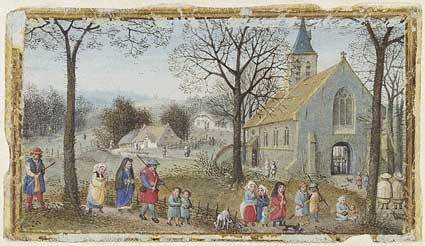 It is analogous, I think, to a chord created by two notes played simultaneously. We perceive the chord as something distinct created by the proximity of two notes, but the integrity of each note is not diminished by it. Something has been created out of nothing. This creation out of nothing is ‘superabundance’; love is always superabundantly fruitful (an example is the creation of the third person in a family). A loving relationship is created out of the harmony that exists between two hearts when each acts for the good of the other. There is a song (by U2 I think) that describes love as two hearts beating ‘as one’. In fact it might be more accurate to say that when love is present, two hearts beat not as one, but as three.
By using the word ‘love’ I do not always have in mind profoundly deep relationships. Any relationship, however casual, can reflect a motive for the good of the other. Even a cheery hello to a shopkeeper can reflect either a loving or self-centred motive. This means that whatever I do I bring to the party, so to speak, an aspect of every relationship that I have. I represent to some degree every community of which I am part – family, work, parish, tennis club and so on.
Liturgical activity is an act of love, in which I participate in the sacrifice made by Christ for all humanity. In participation of this supreme act of love is a transforming experience that by degrees changes me and makes me a better lover (and God knows, there is much room for improvement). This means that through every relationship I have, every other person and community with whom I relate benefits profoundly from my participation. Participation in the liturgy is a sacrifice of love their behalf. The effect is through what one hopes subsequently might be a more loving direct interactions with each person; but also because I am transformed through this participation, the relationship that exists between us and my prayers and intentions for them in the liturgy facilitate a supernatural transformation to the same degree and through my intentions for those people in the liturgy.
 The liturgy therefore is the binding principle of society and those communities in which I participate. Family, friends, parish, Church, workplace, living quarters, country – will all benefit from my participation in the liturgy. This is so even when I am the only person who is doing this and no one else knows of my participation. When I go to Mass or pray the liturgy of the hours, I try to remember to consciously dedicate that day’s prayer to all those groups and individuals with whom I relate.
There is a maxim that the family that prays together, prays together. In the encyclical Marialis Cultus (On the Right Ordering and Development of Devotion to the Blessed Virgin Mary), as well as describing how praying with Christ in the Liturgy is the fullest expression of devotion to Mary, Paul VI calls the Liturgy of the Hours the 'highpoint which family prayer can reach'.(54)
By extension, I suggest, this is true for all communities. The benefit of this liturgical participation in the sacrifice of Christ is magnified if the community prays in community. Unless its raison d’être is communal prayer it is rare that in any community every single member can or would even want to pray regularly with his fellows. But by degrees it is possible to move towards this ideal anywhere. If practicalities allow (and we must be aware that often they will not) a visible posting of regular times that the Liturgy of the Hours is prayed with an invitation for any member to join, would invoke the public nature of liturgy. If that invitation extends to the general public to attend the community prayer, the better still. At Thomas More College we are lucky to have priests who can say daily Mass; in addition a core of devotees to the Liturgy of the Hours have organized a rota by which we do our best to ensure that two or three of us at least pray Lauds and Vespers each day for the community.
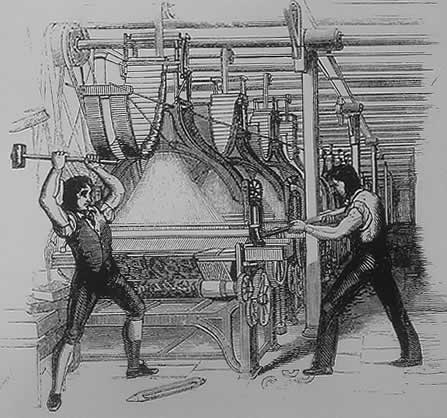 Culture reflects the cult that is at the core of it. However modest the fulfilment of this ideal, this is the means by which the culture of community or organization can be transformed to a Catholic culture that will be in harmony with all other institutions and social groups and work for the common good. It is no surprise, therefore, that any organization, such as many businesses which typically give no thought to liturgical piety at all, reflect a secular culture. So much so, that it doesn’t even occur to many people that the workplace can be or can even aspire to be a community. Consequently it is taken for granted that while it might contribute to the financial support of the families who work there, that it is intrinsic to business that it will undermine the family (for example through demands of time) and so many other aspects of an ordered culture. I do not accept this.
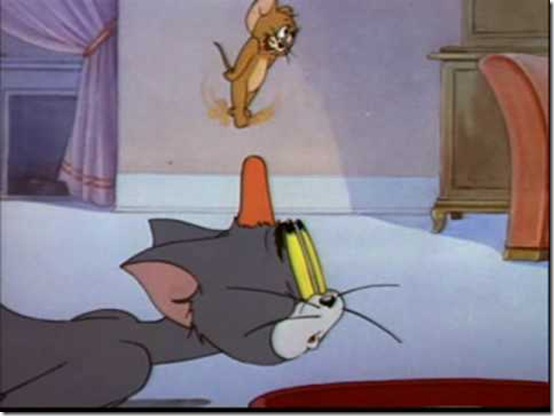
This suggests though that any attempt to change things in a community or organization that does not consider its culture and what culture really is will be dealing with symptoms not causes; and the problems even if apparently solved will eventually reappear elsewhere or in a different form. It is like the Tom and Jerry cartoons when Tom has hit on the head with a giant mallet and has a huge bump on his head. In response he puts his hand on the top of it and pushes it down until the scalp is once again smooth. The only problem is that as the first bump diminishes, a second appears on the side of his head and grows. The end result is that the bump has simply moved. Most organizational change I have seen in the workplace has struck me as bump moving, rather than bump healing.
In the end, I suggest, that answer is always the same: to change a culture you must change the cult.


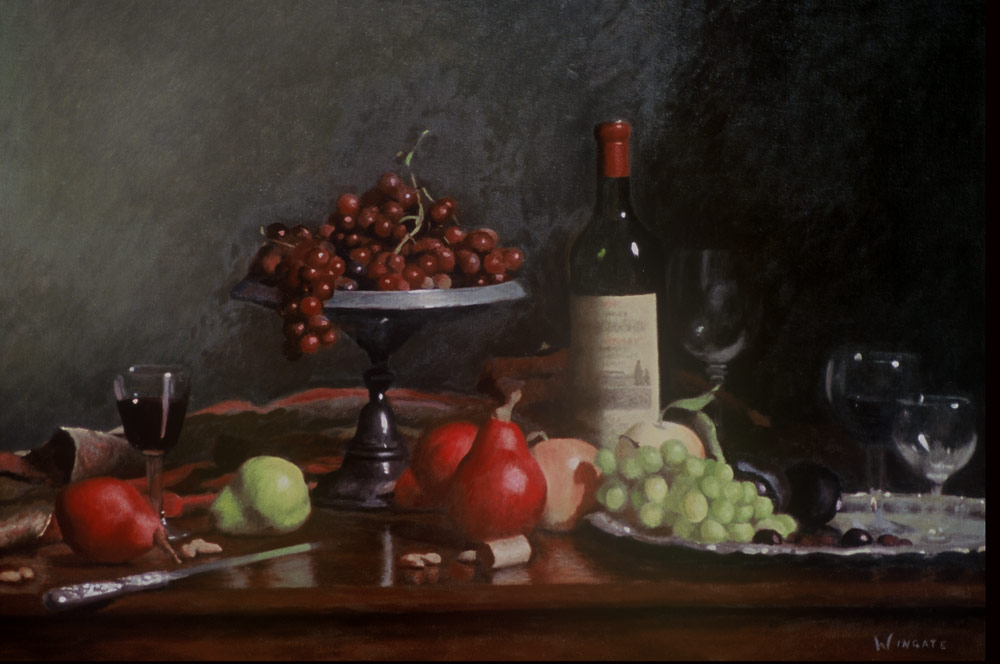

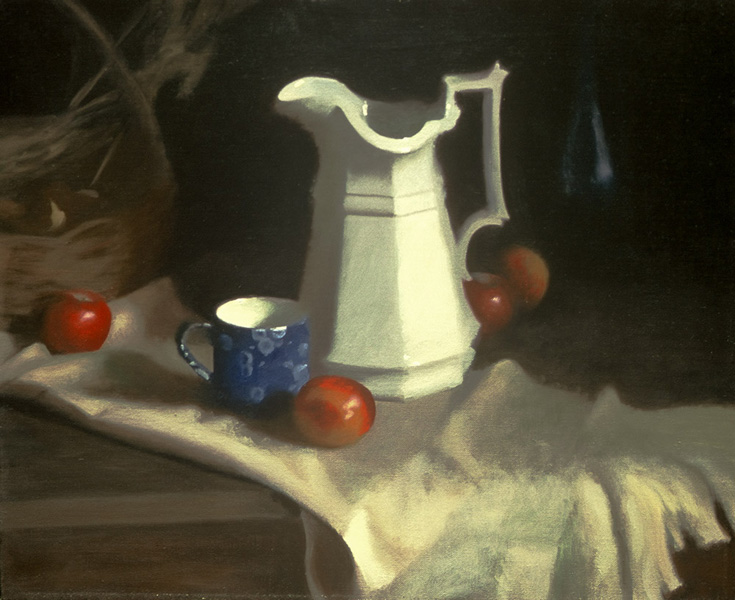
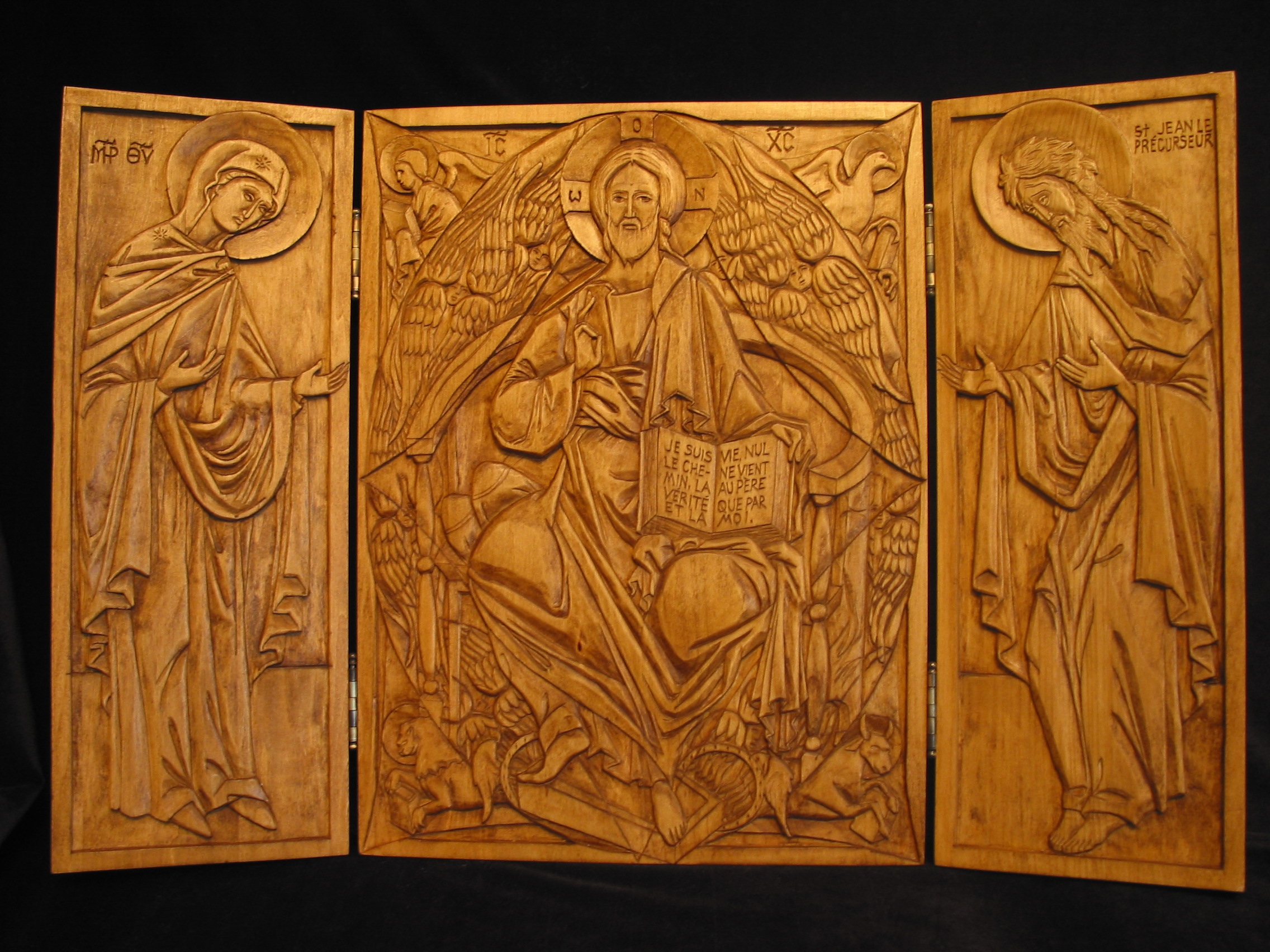
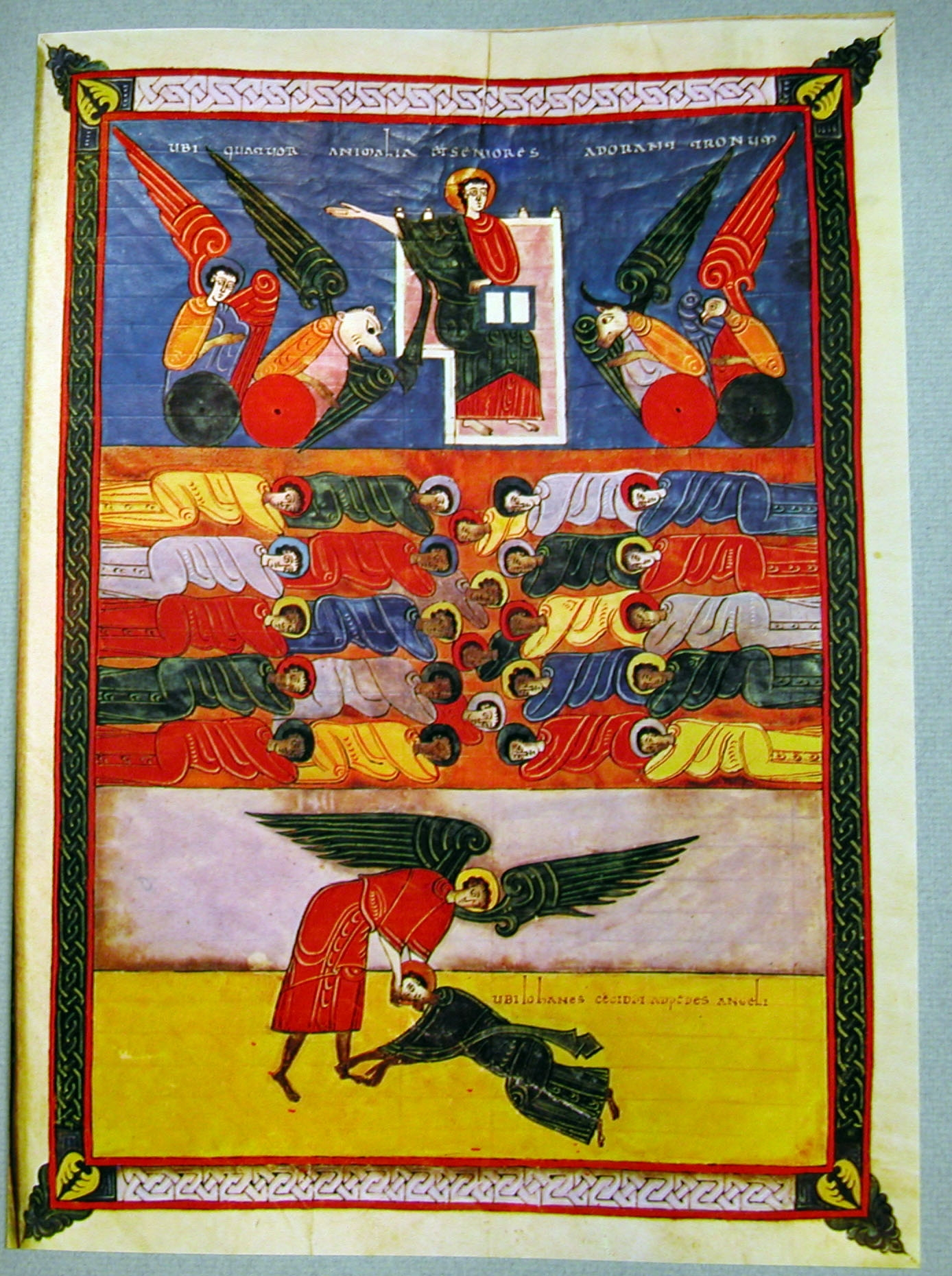
 An original work of art in the Spanish Romanesque style of the Morgan Beatus Manuscript.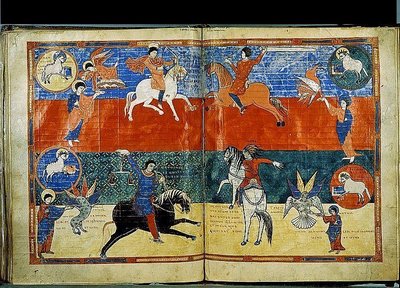








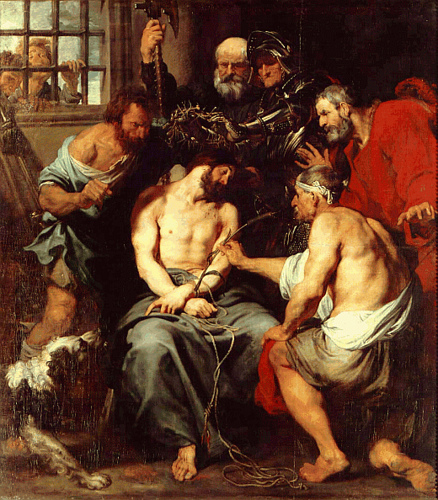
 As part of our build up to Easter during this Holy Week, here is a posting by professional chorister, Elizabeth Black
 (1:16)“Sub Pontio Pilato”(under Pontius Pilate). The music has been at an intense emotion level to this point, and in this third section it slightly abates. We also hear a subtle reference to the opening of the piece when the lower voices sing a sort of mirror image of the opening “crucifixus”; this time with different text (1:30). Here, rather than the notes rising higher (which in the opening imitates the cross being raised, perhaps?), the melody seems to fall.
-792835.jpg) Lotti’s “Crucifixus” is three minutes of emotional distress and anguish as the music takes the listener through a meditation on the pain and trauma of the crucifixion. This piece expresses through sound the emotion that the Church and her members undergo (passus!) during Holy Week as we relive the death of our Lord. However, this piece is not a journey in painful emotion merely for its own sake. For after journeying though emotional anguish, Lotti gives his listeners the resolution of the final chord. Just as after the pain and sadness of Good Friday, when Our Lord has died and been buried, Christians find hope that Easter Sunday will come."
Lotti’s “Crucifixus” is three minutes of emotional distress and anguish as the music takes the listener through a meditation on the pain and trauma of the crucifixion. This piece expresses through sound the emotion that the Church and her members undergo (passus!) during Holy Week as we relive the death of our Lord. However, this piece is not a journey in painful emotion merely for its own sake. For after journeying though emotional anguish, Lotti gives his listeners the resolution of the final chord. Just as after the pain and sadness of Good Friday, when Our Lord has died and been buried, Christians find hope that Easter Sunday will come."



 Interestingly, this ratio (5:3) appears also in the description of the construction of the Noah’s ark. St Augustine directly links the dimensions of Noah’s ark to the perfect proportions of a man, exemplified he says, in Christ. This echoes the classical proportions of the perfect man as described by the Roman Vitruvius in his textbook for architects. Furthermore, Boethius, in his book De Arithmetica, lists a series of 10 perfect proportions that he says came from Pythagoras, Plato, Aristotle and ‘later thinkers’. The final proportion of the series, called the Fourth of Four contains right at the beginning this ratio. (The references for these can be found in an article Harmonious Proportion in the Christian Tradition, here.)



 It seems to me now that the answer is so much simpler than most of these books suggest. This was to use the methods of the Old Masters of the past. All it requires of me is sufficient humility to follow the traditional forms of Western culture. A traditional art education will engender that humility by requiring me to follow the precise directions of the teacher, and by following in the footsteps of the Old Masters by regularly copying their work.
  Upon further reflection, and coming back to this issue of creativity for artists, something that struck me is how unlikely it is that an artist who is not habitually praying with visual imagery is going to be able to produce art that nourishes prayer. If I am habitually making that connection between the prayer and the image, then I will instinctively produce art that nourishes my own prayer. If I am praying well, then that art will be beautiful and will, in turn, nourish the prayers of others. This practice of praying with visual imagery is developing my instincts for what is beautiful. It is also engaging my vision in the prayer, and conforming it to the liturgical practice. This is an act of humility therefore that opens the person as a whole to inspiration and guidance , with a particular focus on that faculty of the visual.
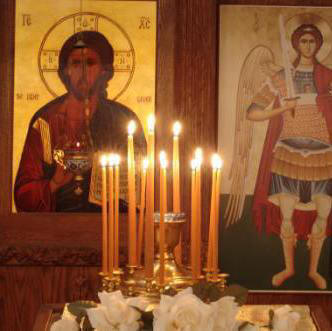
 The Melkite Liturgy at Thomas More College of Liberal Arts, Merrimack, NH. Chaplain, Fr Boucher turns to the icon of Christ at a point when he is addressing Him directly.





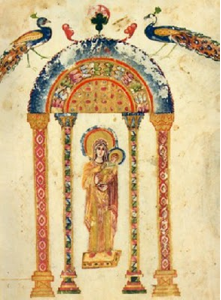
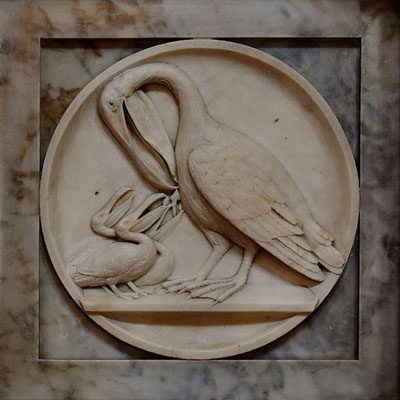 Is there a danger that trying to reestablish traditional Christian symbols in art would sow confusion rather that clarity? Lots of talks and articles about traditional Christian art I see discuss the symbolism of the iconographic content; for example, the meaning of the acacia bush (the immortality of the soul) or the peacock (again, immortality). This is useful if we have a printed (or perhaps for a few of you an original) Old Master in church or a prayer corner as it will enhance our prayer life when contemplating the image. But is this something that we ought to be aiming to reinstate the same symbolism in what we produce today? Should we seek to educate artists to include this symbolic language in their art?
If symbols are meant to communicate and clarify, they should be readily understood by those who see them. This might have been the case when they were introduced – very likely they reflected aspects of the culture at the time – and afterwards when the tradition was still living and so knowledge of this was handed on. But for most it isn’t true now. How many would recognize the characteristics of an acacia bush, never mind what it symbolizes? If you ask someone today who has not been educated in traditional Christian symbolism in art what the peacock means, my guess is that they are more likely to suggest pride, referring to the expression, ‘as proud as peacock’. So the use of the peacock would not clarify, in fact it would do worse than mystify, it might actually mislead. (The reason for the use of the peacock as a symbol of immortality, as I understand it, is the ancient belief that its flesh was incorruptible). So to reestablish this sign language would be a huge task. We would not only have to educate the artists, but also educate everyone for whom the art was intended to read the symbolism. If this is the case, why bother at all, it doesn’t seem to helping very much, and in the end it will always exclude those who are not part of the cognoscenti . This is exactly the opposite of what is desired: for the greater number, it would not draw them into contemplation of the Truth, but push them out.
Is there a danger that trying to reestablish traditional Christian symbols in art would sow confusion rather that clarity? Lots of talks and articles about traditional Christian art I see discuss the symbolism of the iconographic content; for example, the meaning of the acacia bush (the immortality of the soul) or the peacock (again, immortality). This is useful if we have a printed (or perhaps for a few of you an original) Old Master in church or a prayer corner as it will enhance our prayer life when contemplating the image. But is this something that we ought to be aiming to reinstate the same symbolism in what we produce today? Should we seek to educate artists to include this symbolic language in their art?
If symbols are meant to communicate and clarify, they should be readily understood by those who see them. This might have been the case when they were introduced – very likely they reflected aspects of the culture at the time – and afterwards when the tradition was still living and so knowledge of this was handed on. But for most it isn’t true now. How many would recognize the characteristics of an acacia bush, never mind what it symbolizes? If you ask someone today who has not been educated in traditional Christian symbolism in art what the peacock means, my guess is that they are more likely to suggest pride, referring to the expression, ‘as proud as peacock’. So the use of the peacock would not clarify, in fact it would do worse than mystify, it might actually mislead. (The reason for the use of the peacock as a symbol of immortality, as I understand it, is the ancient belief that its flesh was incorruptible). So to reestablish this sign language would be a huge task. We would not only have to educate the artists, but also educate everyone for whom the art was intended to read the symbolism. If this is the case, why bother at all, it doesn’t seem to helping very much, and in the end it will always exclude those who are not part of the cognoscenti . This is exactly the opposite of what is desired: for the greater number, it would not draw them into contemplation of the Truth, but push them out.